To me the variety of languages in Europe is highly valuable, something to cherish. Even if in practice it also provides many hurdles, in order to bridge languages and be able to scale things across Europe. Maintaining the cultural differences is important as a source of creativity and variety of ideas, while at the same time using our commonality to get things done collectively. I’ve held this position for a long time, and since a year or so I have better vocabulary for it when discussing it in terms of books, both fiction and non-fiction. It’s the vocabulary of comparative literatures.

My own language skills do not extend across all European languages, although I’m not limited to my own native language either. Since I read Libraries of the Mind by William Marx I have become much more interested in the works that I cannot, and will not ever be able to read. These are books that also aren’t translated into a language I do read (and in a sense other works that do get translated may falsely convey the notion that a language ‘is covered’, further removing the untranslated from view and any motivation to seek it out). They are literary dark matter to me, so to speak. Having at least a notion of their existence, of both interesting untranslated non-fiction books and their authors, adds them to my European ‘library of the mind’, and brings them into scope of my thinking and writing (something LLMs can help with). Even if I will never be able to actually read these books.

As I found myself working in Oslo this week, and Norwegian is one of the languages I do not have (but can read somewhat though), I thought to put the notions above into practice and go explore Norwegian literary dark matter.
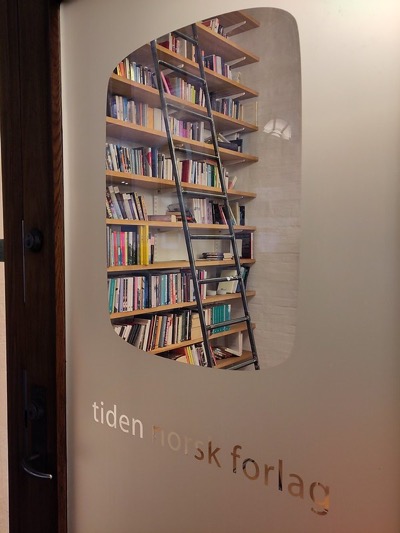
Tiden publishers frontdoor at Universitetsgata

I passed through Universitetsgata (University street) in the center of Oslo last evening as I was exploring on foot. Universitetsgata has two book stores, a publisher and a books antiquariat. All closed as I passed, and walked on to a nice pub with a live jazz combo. I resolved to be back by 9am this morning when the book stores opened up. So I did.

For an hour I browsed the shelves of the Tronsmo book store , an independent bookstore founded in 1973. The store has a mixture of books on display in three languages (Norwegian, Swedish, English), across the various domains they have ‘sakprosa‘ or non-fiction for, and thankfully not in any way focused on what is selling well in the mainstream right now. Additionally the entire basement is given over to a wealth of graphical novels from across Europe, and the wider world, something I only glanced at from the stairs leading down.
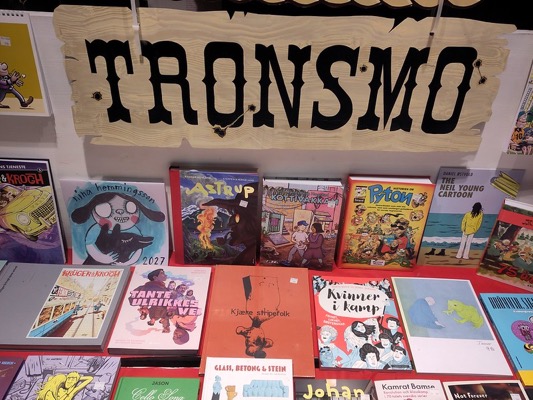
Tronsmo’s graphic novel display last night

Books that looked interesting, both fiction and non-fiction, I photographed. Tronsmo’s selection in English was non-mainstream too, making that interesting to browse too (and it was mixed right in with Norwegian titles). With over 60 photos I have a significant haul to explore later online, and add the curated result to my European library of the mind. Not wanting to leave the book store empty handed, I bought three books. One a title that I had already jotted down early this year (having found it in Swiss Beat Döbeli’s Biblionetz feed) before it was published, Attensity!. One on brainstructures of bilingual people and what that tells us about the science of language (translated from the original Spanish), a title that seemed aligned well with the quest I was on. One an English bundling of two essays that take German Walter Benjamin’s 1935 antifascist cultural criticism ‘Das Kunstwerk im Zeitalter seiner technischen Reproduzierbarkeit‘ (The Work of Art in the Age of Mechanical Reproduction) and apply it to digital reproduction and AI respectively.

An hour very well spent.

A year ago I read Libraries of the Mind by William Marx, and some of it is still very much on my mind ever since. Particularly what William Marx called ‘dark matter’ literature, which exists but you don’t have access to. E.g. because it’s in a language you can’t read, or material you don’t know how to search for. Material that is invisible from your own viewing position. Because that invisibility is easily accepted as proof of absence of such material, rather than proof of limitations on your own toolset and agency preventing you to find it, such resources will be generally ignored.

Still, many questions have global aspects. Our information networks, our trade routes, our dependencies are truly global. Because of it many of our issues, including climate emergencies, are global in both their roots and consequences. We all suffer from small earth syndrome these days, as I phrased it in 2010 at the SHiFT Conference, where everything anyone of us does reverberates around the world because we are continuously bumping into real global limits, Club of Rome style.

The same is true in reverse: many of the pathways to agency, to resolution and mitigation are global in nature too, or at the very least need us to look at available information, thinking, and perspectives globally as well.
‘Global’ therefore is not to be taken here as a level of abstraction or aggregation, which erodes your own place in it and throws out your own localised experience and stories, but global in the scope you yourself default to when it comes to who you see as part of the whole, as worthy of consideration and/or empathy, as affected by your choices and actions. Global also not as an equaliser or one-size-fits-all thing, unmooring identities e.g., but using differences as an energy source and as potential for creativity. In any situation there are boundaries between groups and narratives. Power differences, and identities resting on opposing or similar assumptions, differences in who has legitimacy or standing in which situations and issues, differences in who has or is afforded agency and in which ways, all abound. All these differences are potential energy to tap into.

Put together it spells to me that when I am doing some deskresearch shining a better light on literary ‘dark matter’ becomes much more important. Are there any francophone resources, Nordic authors, Eastern European authors, hispanic movements around an issue I am exploring? Yes, the scientific world largely uses English as lingua franca, but language areas also have their own spheres outside of it. Look in any French or German book store for instance and compare the shelves on topics of your interest to e.g. a UK book store. They also all have their own scientific publishing channels. That is all still within a largely overlapping European context. What about ongoing Chinese perspectives, Southern-American movements, the various spheres of discussion on the African continent, and across Asia? Those will be almost completely invisible to me on any topic, when my own tools are limited to my personal language skills and the general anglo-american bias in online search tools.

Enter AI tools as a middle way, along the lines of what Jeremy Cherfas wrote recently. He posits his own AI use for “things that you perhaps could manage on your own, but that would take too long to be worthwhile.” And while “there are plenty of areas in which I feel that AI could never be appropriate” he “was happy to use generative AI to extend my capabilities” where that strengthened his own efforts andv where outputs are for his personal or intermediate use in his own work processes.

When I ask e.g. Claude about a book and its message, and to help build a more syntopic reading list around something, what you get is a few English titles, as would be expected given their origin. Adding my own language skills, it will add a few other resources. Any extension beyond that you need to directly ask about: is there anything in e.g. Nordic countries, are there traces of similar discourse in China etc.? In steps what will emerge is a fuller list of pointers. Many of those I won’t be able to read directly, but I can circle around them, e.g. through secondary sources, by machine translating parts etc. I’ve noticed that to do this, to go beyond middle of the road AI responses, I need to build it up, in steps. Which is something I can put together as a recipe and feed into Claude.

I won’t speak or read Chinese, Igbo, Swedish or Polish in my lifetime. But I can ferret out resources and what they may tell me this way.

Today I started reading in Rest Is Resistance by US author Tricia Hersey, it was mentioned to me recently in the context of maintaining hope or optimism while also feeling dread and despair about the state and direction of the world, alongside Rebecca Solnit’s Hope in the Dark, and the Dutch title ‘Optimism without hope’ by Tommy Wieringa. Turned out I already bought it in 2023. I wondered about other similar or adjacent texts and used Claude in the way described above. First came a list of mostly English resources, and one German, most of which I was already aware of. Then following up a handful of francophone resources, nordic ones, and hispanic ones came up, which unearthed a link to Latin-American texts I had already explored a few years back related to a local legal initiative in the Netherlands w.r.t. climate adaptation. It struggled with providing pointers to resources from the African continent, but ultimately did. Further prompting brought both official and grass roots perspectives from China, more francophone resources from the Caribbean world, and also more potentially relevant African and Indian resources.

A first approximation of a syntopic approach like this is no output in itself, but a starting point, meaning I now have more to do than if I had been satisfied with just the titles I already own or am already aware of. But I am casting a wider net, even if what the net brought up may not all be equally useful, it pushed me to look further and broader. It stretches my Library of the Mind.


The University of Maastricht Library, which I walked by a week ago. Its collection limited by necessity, like our global digital library is limited by our tooling.

I want to find and learn about non-fiction books I cannot read.
Meaning I don’t have the languages for them.

One of the key aspects of Europe is that there are many languages. I since long believe that is a cultural and socio-economic strength and treasure. Article 3.3 of the EU Treaty and Article 22 of the EU Charter of Fundamental rights say the same thing: The Union shall respect […] linguistic diversity.

In practice people for their interaction often retreat to something overlapping, most often English.
Within the EU institutions 24 languages are in official use. Only a few of them are used as common overlap between participants. Online, globally, nothing is truly multilingual, it’s at most serial mono-lingual. Most people don’t even get to write their names properly online. (For fun I spelled my name on my website using the proper digraph ij and not ij, and my search ranking took an immediate tumble when I did.)

I read, speak and write three languages (Dutch, English, German), and can somewhat read and speak French, and can somewhat guess when reading a few more. Whenever I travel I visit bookstores, to look at what titles are available, ignoring if I could read them or not.
Of course non-fiction bestseller titles often overlap, having been translated from English usually. Other books on display are local.

Some works in other languages will be translated into others, and if that is English, German or Dutch, become accessible to me.
However, the side effect of that is that other works that are not translated become even less visible. If I count on the fact that the most relevant Polish, Swedish, or Greek works of this moment will be translated then it will reduce the probability I will go looking for something beyond that. And I won’t know if an absence of translated works means an actual absence of relevant material. Translation acts like a filter, made up of unknown curation terms. Everything else becomes ‘dark matter’ in the words of William Marx in Libraries of the Mind, outside that language.

In order to change that, at least personally, I want to add more non-fiction titles to my ‘library of the mind’, i.e. books and their core messages that I’m aware of.
With non-fiction you can get a lot from a book even if you cannot read the language. Content overview, index, illustrations and section titles already provide a good first approximation of what a book is positing, without the need of much translation or language.

So, when it is about technology, data, philosophy, futurism, communities, change, democracy, do tell me what books I should be aware of in your language. It would be great too if you can point me to online, local to you, retailers that may have it as e-book.


A bookshop in Seville, Spain (since closed). Photo Metro Centric CC BY.


A bookshop in Athens, Greece. Photo Luke McKernan CC BY SA


A bookshop in Caen, France. Photo TeaMeister CC BY

I am trying out the Books Search plugin for Obsidian. I keep notes on all books I’ve read, own or have come across. I add meta data to those notes manually. The Books Search plugin helps make that easier by picking up that meta data from Google Books through their API. You install the plugin through the Community Plugin list, and can then add an API key. Without that key, after a few tries you will get an error message.

The plugin documentation does however not state how to connect the plugin to that Google API.

These are the steps I took after a bit of searching:

  • In the Google cloud console first create a project. (A Google account is needed)
  • In the same console, under credentials, click create credentials and create an API key. Copy that key and save it in the settings of the Obsidian Books Search plugin.
  • In the same console, under Enable APIs & Services, enable the Google Books API.
  • Go back to Credentials, edit your API key, select Restrict Key under API restrictions, and select from drop down list the Google Books API you’ve just enabled. (If it doesn’t show any APIs to choose, you have not enabled any APIs yet.) Now the key works only for the Google Books API.
  • Ignore the warning in the console about OAuth consent, as this is not needed (the books API is accessible without authorisation, and you’re also not building an app for others to use.)

Using the Book Search plugin I notice it is by default restricted to English books, not finding titles in other languages that Google Books does have in its lists. The locale settings in the plugin allow me to switch language before a search in the search form through a very long drop down menu, but doing that (or doing the same search for each of three or four languages) quickly negates the effectivity gain the plugin provides.

It is unclear from the Google API documentation if locale can be set to multiple languages.

Probably not, given Google’s long history of interpreting multilingual as serial monolingual (see this 2007 presentation at Google by Stephanie Booth pointing this same stuff out), ignoring that multilingual people tend to change languages throughout their activities even for just a single word or short phrase. (I don’t have Dutch, English or German days or topics, in the case of books I may want to find the German original of an English translation, or want to search for a specific thing in French because I know it exists, while also interested in any Dutch translation that might be available or the Italian original. My notes are always in multiple languages.)

In Antwort auf Sprachwechsel in WordPress von Robert Lender

Die Sprachauszeichnung von Textausschnitten in WordPress zu ändern, ist in der Tat schwierig. Ich mache das immer manuell. Sprachunterstützung scheint generell davon auszugehen, dass man immer nur eine Sprache verwendet, oder wenn man die Sprache wechselt, dass man immer nur eine Sprache zugleich verwendet. Der Gedanke, dass man zwei oder mehr Sprachen austauschbar verwenden kann scheint unvorstellbar zu sein. Ganz zu schweigen davon dass man dies innerhalb eines einzigen Beitrags tut oder dass man ein einziges Wort oder einen kurzen Satz in einer anderen Sprache verwendet als in denen man normalerweise schreibt.

Die Einstellung einer Sprache in WordPress ist eine seitenweite Einstellung. Das manuelle auszeichnen der Sprache ist der einzig zuverlässige Weg.

Damit ist es aber noch nicht getan. Wenn man sich ansieht wie z. B. Google Translate Inhalte analysiert, wird es schnell merkwürdig. Google achtet nur auf die für die ganze Webseite angegebene Sprache und berechnet eine algorithmische Wahrscheinlichkeit bez. die Sprache des Textes. Alle anderen Sprachauszeichnungen werden einfach ignoriert. Und selbst dann liegt Google oft falsch. Wenn ich auf einer individuellen Page, die als niederländisch deklariert ist, einen kurzen Beitrag auf Niederländisch schreibe, wird er trotzdem als Englisch interpretiert, weil die Menüstruktur auf meinen Seiten auf Englisch ist und mehr Gewicht zugewiesen bekommt als der Text selbst. Nur wenn es einen längeren niederländischen Text gibt, wird der Beitrag trotz korrekter Sprachauszeichnung der kürzere Texte, korrekt als niederländisch erkannt.

Vor einiger Zeit habe ich mein WordPress-Theme so angepasst, dass es Sprachen besser berücksichtigt:

  • Wenn ein Beitrag auf Deutsch oder Niederländisch ist, und einzeln betrachtet wird, wird die richtige Sprache als Sprache für die ganze Webseite angezeigt.
  • Wenn ein Beitrag auf Deutsch oder Niederländisch ist, wird er in einer Übersicht zusammen mit englischen Beiträge mit einer Sprachauszeichnung auf Post-ebene versehen. Beides mache ich, indem ich für jede Sprache eine eigene Kategorie verwende.
  • Kurze Sätze in einer anderen Sprache markiere ich mit einer Sprachauszeichnung, die ich leicht mit einer Tastenkombination hinzufügen kann.
  • In meinem RSS-Feed füge ich Links zur Maschinenübersetzung deutscher und niederländischer Beiträge ins Englische hinzu, erstelle sie aber als spezifische Links: Man kann sich nicht darauf verlassen dass die automatische Erkennungsfunktion von Google Translate dies richtig macht.

Kurz gesagt, ich bin nicht zuversichtlich, dass WordPress es richtig machen wird. Diese Diskussion ist kein neues Phänomen, und ein branchenweites Problem in der Tech Industrie. Vielleicht sollten gerade Coder in Europa mit unserer Sprachenvielfalt sich auf ein gut funktionierendes WP Plugin konzentrieren.

Die Auszeichnung des Sprachwechsels ist eigentlich keine Kleinigkeit. Denn immerhin geht es darum, dass z.B. Screenreader sehbehinderten Menschen Wörter richtig vorlesen und diese somit überhaupt verständlich sind. .[Was man] bis heute für einzelne Worte nicht machen kann. …da hoffe ich in Zukunft auf mehr Einsicht bei den WordPress Entwicklern.

Robert Lender

This is a worthwile question I asked exactly a year ago that bears repeating:

Can you help me find additional blogs to follow? I am looking to broaden the scope of blogs in my reader. That broadening has two main dimensions: language and geography. Right now, because they’re often easier to find, and more regularly linked to, my feed reader is heavily anglosphere centric.

Some specifications for the type of blogs I am looking for:

  • Individual or group authored blogs, not company or organisational blogs. A blog maintained by a research group is an acceptable ‘in-between’ version. The reason is I see blogging as distributed conversations. Companies don’t have conversations. As a result I follow people, not blogs, in my feedreader
  • Some thematic overlap with my interests is needed, something to have those distributed conversations around. Such interests are: making, open data/source/access/everything, agency, civic tech, ethics, digital transformation for all, climate adaptation, knowledge work, complexity, philosophy of science/tech, change, learning

The areas I am looking to extend my blog reading towards are:

  • Indian bloggers, or India based blogs in English
  • Chinese bloggers, or China based blogs in English
  • EU based bloggers, in Spanish, French, Italian or German languages. Or Spain, France, Italy, or Germany based bloggers in English
  • Middle-, South-American bloggers in Spanish/Portuguese or English
  • Bloggers based in SE-Asia
  • Bloggers based in Nigeria, Kenya, Tanzania, Uganda, South-Africa

Any pointers, or pointers to list- or aggregator sites to explore are appreciated.