To me the variety of languages in Europe is highly valuable, something to cherish. Even if in practice it also provides many hurdles, in order to bridge languages and be able to scale things across Europe. Maintaining the cultural differences is important as a source of creativity and variety of ideas, while at the same time using our commonality to get things done collectively. I’ve held this position for a long time, and since a year or so I have better vocabulary for it when discussing it in terms of books, both fiction and non-fiction. It’s the vocabulary of comparative literatures.
My own language skills do not extend across all European languages, although I’m not limited to my own native language either. Since I read Libraries of the Mind by William Marx I have become much more interested in the works that I cannot, and will not ever be able to read. These are books that also aren’t translated into a language I do read (and in a sense other works that do get translated may falsely convey the notion that a language ‘is covered’, further removing the untranslated from view and any motivation to seek it out). They are literary dark matter to me, so to speak. Having at least a notion of their existence, of both interesting untranslated non-fiction books and their authors, adds them to my European ‘library of the mind’, and brings them into scope of my thinking and writing (something LLMs can help with). Even if I will never be able to actually read these books.
As I found myself working in Oslo this week, and Norwegian is one of the languages I do not have (but can read somewhat though), I thought to put the notions above into practice and go explore Norwegian literary dark matter.
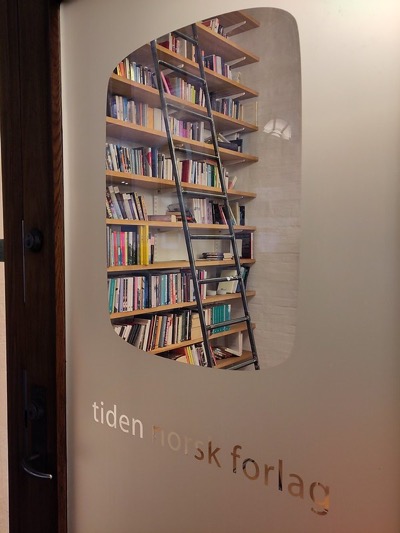 Tiden publishers frontdoor at Universitetsgata
I passed through Universitetsgata (University street) in the center of Oslo last evening as I was exploring on foot. Universitetsgata has two book stores, a publisher and a books antiquariat. All closed as I passed, and walked on to a nice pub with a live jazz combo. I resolved to be back by 9am this morning when the book stores opened up. So I did.
For an hour I browsed the shelves of the Tronsmo book store , an independent bookstore founded in 1973. The store has a mixture of books on display in three languages (Norwegian, Swedish, English), across the various domains they have ‘sakprosa‘ or non-fiction for, and thankfully not in any way focused on what is selling well in the mainstream right now. Additionally the entire basement is given over to a wealth of graphical novels from across Europe, and the wider world, something I only glanced at from the stairs leading down.
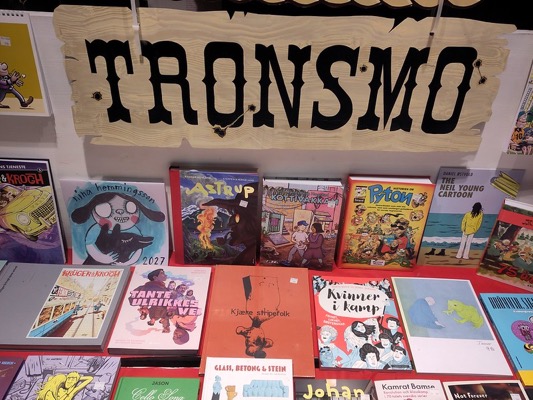 Tronsmo’s graphic novel display last night
Books that looked interesting, both fiction and non-fiction, I photographed. Tronsmo’s selection in English was non-mainstream too, making that interesting to browse too (and it was mixed right in with Norwegian titles). With over 60 photos I have a significant haul to explore later online, and add the curated result to my European library of the mind. Not wanting to leave the book store empty handed, I bought three books. One a title that I had already jotted down early this year (having found it in Swiss Beat Döbeli’s Biblionetz feed) before it was published, Attensity!. One on brainstructures of bilingual people and what that tells us about the science of language (translated from the original Spanish), a title that seemed aligned well with the quest I was on. One an English bundling of two essays that take German Walter Benjamin’s 1935 antifascist cultural criticism ‘Das Kunstwerk im Zeitalter seiner technischen Reproduzierbarkeit‘ (The Work of Art in the Age of Mechanical Reproduction) and apply it to digital reproduction and AI respectively.
An hour very well spent.
 English