Some things I thought worth reading in the past days

  • A good read on how currently machine learning (ML) merely obfuscates human bias, by moving it to the training data and coding, to arrive at peace of mind from pretend objectivity. Because of claiming that it’s ‘the algorithm deciding’ you make ML a kind of digital alchemy. Introduced some fun terms to me, like fauxtomation, and Potemkin AI: Plausible Disavowal – Why pretend that machines can be creative?
  • These new Google patents show how problematic the current smart home efforts are, including the precursor that are the Alexa and Echo microphones in your house. They are stripping you of agency, not providing it. These particular ones also nudge you to treat your children much the way surveillance capitalism treats you: as a suspect to be watched, relationships denuded of the subtle human capability to trust. Agency only comes from being in full control of your tools. Adding someone else’s tools (here not just Google but your health insurer, your landlord etc) to your home doesn’t make it smart but a self-censorship promoting escape room. A fractal of the panopticon. We need to start designing more technology that is based on distributed use, not on a centralised controller: Google’s New Patents Aim to Make Your Home a Data Mine
  • An excellent article by the NYT about Facebook’s slide to the dark side. When the student dorm room excuse “we didn’t realise, we messed up, but we’ll fix it for the future” defence fails, and you weaponise your own data driven machine against its critics. Thus proving your critics right. Weaponising your own platform isn’t surprising but very sobering and telling. Will it be a tipping point in how the public views FB? Delay, Deny and Deflect: How Facebook’s Leaders Fought Through Crisis
  • Some of these takeaways from the article just mentioned we should keep top of mind when interacting with or talking about Facebook: FB knew very early on about being used to influence the US 2016 election and chose not to act. FB feared backlash from specific user groups and opted to unevenly enforce their terms or service/community guidelines. Cambridge Analytica is not an isolated abuse, but a concrete example of the wider issue. FB weaponised their own platform to oppose criticism: How Facebook Wrestled With Scandal: 6 Key Takeaways From The Times’s Investigation
  • There really is no plausible deniability for FB’s execs on their “in-house fake news shop” : Facebook’s Top Brass Say They Knew Nothing About Definers. Don’t Believe Them. So when you need to admit it, you fall back on the ‘we messed up, we’ll do better going forward’ tactic.
  • As Aral Balkan says, that’s the real issue at hand because “Cambridge Analytica and Facebook have the same business model. If Cambridge Analytica can sway elections and referenda with a relatively small subset of Facebook’s data, imagine what Facebook can and does do with the full set.“: We were warned about Cambridge Analytica. Why didn’t we listen?
  • [update] Apparently all the commotion is causing Zuckerberg to think FB is ‘at war‘, with everyone it seems, which is problematic for a company that has as a mission to open up and connect the world, and which is based on a perception of trust. Also a bunker mentality probably doesn’t bode well for FB’s corporate culture and hence future: Facebook At War.

Frank writes about how the Netherlands became the first connection outside the USA on the open net by the NSF (as opposed to the military initiated ARPANET academic institutions used then), thirty years ago yesterday on November 17th 1988. Two years previously .nl had been created as the first ever country top level domain. This was the result of the work and specifically the excellent personal connections to their US counterparts of people at the Amsterdam CWI, the center for mathematics. Because of those personal connections the Netherlands was connected very early on to the open internet and still is a major hub. Through that first connection Europe got connected as well, as the CWI was part of the European network of academic institutions EUnet. A large chunk of the European internet traffic still runs through the Netherlands as a consequence.

I went to university in the summer of 1988 and had the opportunity to early on enjoy the fruits of the CWI’s work. From the start I became active in the student association Scintilla at my electronic engineering department at University of Twente. Electronic engineering students had an advantage when it came to access to electronics and personal computers and as a consequence we had very early connectivity. As first year student I was chairman of one of Scintilla’s many committees and in that role I voted in late ’88 / early ’89 to spend 2500 guilders (a huge sum in my mind then) for cables and plugs and 3 ethernet cards for the PC’s we had in use. I remember how on the 10th floor of the department building other members were very carefully connecting the PC’s to each other. It was the first LAN on campus not run by the University itself nor connected to the mainframe computing center. Soon after, that LAN was connected to the internet.

In my mind I’ve been online regularly since late 1989, through Scintilla’s network connections. I remember there was an argument with the faculty because we had started using a subdomain directly of the university, not as a subdomain of the faculty’s own subdomain. We couldn’t, because they hadn’t even activated their subdomain yet. So we waited for them to get moving, under threat of losing funding if we didn’t comply. Most certainly I’ve been online on a daily basis since the moment I joined the Scintilla board in 1990 which by then had moved to the basement of the electronics department building. We at first shared one e-mail address, before running our own mail server. I used telnet a lot, and spent an entire summer, it must have been the summer of ’91 when I was a board member, chatting to two other students who had a summer job as sysadmin at the computer center of a Texas university. The prime perk of that job was they could sit in air conditioning all summer, and play around with the internet connection. Usenet of course. Later Gopher menus, then 25 years ago the web browser came along (which I first didn’t understand as a major change, after all I already had all the connectivity I wanted).

So of those 30 years of open internet in the Netherlands, I’ve been online daily 28 years for certain, and probably a year longer with every-now-and-then connectivity. First from the basement at university, then phoning into the university from home, then (from late ’96) having a fixed IP address through a private ISP (which meant I could run my own server, which was reachable when I phoned into the ISP), until the luxury we have now of a fiber optic cable into our house, delivering a 500Mbit/s two-way connection (we had a 1Gb connection before the move last year, so we actually took a step ‘backwards’).

Having had daily internet access for 28 years, basically all of my adult life, has shaped both my professional and personal life tremendously. Professionally, as none of my past jobs nor my current work would have been possible without internet. None of my work in the past decades would have even existed without internet. My very first paid job was setting up international data transmissions between an electronics provider, their factories, as well as the retail chains that sold their stuff. Personally it has been similar. Most of my every day exchanges are with people from all over the world, and the inspiring mix of people I may call friends and that for instance come to our birthday unconferences I first met online. Nancy White‘s husband and neighbours call them/us her ‘imaginary friends’. Many of our friends are from that ‘imaginary’ source, and over the years we met at conferences, visited each others houses, and keep in regular touch. It never ceases to amaze.

To me the internet was always a network first, and technology second. The key affordance of the internet to me is not exchanging data or connecting computer systems, but connecting people. That the internet in its design principles is a distributed network, and rather closely resembles how human networks are shaped, is something we haven’t leveraged to its full potential yet by far. Centralised services, like the current web silos, don’t embrace that fundamental aspect of internet other than at the hardware level, so I tend to see them as growths more than actualisation of the internets’s foremost affordance. We’ve yet to really embrace what human digital networks may achieve.

Because of that perspective, seeing the digital network as a human network, I am mightily pleased that the reason I have been able to be digitally connected online for almost 30 years, is first and foremost because of a human connection. The connection between Piet Beertema at CWI in Amsterdam to Rick Adams at NSF in the USA, which resulted in the Netherlands coming online right when I started university. That human connection, between two people I’ve never met nor interacted with, essentially shaped the space in which my life is taking its course, which is a rather amazing thought.

This is a naive exercise to explore what ethics by design would look like for networked agency. There’s plenty of discussion about ethics by design in various places. Mostly in machine learning, where algorithmic bias is a very real issue already, and where other discussions such as around automated driving are misguided for lack of imagination and scope. It’s also an ongoing concern in adtech, especially since we know business practices don’t limit themselves to selling you stuff but also deceive you to sell political ideas. Data governance is an area where I encounter ethics by design as a topic on a regular basis, in decisions on what data to collect or not, and in questions of balancing or combining the need for transparency with the need for data protection. But I want to leave that aside, also because many organisations in those areas already have failed their customers and users. Which would make this posting a complaint and not constructive.

My current interest is in exploring what ethics means, and can be done by design, in the context of networked agency, and by extension a new civil society emerging in distributed digital transformation. A naive approach helps me find a first batch of questions and angles.

The notions that are the building blocks of networked agency are a starting point. Ethical questions follow directly from those building blocks.

First there are the building blocks related to the agency element in networked agency. These are technology and methods/processes, striking power, resilience and agility.
a) For the technologies and methods/processes involved, relevant are issues relating to who controls those tools, how these tools can be deployed by their users, and if a user group can alter the tools, adapt them to new needs and tinker with them.
b) Low thresholds of adoption need an exploration of what those thresholds are and how they play out for different groups. These are thresholds of technological and financial nature, but also barriers concerning knowledge, practicality, usability, and understandability.
c) Striking power, the actual acting part of agency provides questions about if a tool provides actual agency, and isn’t actually a pacifier. Not every action or activity constitutes agency. It’s why words like slacktivism and clicktivism have emerged.
d) Resilience in networked agency is about reducing the vulnerability to propagating failures from outside the group, and the manner in which mitigation is possible. Reduction of critical dependencies outside the group’s scope of control is something to consider here. That also works in reverse. Are you creating dependencies for others? In a similar vein, are you externalising costs onto others? Are you causing unintended consequences elsewhere, and can you be aware of them arising, or pre-empt them?
e) Agility in networked agency is about spotting and leveraging opportunities relative to your own needs in your wider network. Are you able to do that from a constructive perspective, or only a competitive/scarcity one? Do your opportunities come at the cost of other groups? When you leverage opportunities are you externalising costs or claiming exclusivity? In a networked environment externalising costs will return as feedback to your system. Networks almost by definition are endless repeats of the prisoners dilemma. Another side of this is which ways exist in which you can provide leverage to others simultaneously to creating your own, or when to be the lever in a situation.

Second there are notions that follow from the networked part of networked agency. The unit of agency in networked agency is a group of people that share some relationship (team, family, org, location, interest, history, etc), that together act upon a need shared across that group. This introduces three levels to evaluate ethical questions on, at the level of the individual in a group, at the level of the group itself, and between groups in a network. Group dynamics are thus firmly put into focus: power, control, ownership, voice, inclusion, decision making, conflict resolution, dependencies within a group, reciprocity, mutuality, verifiability, boundaries, trust, contributions, engagement, and reputations.
This in part translates back to the agency part, in terms of technology and skills to work with it. Skills won’t be evenly distributed in groups seeking agency, so potentially introduce power asymmetries, when unique capabilities mean de-facto gatekeepers or single points of failure are introduced. These may be counteracted with some mutual dependencies perhaps. More likely operational transparency in a group is of more importance so that the group can see such issues arise and calling them out is a normal thing to do, not something that has a threshold in itself. Operational transparency might build on an obligation to explain, which also is a logical element in ensuring (networked) agility.

The above output of this first exercise I will try and put in an overview. Not sure what will be useful here, a tree-like map, or a network, or a matrix. A next step is fleshing out the ethical issues in play. Then projecting them on for instance specific technologies, methods and group settings, to see what specific actions or design principles emerge from that.

Some links I thought worth reading the past few days

  • Peter Rukavina pointed me to this excellent posting on voting, in the context of violence as a state monopoly and how that vote contributes to violence. It’s this type of long form blogging that I often find so valuable as it shows you the detailed reasoning of the author. Where on FB or Twitter would you find such argumentation, and how would it ever surface in a algorithmic timeline? Added Edward Hasbrouck to my feedreader : The Practical Nomad blog: To vote, or not to vote?
  • This quote is very interesting. Earlier in the conversation Stephen Downes mentions “networks are grown, not constructed”. (true for communities too). Tanya Dorey adds how from a perspective of indigenous or other marginalised groups ‘facts’ my be different, and that arriving a truth therefore is a process: “For me, “truth growing” needs to involve systems, opportunities, communities, networks, etc. that cause critical engagement with ideas, beliefs and ways of thinking that are foreign, perhaps even contrary to our own. And not just on the content level, but embedded within the fabric of the system et al itself.“: A conversation during EL30.mooc.ca on truth, data, networks and graphs.
  • This article has a ‘but’ title, but actually is a ‘yes, and’. Saying ethics isn’t enough because we also need “A society-wide debate on values and on how we want to live in the digital age” is saying the same thing. The real money quote though is “political parties should be able to review technology through the lens of their specific world-views and formulate political positions accordingly. A party that has no position on how their values relate to digital technology or the environment cannot be expected to develop any useful agenda for the challenges we are facing in the 21st century.” : Gartner calls Digital Ethics a strategic trend for 2019 – but ethics are not enough
  • A Dutch essay on post-truth. Says it’s not the end of truth that’s at issue but rather that everyone claims it for themselves. Pits Foucault’s parrhesia, speaking truth to power against the populists : Waarheidsspreken in tijden van ‘post-truth’: Foucault, ‘parrèsia’ en populisme
  • When talking about networked agency and specifically resilience, increasingly addressing infrastructure dependencies gets important. When you run decentralised tools so that your instance is still useful when others are down, then all of a sudden your ISP and energy supplier are a potential risk too: disaster.radio | a disaster-resilient communications network powered by the sun
  • On the amplification of hate speech. It’s not about the speech to me, but about the amplification and the societal acceptability that signals, and illusion of being mainstream it creates: Opinion | I Thought the Web Would Stop Hate, Not Spread It
  • One of the essential elements of the EU GDPR is that it applies to anyone having data about EU citizens. As such it can set a de facto standard globally. As with environmental standards market players will tend to use one standard, not multiple for their products, and so the most stringent one is top of the list. It’s an element in how data is of geopolitical importance these days. This link is an example how GDPR is being adopted in South-Africa : Four essential pillars of GDPR compliance
  • A great story how open source tools played a key role in dealing with the Sierra Leone Ebola crisis a few years ago: How Open Source Software Helped End Ebola – iDT Labs – Medium
  • This seems like a platform of groups working towards their own networked agency, solving issues for their own context and then pushing them into the network: GIG – we are what we create together
  • An article on the limits on current AI, and the elusiveness of meaning: Opinion | Artificial Intelligence Hits the Barrier of Meaning

Today I attended the presentation of this year’s Shaking Tree Award. This annual award started in 2016, and is named after my friend Niels who received the first award during his ‘last lecture‘. Niels died a year ago. The Ministry of Healthcare has pledged to keep going with the award, in the spirit of Niels’ efforts: shake up the system, fighting unneeded and kafkaesque bureaucracy, have hands-on experience with the system at ‘the receiving end’ so you know what you’re talking about, have a sense of humor to go with it, and be able to ‘dance with the system‘.

The meeting was attended by a diverse range of people, from the healthcare domain, Niels’ family, and of course a smattering of Niels’ friends.

Before presenting this year’s nominees and the award, time was given to remembering Niels and the reason for this award. This was followed by two conversations between a previous winner and nominee and a representative of an institution they struggled with. First were Annette Stekelenburg and Ria Dijkstra, manager operations at a health care insurer. Annette has a son that needs tube feeding to survive. This situation will not change. Yet every year they need to apply for approval to continue receiving the materials needed. Annette and Ria had a frank conversation about what happened when Annette publicly announced she was fed up with this yearly bureaucracy that should be unneeded. Dijkstra explained how they thought that they had already changed the rules, making the renewal once every 5 years, but that the suppliers never knew, and that forms are being sent out in the insurers name that don’t actually exist anymore.

The second conversation was between Kathi Künnen, a previous nominee, and Betsie Gerrits, department head at UWV, the government agency in charge of employee insurance. Kathi is 29 and has incurable cancer. Because of that she has been determined to be 100% incapable of working, yet there are lots of phases where she actually does want to work. 25% of young professionals with cancer have an incurable form, and most want to remain active as long as possible. Yet the system tells them their ‘earning capacity is 0’ and with a stamp like that there’s no way to find paid activity. Here too, the conversation first of all made the two parties at the table see each other as individual human beings. And from it energy and potential solutions follow. Kathi said she needs reassurance that there can be administrative certainty (other than being tossed out as worthless), as her own life is fluid enough as it is and changing all the time.

I thought both conversations were impressive, and the type of thing we need much more of. Once you get past the frustration, anger and disbelief that often plays a role too, you can see the actual human being at the other side of the table. Dancing with the system is, in part, being able to have these conversations.

The award was presented by the previous winner, Tim Kroesbergen, and the secretary general of the Ministry Erik Gerritsen was host to the event, with Maarten den Braber as MC. The jury, consisting of Sanne (Niels’ wife) and the previous two winners, Annette Stekelenburg and Tim Kroesbergen, made their choice known from amongst the three nominees: Eva Westerhoff, Elianne Speksnijder and Geert-Jan den Hengst. All three nominees were presented by a video, as well as a conversation about their experiences.

Eva Westerhoff is a disability rights advocate & accessibility consultant who happens to be deaf. Next to her job at a bank, she does lots of volunteer work on diversity, inclusion & accessibility in information, communication & tech. She’s been knocking on doors in the Healthcare Ministry for over 20 years. Today she said that because of the political cycle, it seems you need to do everything again every four years or so, to keep awareness high enough.

Elianne Speksnijder is a professional fashion model, photographer and story teller. Lyme disease and epilepsy caused her to land in a wheelchair when she was 15. As she said today, an age which brings enough difficulties as it is. It took her a decade to accept that her wheels were a permanent part of her life. She’s 28 now, a woman with ambitions ‘on wheels’. When she was a teenager she sorely missed a role model (or rolling model, as the Dutch word ‘rolmodel’ can mean both). Now she is setting out to be that role model herself. She hopes for much more inclusivity in media, and challenges companies about it.

Geert-Jan den Hengst, is a 48 year old father of two adult children. He has MS and has been living the last decade or so in an environment that provides 24/7 care. His laptop is his core conduit to the rest of the world. Writing is a need for him. He blogs on his own blog, and writes for the local football team’s website, various media in his hometown and more. At the heart of his writing are everyday observations. He says he is “not a political animal, so I need to stay close to my everyday life in what I do”. Often those observations are examples of how life can be made impractical for someone in his position. He mentioned an early example that got him started: for the local football stadium all types of tickets could be bought online, except for …. tickets for wheel chair access. People with wheel chairs needed to come buy the tickets in person. The group least likely to be able to do that easily.

From all three nominees, I think the main takeaway is taking the time to share and listen to the actual stories of people. Especially when things get complicated or complex. Not news, there’s a reason I’ve been active in participatory narrative inquiry and sense making for a long time, but it bears repeating. Stories are our main way of ‘measurement’ in complex situations, to catch what’s going on for real, to spot the actual (not just the intended) consequences of our actions, structures and regulations, to see the edge cases, and to find the knobs to turn towards getting better results (and know what better actually is).

Jury chairman Tim Kroesbergen after reading the jury motivations for all three nominees, announced Eva Westerhoff as the new Shaking Tree Award winner.


The Shaking Tree Award statuette (photo by Henk-Jan Winkeldermaat, CC by-nc-sa)

Inside the Ministry a poem by Merel Morre is painted on the wall, that she wrote in honor of Niels ‘Shakingtree’.
A rough translation reads (anything unpoetic is all my doing)

outside

shake goals awake
jump past rules
dance joints wider
dream chances free

out of bounds
outside limitation
it grows
as it grows

tree high
dream high
where it lighter
but never stops

In the ministy’s central hall all the pillars show a face of someone with the words “I care”. That and the poem are promising signs of commitment to the actual stories of people. The Ministry still has 24 statuettes in stock for the Shaking Tree Award, so there’s a likelihood they will keep the annual award up as well. But as this year’s winner Eva Westhoff warned, every 4 years the politics changes, so it’s better to make sure.
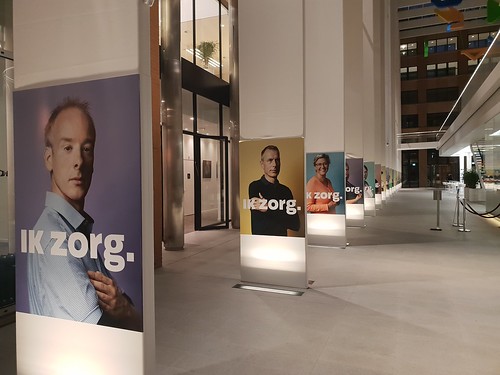

The faces in the Ministry with the text ‘I care’
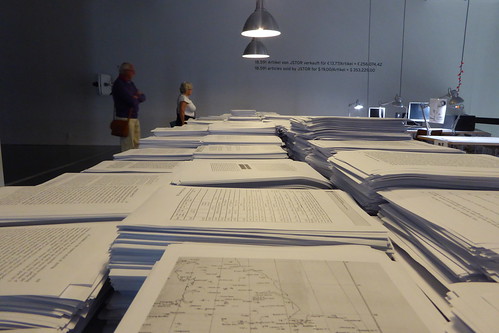
Aaron Swartz would have turned 32 November 8th. He died five years and 10 months ago, and since then, like this weekend, the annual Aaron Swartz weekend takes place with all kinds of hackathons and events in his memory. At the time of his suicide Swartz was being prosecuted for downloading material in bulk from JSTOR, a scientific papers archive (even though he had legitimate access to it).

In 2014 the Smart New World exhibition took place in Kunsthalle Düsseldorf, which Elmine and I visited. Part of it was the installation “18.591 Articles Sold By JSTOR for $19 = $353.229” with those 18.591 articles printed out, showing what precisely is behind the paywall, and what Swartz was downloading. Articles, like those shown, from the 19th century, since long in the public domain, sold for $19 each. After Swartz’ death JSTOR started making a small percentage of their public domain content freely accessible, limited to a handful papers per month.

The Düsseldorf exhibit was impressive, as it showed the volumes of material, but the triviality of most material too. It’s a long tail of documents with extremely low demand, being treated equally as recent papers in high demand.


Scientific journal publishers are increasingly a burden on the scientific world, rent-seeking gatekeepers. Their original value added role, that of multiplication and distribution to increase access, has been completely eroded, if not actually fully reversed.