A project I’m involved has won funding from the SIDN Fund. SIDN is the Dutch domain name authority, and they run a fund to promote, innovate, and stimulate internet use, to build a ‘stronger internet for all’.
With the Open Nederland association, the collective of makers behind the Dutch Creative Commons Chapter, of which I’m a board member, we received funding for our new project “Filter me niet!” (Don’t filter me.)

With the new EU Copyright Directive, the position of copyrights holders is in flux the coming two years. Online platforms will be responsible for ensuring copyrights on content you upload. In practice this will mean that YouTube, Facebook, and all those other platforms will filter out content where they have doubts concerning origin, license or metadata. For makers this is a direct threat, as they run the risk of seeing their uploads blocked even while they clearly hold the needed copyright. False positives are already a very common phenomenon, and this will likely get worse.

With Filtermeniet.nl (Don’t filter me) we want to aid makers that want to upload their work, by inserting a bit of advice and assistance right when they want to hit that upload button. We’ll create a tool, guide and information source for Dutch media makers, through which they can declare the license that fits them best, as well as improve metadata. In order to lower the risk of being automatically filtered out for the wrong reasons.

Yesterday I realised once again the importance of watching how others work with their tools. During the demo’s of what people worked on during IndieWebCamp Utrecht I was watching remotely as Frank demoed his OPML importer for Microsub servers. At some point he started sending messages to his Microsub server’s API, and launched Postman for it. It was the first takeaway from his demo. I decided to look Postman up, install it, and resolved to blog about the importance about sharing your set-up and showing people your workflows.

Then Peter independently, from a different cause, beat me to it with “You do it like that?”.

So consider this reinforcement of that message!

Björn Wijers demoing, with Dylan, Neil and Julia in the photo looking on

Most of yesterday’s participants returned today to get under the hood of their websites and build something. I didn’t attend in person, but participated remotely in the opening session this morning, and the demo’s this afternoon. The demo session has just concluded and some cool things were created, or at least started. Here are a few:

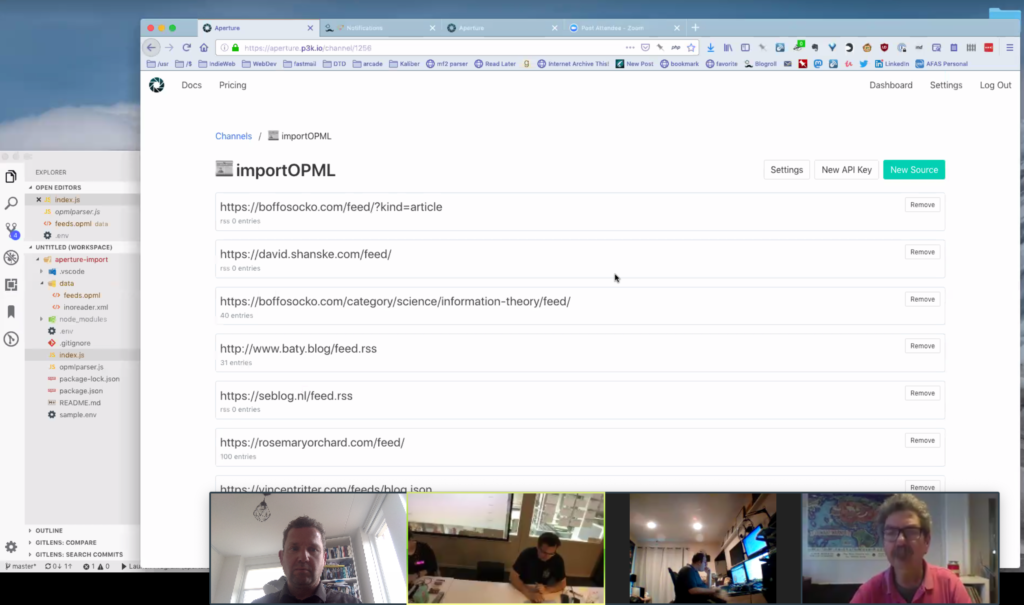
Frank Meeuwsen worked on an OPML importer for Aperture, a microsub server. This way it is possible to import the feeds from your existing RSS reader into your microsub server. Very useful to aid migrating to a new way of reading online content.

Jeremy Cherfas worked on displaying his gps tracks on his site, using Compass

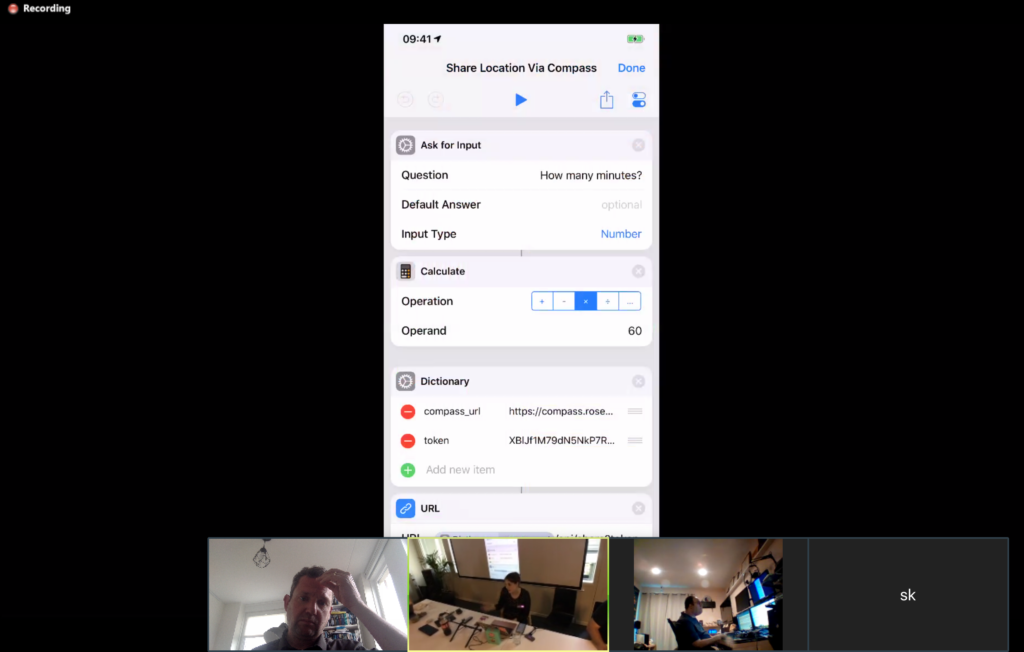
Rosemary Orchard, extending on that, created the option of sharing her geo location on her site for a specified number of minutes.

Neil Mather installed a separate WordPress install to experiment with ActivityPub, and succeeded in sending messages from WordPress to Mastodon, and receive back replies.

Björn Wijers wrote a tool that grabs book descriptions from GoodReads for him to post to his blog when he finishes a book.

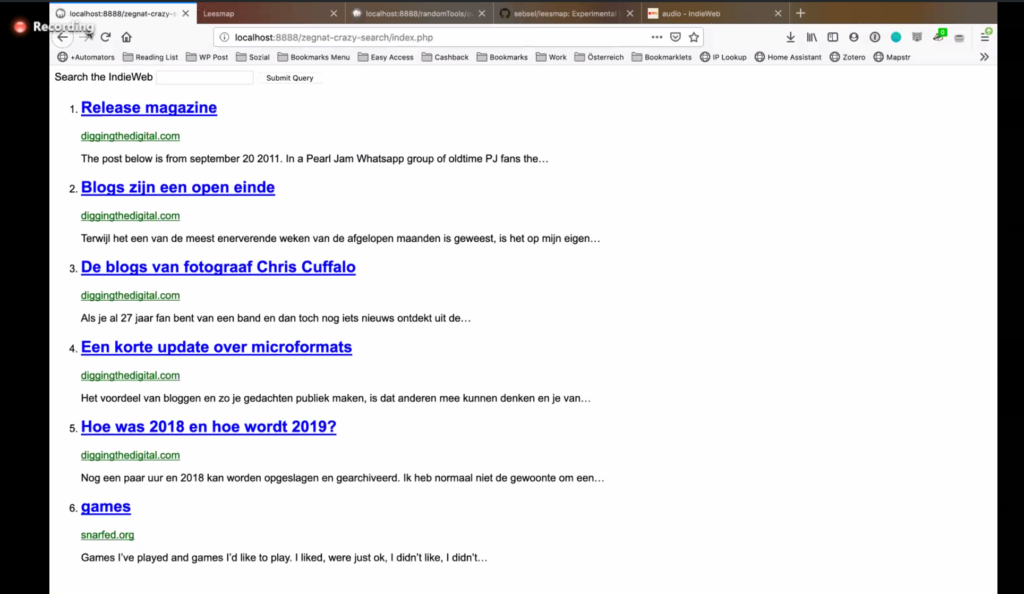
Martijn van der Ven picked up on Djoerd Hiemstra’s session yesterday on federated search, and created a search tool that searches within the weblogs of IndieWeb community members.

That concludes the first IndieWebCamp in Utrecht, with a shout-out to all who contributed.

This is a quick exploration of my current and preferred feed reading patterns. As part of my activities, for Day 2, the hack day, of IndieWebCamp Utrecht.

I currently use a stand alone RSS reader, which only consumes RSS feeds. I also experiment with TinyTinyRSS which is a self-hosted feed-grabber and reader. I am attracted to TinyTiny RSS beacue 1) it has a database I can access, 2) it can create RSS from any selection I make, and it publishes a ‘live’ OPML file of feeds I track, which I use as blogroll in the side bar.

What I miss is being able to follow ‘any’ feed, for instance JSON feeds which would allow tracking anything that has an API. Tracking #topics on Twitter, or people’s tweets. Or adding newsletters, so I can keep them out of my mail client, and add them to my reader. And there are things that I think don’t have feeds, but I might be able to create them. E.g. URLs mentioned in Slack channels, or conversation notes I take (currently in Evernote).

Using IndieWeb building blocks: the attraction of IndieWeb here is that it makes a distinction between collecting / grabbing feeds and reading them. A Microsub server grabs and stores feeds. A Microsub client then is the actual reader.
Combined with Micropub, the ability to post to your own site from a different client, allows directly sharing or responding from a reader. In the background Webmention then works its magic of pulling all that together so that the full interaction can be shown on my blog.

The sharing buttons in a (microsub client) reader like Monocle are ‘liking’, ‘repost’ and ‘reply’. This list is too short to my taste. Bookmarking, ‘repost with short remarks’ and ‘turn into a draft for long form’ are obvious additions. But there’s another range of things to add about sharing into channels that aren’t my website or not a website at all, and channels that aren’t fully public.

To get things under my own control, first I want to run my own microsub server, so I have the collected feeds somewhere I can access. And so I can start experimenting with collecting types of feeds that aren’t RSS.

It was a beautiful morning, cycling along the canal in Utrecht, for the first IndieWebCamp. In the offices of shoppagina.nl about a dozen people found each other for a day of discussions, demo’s and other sessions on matters of independent web activities. As organisers Frank and I aimed to not just discuss the IndieWeb as such, but also how to tap into the more general growing awareness of what the silos mean for online discourse. To seek connection with other initiatives and movements of similar minded people.

Frank’s opening keynote

After Frank kicking off, and introducing the key concepts of IndieWeb, we did an introduction round of everyone there. Some familiar faces, from last year’s IndieWebCamp in Nürnberg, and from last night’s early bird dinner, but also new ones. Here’s a list with their (personal) websites.

Sebastiaan http://seblog.nl
Rosemary http://rosemaryorchard.com/
Jeremy https://jeremycherfas.net
Neil http://doubleloop.net/
Martijn https://vanderven.se/martijn/
Ewout http://www.onedaycompany.nl/
Björn https://burobjorn.nl
Harold http://www.storyconnect.nl/
Dylan http://dylanharris.org
Frank http://diggingthedigital.com
Djoerd https://djoerdhiemstra.com/
Ton https://www.zylstra.org/blog
Johan https://driaans.nl
Julia http://attentionfair.com

After intro’s we collectively created the schedule, the part of the program I facilitated.

The program, transcribed here with links to notes and videos

Halfway through the first session I attended, on the IndieWeb buidling blocks, an urgent family matter meant I had to leave, just as Frank and I were starting to prepare lunch.

Later in the afternoon I remotely followed the etherpad notes and the live stream of a few sessions. Things that stood out for me:

Federated Search
Djoerd Hiemstra talked us through federated search. Search currently isn’t on the radar of indieweb efforts, but if indieweb is about taking back control, search cannot be a blind spot. Search being your gateway to the web, means there’s a huge potential for manipulation. Federated search is a way of trying to work around that. Interestingly the tool Djoerd and his team at Twente University developed doesn’t try to build a new but different database to get to a different search tool. This I take as a good sign, the novel shouldn’t mimic what it is trying to replace or defeat.

Discovery
This was an interesting discussion about how to discover new people, new sources, that are worthwile to follow. And how those tactics translate to indieweb tools. Frank rightly suggested a distinction between discovery, how to find others, and discoverability, how to be findable yourself. For me this session comes close to the topic I had suggested for the schedule, people centered navigation and personal information strategies. As I had to leave that session didn’t happen. I will need to go through the notes once more, to see what I can take from this.

Readers
Sebastiaan took us all through the interplay of microsub servers (that fetch feeds), readers (which are normally connected to the feed fetcher, but not in the IndieWeb), and how webmention and micropub enable directly responding and sharing from your reader interface. This is the core bit I need to match more closely with my own information strategies. One element is that IndieWeb discussions assume sharing is always about online sharing. But I never only think of it that way. Processing information means putting it in a variety of channels, some might be online, but others might be e-mails to clients or peers. It may mean bookmarked on my blog, or added to a curated bookmark collection, or stored with a note in my notes collection.

Day 2: building stuff
The second day, tomorrow, is about taking little steps to build things. I will again follow the proceedings remotely as far a possible. But the notes of the sessions about reading, and discovery are good angles for me to start. I’d like to try to scope out my specs for reading, processing and writing/sharing in more detail. And hopefully do a small thing to run a reader locally to tinker.

This looks like a very useful work, by over 65 authors and a team of editors including Mor Rubinstein and Tim Davis: The State of Open Data

A little over a decade has passed since open data became a real topic globally and in the EU. I had my first discussions about open data in the spring of 2008, and started my first open data project, for the Dutch Ministry for the Interior, in January 2009. The State of Open Data looks at what has been achieved around the world over that decade since, but also looks forward:

How will open data initiatives respond to new concerns about privacy, inclusion, and artificial intelligence? And what can we learn from the last decade in order to deliver impact where it is most needed? The State of Open Data brings together over 65 authors from around the world to address these questions and to take stock of the real progress made to date across sectors and around the world, uncovering the issues that will shape the future of open data in the years to come.

Over 18 months the authors and editors worked to pull all this material together. That is quite an impressive effort. I look forward to working my way through the various parts in the coming time. Next to the online version African Minds has made a hard copy version available, as well as a free downloadable PDF. That PDF comes in at 594 pages, so don’t expect to take it all in in one sitting.