The P2P Foundation reposts an article by Jeremy Lent from late 2017 on how corporations are artificial intelligences.

It doesn’t mention Brewster Kahle’s 2014 exploration of the same notion.
SF writer Charlie Stross referenced Kahle when he called corporations a 19 century form of ‘slow AI’.
Because “corporations are context blind, single purpose algorithms“.

I like that positioning of organisations as slow AI and single purpose algorithms. For two reasons.
First, as it refocuses us on the fact that organisational structures are tools. When those tools get bigger than us, they stop serving us. And it points the way to how we always need to think about AI as tools, with their smallness as design principle.
Second, because it nicely highlights what I said earlier about ethics futurising. Futurising is when ethical questions are tied to AI in ways that puts it well into the future, and not paying attention to how those same ethical issues play out in your current context. All the ethical aspects of AI we discuss apply to our organisations, corporations just as much, but we simply assume that was considered some point in the past. It wasn’t.

Your Slow AI overlords looking down on you, photo Simone Brunozzi, CC-BY-SA

My friend Peter has been blogging for exactly 20 years yesterday. His blog is a real commonplace book, and way more than my blog, an eclectic mixture of personal things, professional interests, and the rhythm of life of his hometown. When you keep that up for long enough, decades even, it stops being a random collection and becomes a body of work, an œuvre. Œuvre really is the right word, according to Peter he’s written 2.67 million words. Novels on average have eighty thousand words, so Peter’s blog is over 33 novels long. Most novelists aren’t that prolific.

I’m a regular reader of Peter’s blog exactly because of the quirky mix of observations, travelogues, personal things, snippets of code, and reflection. To me the way he weaves all those things into one, is what we also tried to achieve with our Smart Stuff that Matters unconference (in which Peter participated): bringing global (technology) developments back to the size of your own home life, your own city life, and letting your life inform how you want to shape and use the tools available to you. So that, in the words of Heinz Wittenbrink (another participant last summer), when you discuss themes important to you, you actually are discussing the details of your own life:

To list the themes [….of the sessions I attended…] fails to express what was special about the unconference: that you meet people or meet them again, for whom these themes are personal themes, so that they are actually talking about their lives when they talk about them. At an unconference like this one does not try to create results that can be broadcast in abstracted formulations, but through learning about different practices and discussing them, extend your own living practice and view it from new perspectives. These practices or ways of living cannot be separated from the relationships in which and with which you live, and the relationships you create or change at such an event like this.

Heinz’ last sentence in that quote “These practices or ways of living cannot be separated from the relationships in which and with which you live.” is true and important as well.

Of the 20 years Peter kept up his blog, I’ve known him for 14 years almost to the day, ever since we met in a Copenhagen hotel lobby mid June 2005. Our first meeting was aptly technology mediated. As Heinz wrote, our blogging practices cannot be separated from the relationships in which we live. Traces of our connections are visible through the years, building on each others thinking, meeting up in various places, visiting each others homes. Not just our specific connection but the shared connections to so many others.
Blogging isn’t just a reflection of our lives, but is an active part in weaving the connections that make up our lives.

Next week Peter organises an unconference, called Crafting {:} a Life. Modelled after Elmine’s and my unconference birthday parties, Peter is celebrating not just the 20 year milestone of his blog and his company. He’s celebrating in the same way he blogs, the completeness of our lives, both the sweet and the bitter. It’s in that contrast where beauty lives to me, and how we can appreciate the value of the connections we weave. Elmine and I will go visit Peter and his family, with 50 or so others, on Prince Edward Island in Canada in a few days.

Peter recently said about our and other participants coming to Canada from Europe
“It is humbling to consider that each of these old friends is coming across the ocean to join us for the simple act of spending time together talking about life for a while.”
We felt the same every time we did an edition of our unconferences. Elmine wrote last summer, looking back on her birthday unconference Smart Stuff That Matters:

How do you put into words how much it means to you that friends travel [literally] across the world to attend your birthday party? … How can I describe how much it means to me to be able to connect all those people Ton and I collected in our lives, bring them together in the same space and for all of them to hit it off? That they all openly exchanged life stories, inspired each other, geeked out together, built robots together?

The simple act of spending time together talking about life for a while. is a rather rich and powerful thing to do, Peter, which packs the full complexity of being human. We look forward to seeing you, Catherine and Oliver next week, as well as 50 or so others that came to form your ‘global village’ while you were engaged in blogging a life.

I need to write more extensively about two things that I for now want to link / bookmark here, both coming from Neil Mather.

One is local-first software, an article by Ink and Switch:

In this article we propose “local-first software”: a set of principles for software that enables both collaboration and ownership for users. Local-first ideals include the ability to work offline and collaborate across multiple devices, while also improving the security, privacy, long-term preservation, and user control of data.

This resonates with me on two frequencies, one the notion that tools need to be useful on their own, and more useful when connected across instances, the other that information strategies and agency in my mind correlate with social distance.

The second thing is Neil’s reference to Gevulot. At IndieWebCamp Utrecht one session took place around oversharing and conditional sharing. Gevulot is a device that allows for very precise contextual sharing, in the SF trilogy The Quantum Thief by Finnish author Hannu Rajaniemi (previously mentioned in this blog).

Gevulot is a form of privacy practised in the Oubliette. It involved complex cryptography and the exchange of public and private keys, to ensure that individuals only shared that information or sensory data that they wished to. Gevulot was disabled in agoras.

This resonates again with information strategies and the role of social distance, but also with how I think that our tools need to align with how we humans actually interact such as flexibly and fluently switching between different levels of disclosure for different aspects of our lives in conversation with someone. That link to a posting on what I’d like my tools to do is from 2006, and my description of a ideal reader more recently is still consistent with it over a decade later (albeit from the reading perspective, not the sharing perspective). Gevulot from now is definitely the shorthand I will use for these type of explorations.

Yesterday we had our monthly all hands meeting at my company. In these meetings we allocate some time to various things to increase our team’s knowledge and skills. This time we looked at information security, and I gave a little intro to start a more long term discussion and effort to raise information security in our company.

When people discuss information security it’s often along the lines of ‘if you want to do it right I’d have to go full paranoid, and that is completely over the top, so I won’t bother with it at all’. This is akin to saying that because it makes no sense to turn your home into an impenetrable fortress against invaders, you’ll just leave the door standing open. In practice you’ll do something in between those two extremes, and have locks on the door.

The Magic Door

Fortress or open door? That’s a false dilemma. (fortress by Phillip Capper, CC-BY, open door by Hartwig HKD, CC-BY-SA and locked door by Robert Montalvo CC-BY)

You know the locks on your door won’t keep out very determined burglars or say a swat team, but it will raise the time and effort needed for less determined invaders to a point they will be discouraged.
At the same time keeping the door closed and locked isn’t just useful to keep out burglars but also serves as a way to keep out the wind, rain and leaves and dust blowing in from the street.
Similarly in information security you won’t keep out determined government three letter agencies, but there too there are basic hygiene measures and a variety of measures to raise the cost of more casual or less determined attacks. Like with preventative measures at home, information security can be viewed in layers on a spectrum.

I tried to tease out those layers, from the most basic to the most intensive:

  1. hygiene
  2. keeping your files available
  3. basic steps against loss or theft, also on the road
  4. protect client information, and compliance
  5. secure communication and exchanges
  6. preventing danger to others
  7. traveling across borders outside of the Schengen area
  8. active defence against being targeted
  9. active defence against being targeted by state actors

For each of those levels there are multiple dimensions to consider. First of all in recent years a new group of actors interested in your data has clearly emerged. The tech companies for whom adtech is their business model started tracking you as much as they can get away with. This adds the need for measures to all but the most intensive levels, but especially means the basic levels intensify.
Then there’s the difference between individual measures, and what can be arranged at the level of our organisation, and how those two interplay.

Practically each level can be divided first along the lines of our two primary devices, laptop and phone. Second, there’s a distinction between technological measures, and behaviour (operational security).
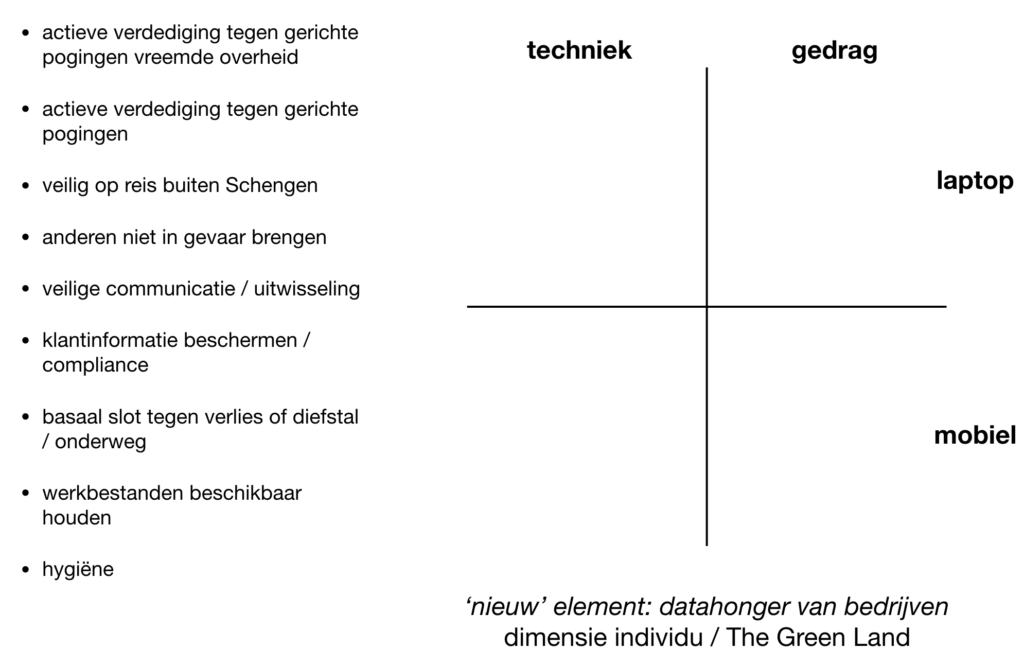
the list of levels, and the distinction in dimensions as I showed them yesterday

I provided examples of how that plays out on the more basic levels, and on the most intensive level. E.g. on the level of hygiene, technological measures you can think of are firewalls, spam and virus filters, a privacy screen, ad blockers and tracker blockers, using safer browsers. Behavioural measures are not clicking links before checking what they lead to, recognising phishing attempts, not plugging in usb sticks from others, using unique user names and passwords, using different browsers for different tasks, and switching off wifi, bluetooth and gps (on mobile) when you’re not specifically using them.

Over the years working on open data I’ve increasingly become aware of and concerned about information security, and since early 2014 actively engaging with it. I’m more or less at level 7 of the list above, and with the company I think we need to be at level 5 at least, whereas some of us haven’t quite reached level 1 at the moment. From the examples I gave, and showing some of the (simple) things I do, we had a conversation about the most pressing questions and issues each of us has. This we’ll use to sequence steps. We’ll create short faq’s and/or how-to sheets, we’ll suggest tools and behavioral measures, suggest what needs a collective choice, and provide help with adoption / implementation. I feel with this we have a ‘gentle’ approach, that avoids overwhelm that leads to not taking measures at all.

The first things people mentioned because they were worried about it are: usernames/passwords, e-mail, trackers, vpn, and handling copies of ID’s.
So we’ll take those as starting points.

If you want to read up on information security and operational security around your devices, dearly missed Arjen Kamphuis’s book on information security for journalists is a very useful resource. My approach as described is more geared to the actual context of the people involved, and what I know about their habits and routines, and to the context of our work and typical projects.

Via Iskander Smit an interesting editorial on practices in digital ethics landed in my inbox: Translating Principles into Practices of Digital Ethics: Five Risks of Being Unethical, by Luciano Floridi, director of the Digital Ethics lab of Oxford University’s Internet Institute.

It lists 5 groups of practices that subvert (by being distracting or destructive) actual ethical principles being applied in digital technology. They are very recognisable from ethical discussions I’ve been in or witness to. The paper also provides some pointers in how to address them.
I will list and quote the five practices, and add a sixth that I come across regularly in my own work. Together they are digital ethics dark patterns so to speak:

  1. ethics shopping: “the malpractice of choosing, adapting, or revising (“mixing and matching”) ethical principles, guidelines, codes, frameworks, or other similar standards (especially but not only in the ethics of AI), from a variety of available offers, in order to retrofit some pre-existing behaviours (choices, processes, strategies, etc.), and hence justify them a posteriori, instead of implementing or improving new behaviours by benchmarking them against public, ethical standards.“
  2. ethics bluewashing: the malpractice of making unsubstantiated or misleading claims about, or implementing superficial measures in favour of, the ethical values and benefits of digital processes, products, services, or other solutions in order to appear more digitally ethical than one is.
  3. ethics lobbying: the malpractice of exploiting digital ethics to delay, revise, replace, or avoid good and necessary legislation (or its enforcement) about the design, development, and deployment of digital processes, products, services, or other solutions. (can you say big tech?)
  4. ethics dumping: the malpractice of (a) exporting research activities about digital processes, products, services, or other solutions, in other contexts or places (e.g. by European organisations outside the EU) in ways that would be ethically unacceptable in the context or place of origin and (b) importing the outcomes of such unethical research activities.
  5. ethics shirking: the malpractice of doing increasingly less “ethical work” (such as fulfilling duties, respecting rights, and honouring commitments) in a given context the lower the return of such ethical work in that context is mistakenly perceived to be.
  6. To which I want to add a sixth, based on observations in my work in various organisations, and what pops up ethics-related in my feedreader:

  7. ethics futurising: the malpractice of discussing ethics and even hiring ethics advisors only for technology and processes that are 10 years into the future for the organisation in question. E.g. AI ethics in a company that as yet has nothing to do with AI. At the same time that same ethical soul searching is not applied to currently relevant and used practices, technology or processes. It has a part of ethics bluewashing in it (pattern 2, being seen as ethical rather than being ethical), but there’s something else at play as well, a blind spot to ethical questions being relevant in reflecting on current digital practices, tech choices, processes and e.g. data collection methods, the assumption being that current practice is all right.
  8. I find this sixth one both distracting and destructive: it let’s an organisation believe they are on top of digital ethics issues, but it is all unrelated to their core activities. As a result staff currently involved in real questions are left to their own devices. Which means that for instance data protection officers are lonely figures and often all but ignored by their organisations until after a (legal) issue arises.

Late June, I will be contributing to a course of the The Hague Academy for Local Governance on Integrity and Anti-Corruption efforts. My part in this course will look at the role and use of open data and transparency efforts.

How open data helps create transparency, like public procurement data, land registry and land banks data, ultimate beneficial ownership data, public spending, (farming) subsidies, politicians expenses, etc. and the role of ‘many eyes’ in such cases.
I will certainly talk about how open data can create new agency, levelling the playing field between citizens and government entities (like local budget monitoring does). Also the role of investigative journalism (like Follow the Money here in NL), especially the cross-border variety, leaks, novel research groups like Bellingcat, and crowd sourced efforts to wade through large responses made to Freedom of Information requests, mapping impact of civil war, or detecting war crimes. All examples of, let’s call it ‘Data Driven Daylight’. I probably will also need to talk a bit about data provenance and data governance, as well as how understanding the basics of technology is a prerequisite if you have a role in preventing and detecting integrity and corruption issues.

My experiences in open data, work for the World Bank, and the UNDP (for which I contributed to an anti-corruption training a few years ago), as well as my role as board member of the leading Dutch transparency NGO Open State Foundation will be the basis.