At last week’s Crafting {:} a Life unconference on PEI I participated in three conversations on blogging:

  1. What happened to blogging? Initiated by Steven Garrity
  2. The future of blogging. Initiated by Peter Rukavina
  3. Doing Blogging. Initiated by me

Elmine already blogged some of her impressions from these conversations. I’ll add some of my own.

What happened to blogging?
It started with Steven Garrity who asked “What happened to blogging?” in the morning of the first day. Some 20 people wanted to take part in that so we put together a big circle in the main hall. The group had long time bloggers (over 20 years), those whose blogs fell more or less silent, and those who never blogged but are interested in doing so. What followed was a discussion of why we started blogging, and what happened to those initial conditions. I started to think out loud, but kept going because of the wide peer network that emerged because of our distributed conversations across blogs. We suspected started blogging right in the perfect moment: the number of people blogging in your fields of interest was big enough to feel engaged, and small enough to feel like a town you can keep an overview of. We first welcomed the silos like Facebook and Twitter as it made interacting even easier and brought in more people as the required level of tech savvy dropped. What however at first seemed like a source of agency turned into the erosion of it. Long form writing evaporated, more exchanges turned into ’empty calories’. RSS as an easy way of following what was going on eroded the too. Many sites ‘forgot’ what RSS was, and that accelerated when the most visible reader by Google fell by the wayside. Although we also felt that blaming Google Reader solely isn’t right, it was a development that fit in a larger change already underway.
We also discussed how some of that original blog interaction in the early ’00s has been channeled into other modes of communications, like newsletters. Peter Bihr for instance mentioned how it felt like newsletters are a more direct form of communication, with a clear audience in mind, and responses to it are of much higher quality. We missed the kick of the interaction between blogs, as well as having the time and attention to reflect and write more deeply.


Part of the blogging circle

The future of blogging
Having looked back in the morning, some of us felt we wanted to not just be melancholic but also look at what a constructive future of blogging looks like. So Peter suggested to do another conversation in the afternoon. Part of the reason for this was in our immediate circle we saw several people who ‘returned’ to blogging, like myself. Part of it is the appearance of new web standards, the IndieWeb that intends to take the useful traits of social media platforms and apply them to your own websites. Opting to enjoy the weather we had this conversation in Peter’s back yard. We talked about a variety of things connected to blogging. The technology that can assist in getting more interaction between blogs, in helping to make publishing easy. And the behaviours that help to blog more, doing away with expectations of what ‘proper’ blogging is and giving oneself permission to just do what you want.


The future of blogging taking shape in Peter’s back yard

Doing blogging
The second day of the unconference was positioned as a ‘doing’ day. As the ‘future of blogging’ conversation surfaced a lot of ‘how-to’ questions, I suggested we could do a more practice oriented session. On what is currently technically possible, and how that looks in practice for instance in my blog. The weather was great again, so we opted for the back yard like the day before. Bright sunlight and a scarcity of laptops meant we didn’t ‘do’ much. We did talk about the practical steps one can take, and the purpose and working of the various IndieWeb standards. This developed in a wider ranging conversation on our various information routines and the tools we use. Participants were eagerly taking notes to learn from each other’s tool use. From tools and routines we went to life hacks, and a much wider scope of topics. That was a great experience, although it meant that the original topic of conversation moved out of sight. I felt in flow in this conversation, and it went on literally for hours without effort and without energy levels dropping away.


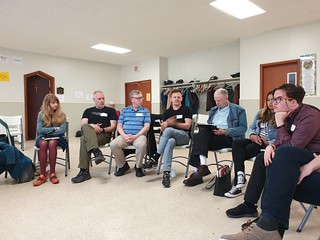
The ‘doing blogging’ circle of participants

Direct consequence is that one of the participants launched her own blog, with IndieWeb support from the start. Another that questions about how I read along lines of ‘social distance’ led to me explaining that in detail today. Important to me is that I also could add a number of bloggers to my ‘global village’ of people whose postings I read, adding more voices to the mix I take in. I also plan to write a number of postings starting from the issues raised in the conversations to introduce and explain the IndieWeb standards. The current documentation mostly starts with tech, and that means a too high threshold for adoption for large groups.

At the Crafting {:} a Life unconference one of the things that came up in our conversations was how you take information in, while avoiding the endlessly scrolling timelines of FB and Twitter as well as FOMO. My description of how I read feeds ‘by social distance‘ was met with curiosity and ‘can you show us?’. I realised I have blogged about this, but always as part of a much wider discussion of reading and writing on the web, and never as something on its own and in detail. So let’s do that now.

My notions about information strategies and filtering
Let’s start with the underlying assumptions and principles I landed upon using over time:

  • There is no way you can take in all available information, there’s simply too much, it’s always been that way. Internet amped up the volume of course.
  • Because there’s always been too much information, although internet changed its volume and quality, there’s no such thing as information overload. There do exist failing information strategies, and failing filtering strategies.
  • It’s not useful to fear you might miss something in the ocean of information. If it is important it will come back tomorrow, through some other path.
  • Filtering, as mental activity I mean, not as rule based technological fix, needs attention, as it is the primary way to shape your information diet
  • Filtering also needs attention as it is a key part of what information you share and propagate yourself. Output is the result of processed input. Filtering, again as mental activity as verb, determines input, and thus impacts output.
  • My filtering is not a stand alone thing in isolation, it is part of a network of filters, yours, mine, and other people’s. My output is based on filtered input, and that output ends up in other people’s filtered input.I treat blogging as thinking out loud and extending/building on other’s blogposts as conversation. Conversations that are distributed over multiple websites and over time, distributed conversations.
  • If you are part of my input, and I am part of your input, then feedback loops get created. It is these feedback loops that lift signals above the sea of general background noise. This is the key bit that means you don’t need to fear missing something, as it will resurface through a feedback loop if it’s important.
  • This means that where I source information can’t be of the ‘news’ type, stuff that pretends it is neutral. Neutral isn’t useful in a filter. Commented, interpreted, augmented material is useful in a filter, as it adds context that help determine its information value. I source information from individuals as a result.
  • Who you are as a person is an essential piece of context in how to judge information. If you’re walking on the street and a random stranger asks to have a coffee, you interpret it very differently from when your partner walking next to you asks you the same thing. We are all walking information filters, our brains are very well used to doing that. So what I know socially about you helps me interpret what you share, as it will be coloured by who you are. Let’s call this social filtering.
  • I know many people, some very well, others less so, or I only know what you’ve shared on your site recently and we haven’t met at all. The social distance I perceive between me and you is part of the context of filtering. This is an otherwise unspecified mix of personal, professional, and other aspects that I am aware of with others.
  • When social distance and social filtering are key elements in filtering information, preventing echo chambers is a key concern. This translates into purposefully seeking out divergence and diversity in your network. All your favourite enemies need to be in your information filter as well. And you need to extend your network periodically, while monitoring its health in terms of variety. You then end-up half way between ‘subjective’ (me and my echo chamber), and ‘objective’ (journalism as per its ideal), at ‘multi-subjective’. That’s great because all of human complexity is at that intermediate level between ‘n=1’ / me, and statistics (probabilities across populations): networks of interdependent actors.

Over the years I’ve written a number of postings about the points above. I try to maintain an overview on my page about information strategies.

How I organise my feed reader
All the above serves as a long introduction to why I organise my feed reading the way I do:

  • I follow people, not sources. This means that I’m not subscribed to ‘The Local News’, but to blogs kept by individuals. It also means that if you’re Jenny Jensen who writes the blog Pangean Pontifications, I will have you as Jenny Jensen in my feed reader, not your masthead
  • I order the feeds I follow in folders roughly by social distance. From people closer to me, to total strangers through multiple levels in between. This isn’t an exactly determined ‘weight’. It is an intuitive arrangement of where I think our current connection/interaction is at. I move things around. E.g. a recent extended blog-based conversation may move you from total stranger to something closer. Meeting and having conversations at an event very likely will as well.

Above is a screenshot of the folder structure in my reader that implies social distance. A12 is the closest level. A I originally meant as my personal ‘A-listers’, and 12 as a number that roughly indicates a circle the size of immediate family and closest friends. The other folders have a similar meaning. B50, a slightly wider group of close professional and personal peers, C150 the connections with let’s say my Dunbar ‘horizon’ or close connections of my close connections, D500 people from various ‘Dunbar number‘ sized circles, communities, contexts I’m part of. E999 new connections, strangers. Most feeds will start in E999, as everything starts out as being miscellaneous. Over time (remember, feedback loops), some will stand out more for me and move to a deeper folder / layer of the onion. People I’ve met will mostly be in folders A12-D500. But I also have one person in my A12 folder I never met in person. Bryan Alexander and I have been in touch a very long time through our blogs, consistently and intensively, and that’s why he’s in the A12 folder. Invitations we made to people for our birthday unconferences will all come from at most the D500 ‘distance’. There is one other folder ‘Keeptrack’ which contains feeds of my own, my company’s or project related and group stuff. The comment feed for my blog for instance.

Within each folder are a number of feeds, which as I wrote are named after their author.
Who is where isn’t an assessment of the person, but of their relative position in my mental network map of every one I know (about). Within a folder there’s no deliberate structure.


You can see the current list of blogs I follow in the right hand sidebar, where you can download it as an OPML file. Most rss readers will allow you to import that and select the feeds you want to subscribe to. I regularly browse such lists when others publish them, to find new people for in my e999 folder.

I counted the feeds I currently have, and this is the distribution:

folder # of feeds
A12 10
B50 14
C150 14
D500 16
E999 129

This is not a huge amount of feeds, just under 200. There used to be many many more, but when I started blogging more intensively again at the end of 2017, I realised most of my old feeds had gone silent, and I started out with an empty reader. What stands out to me most from that table is that it’s about 50 people I know somehow (A through D), and 129 ‘strangers’ from the e999. That is a visible effect from starting out with ‘everything is miscellaneous‘ and populating e999, after which people will move into one of the other folders over time as patterns and depth of connection emerge. In my old set of subscriptions the ‘closer’ folders were more populated, along the lines of the numbers in the folder names. I expect to over time stabilise that way again (meaning some 500 feeds followed in the A through D folders). Adding, removing or moving feeds I treat as a form of gardening.

The numbers would likely become very different if I can more easily add feeds from other spaces where people I know actually do write and post (LinkedIn, Facebook, Twitter, Flickr, Instagram etc mostly). Hence my interest in IndieWeb protocols such as Microsub and tools like Granary as they can be used to pull stuff out of silos, and hence my interest in what Aaron Parecki calls the social reader, that allows direct interaction with material within my reader, responding and posting directly from it.

Daily reading routines
I currently use Readkit as feedreader, which allows folders, and allows me to rename feeds (so I can turn Pangean Pontification into Jenny Jensen). It also is an ‘offline first’ tool, which is my preferred mode of reading. I let it sync at the start of the day, and then at some point will go through it without needing an internet connection. It’s not in any way getting close to what would be my ideal feedreader (a posting that touches upon many of the points in this posting).

If I have only a little time to take in what others share, I will look only at the A12 folder, or if nothing got posted there at the B50 folder. More time means I will read more widely, moving to the C-D-E folders. That way I get a notion of what bloggers closest to me are writing about every day, and if I have time I will dive into the firehose of everything else. That’s an outside in approach: getting a feeling for what others are writing.

There’s also an inside-out approach where I use the search function to see if anyone has written about e.g. their impressions of Crafting {:} a Life which we visited in the past days, or the current political unrest in Moldova. Ideally I would also be able to tag feeds with aspects I know about its author (e.g. Berlin, coder, art, cycling, Drupal). Then I could ask ‘what are the German people I have in here that are into Drupal talking about this week?’

When I’m done reading for the day I hit ‘mark all as read’, or at least once every few days as I might forget to do it sometimes. ‘Mark all read’ is an important bit of functionality. I don’t really need to read everything, because if I overlooked something, and it’s important, I will come across it tomorrow or whenever the feedback loops bring it back again. Having your reader guilt-tripping you because you have ‘1276 unread items’ is not proper information-hygiene 😀

And you?
So how do you read? Do you publish a list of feeds you follow? I’d be interested to see your list. What would make your reading better, easier, a better routine? What seems useful to you from the above, and might be useful to me from your current set-up?

One of the things I always do after an event is go through the people I met and see if I can connect to them, e.g. on LinkedIn, Twitter or Facebook. This time around, part of that is adding people to my RSS reader, because they blog. This is an additional pleasure, not just because it extends my network of bloggers that I read, but also because doing so was a key part of my conversations at Crafting {:} a Life in the past days. So I am subscribing to people with which I already have had extended time talking. This immediately puts them at a shorter social distance than normally when exploring new blogs (and they requested me to describe better the importance to me of that, and what/why/how I do that).

Rosie le Faive as a direct consequence of the conversations at Peter’s unconference started a blog press pound. Her first posting is a very good start (definitely not the ‘hello world, is this thing on?’ variety) and I hope to read much more (here’s a bunch of reminders to self that I keep handy when falsely thinking I need to write ‘properly’ before I can press pound to publish). It’s a WordPress blog and it launched with IndieWeb support for Webmention, which is very good. There’s a whole bunch of IndieWeb peeps hanging out on IRC/Slack, Rosie.

Clark McCleod’s Kelake blog in contrast has been around since 2001/2. This too is a WP blog, so I hope to see Clark add Webmention and other IndieWeb features.

Steven Garrity’s blog Acts of Volition goes back to 2000. I’ve been aware of him for a long time, ever since he figured in Peter’s surprise at how well known PEI turned out to be when he first visited Reboot in Copenhagen. Now I’ve met him in person and added him to my reader.

And then the unconference Crafting {:} a Life had ended, and you have to come back to the regular flow of things. Dealing with the aftermath so to speak. Sunday, still on PEI, we spent mostly hanging out on the deck in Peter and Catherine’s back yard. Then we joined some lobsters on the flight to Montréal.

Monday we had a day to explore Montréal, before our early evening flight to Amsterdam. Now fighting jet lag on the couch, and trying to figure out how to take time this week to reflect and write more on the event.


Impressions of Montréal

Sunset over Labrador

It is good to see that the event is already causing ripples that move forwards in time. Rosie started a blog with support for IndieWeb standards, and Clark thinks he may permanently reshape his approach to workshops and presentations. I’ve also got a conference call planned with Mark on organising an unconference around the creative hub / makerspace project he is shaping.

And that is the real way participants can thank Peter for organising Crafting {:} a Life, and how ‘our’ participants, such as Peter did these past days, have thanked and are thanking us for our events: by taking something out of it and run with it. Bring it forward. Not an aftermath therefore, but unconference forwarding.

Walking to the market

I’ve just woken up after a great Day 2 of Peter’s Crafting {:} a Life unconference. Nominally the day was more about doing, where the first day was more about meeting and talking. We started with a walk from Peter Catherine and Oliver’s home to the Charlottetown Farmers Market. There I enjoyed a second breakfast of tasty crab cake, a lovely salmon bagel and good espresso. It was a beautiful sunny morning and we chatted both during the walk and outside the Farmers Market.

Peter, Oliver and Ethan holding court

One of the participants has access to a bus so he drove us back to the ‘campus’ where we all gathered again to build the program for the day together. A fantastic line-up of things ranging from ‘blood memories’ , the history of Peter’s home and surrounding houses (including daguerrotypes), drinking your first ever cup of coffee (and the life changing story behind it), to drawing fantasy maps.
I suggested doing a session on blogging, building on Day 1’s conversations about what happened to blogging, and the future of blogging. It ended up on the schedule for the afternoon.

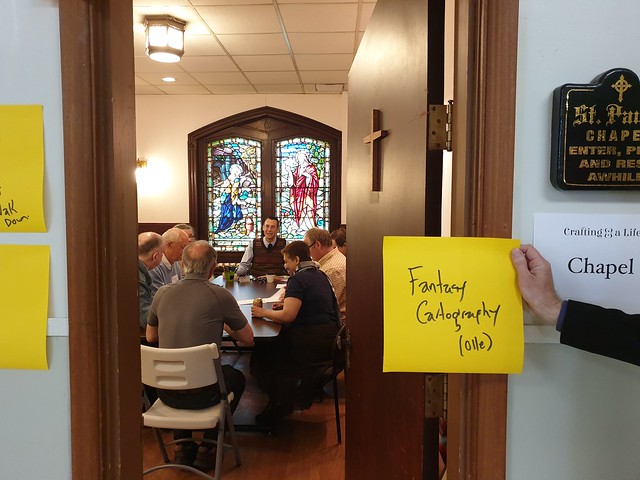
Olle starting the fantasy cartography session

The rest of the morning I spent with a small group of people at the harbour location of Receiver Coffee, where two of us had their first ever cup of coffee (“I never deliberately put a bitter thing in my mouth with the intention to enjoy it”). Around the coffee we had a fascinating conversation of the seismic consequences of leaving a prescriptive strict organised religious community. The methods, tactics and tools I use in working with groups a lot, in order to create a space for collective change to happen, to build connections and community, essentially can be and are being used to introduce and maintain power differences, isolate groups etc. It’s as if a tool you see as fit for beautiful craftsmanship is deployed to stab someone.


a first coffee, and back yard conversation

After lunch I sat down with a handful of people in Peter’s back yard for a session on IndieWeb tools and how they can breathe life back into blogging by taking control over your own content and the tools to connect you to others. For lack of laptops and because of bright sunlight, we talked more than we did things. And because of a bit of confusion around the schedule a larger group joined us an hour later under the assumption that was the correct starting time. But those ‘glitches’ worked out fine, as whoever is here are the right people, and whatever we talk about is the right topic. At first we talked about the IndieWeb tools and underlying standards and intentions, and examples of how that works out in practice (or doesn’t). From there we looped through an enormous variety of topics, from filling moments with listening to podcasts, to lifehacks, to getting transcripts of YouTube videos to parenting, reading to elderly people to improve quality of life, to instagram posers, grooming and language, and much much more. The free flow of the conversation with people drifting in and out, went on for some 4 hours effortlessly. People were taking notes but not disengaging on their phones. For me this session was worth the entire trip on its own, I was in flow. There’s much I still need to tease out for myself, to go back into the conversation and pick on a few strands to explore further, but right now it’s enough for me to admire the shape of the ephemeral construct we put together in that back yard. I came out sun burned not having noticed it in the conversational flow.

Pre-dinner waiting time was filled with terrific oysters. It had been a long time since I had them, and the last time was of the ‘here’s a bit of salty watery snot’ variety. These were fresh, we’re on an island after all, delicate of taste and very meaty. A local chef then served a nice bbq burger meal, after singing an Irish dedication song to us. More music followed.

pre-dinner rush to finish the first draft

Elmine had been working on writing a story during the day, which she plotted together with Rob Paterson, and she read out the first finished draft in front of not just the 50 people who participated in the unconference, but also their partners, families and others who had joined us for dinner. It must be daunting to stand up and read aloud something you created just now, and of which the ink isn’t even dry yet. Leaving half the audience brushing away a tear, it was great. I also felt it completed the circle of our own participation. Elmine led us through the first exercise on Day 1 where we told each other stories, and now she rounded it off with reading us all a story inspired by the family who brought us together in and around their home. When Peter thanked Elmine and they embraced, that was the moment I felt myself release the space I opened up on Day 1 when I helped the group set the schedule. Where the soap bubble we blew collapsed again, no longer able to hold the surface tension. I felt a wave of emotions wash through me, which I recognise from our own events as well. The realisation of the beauty of the collective experience you created, the connections made, the vulnerability allowed, the fun had, the playfulness. We wound down from that rush chatting over drinks in the moon lit back yard.

Thank you Peter for bringing us all to PEI for a few days of, as you wrote earlier, the simple act of spending time together talking about life for a while. Crafting a life is in part about crafting shared experiences. This most definitely was one.

Today was day 1 of the Crafting {:} a Life unconference that our friend Peter is organising on Prince Edward Island. It was a fun and wonderful day.
It was a novel experience, doing an unconference party like this as a participant. Elmine and I have always been on the other side, the persons convening a group of our friends and connections in our home for the event. Then you know all of those there, although most participants won’t know each other. Today it was like the latter for me, half a dozen familiars, and 40 or more people you never met. Peter said when he picked us up at the airport “you are the only two people in the world who know in what position I am right now.” The flip side of that is I’ve learned what all of you who participated in our events knew all along, how it is to participate.

Before the start, the circle of chairs waiting for us

Both Elmine and I did take some role in today’s events. In the run-up we chatted with Peter to provide feedback and share some of our previous experiences. And today, we helped set the scene. After Peter’s welcoming words and intro, some songs by Michael, and a welcome from Oliver, Elmine took the group through an introductory exercise. It was a version of the ‘anecdote circle lite‘ we did ourselves last summer. Groups of 5 or 6 would talk about “something you crafted or created that you’re most proud of, gave you most pleasure or was the most fun to do.” It is a good way to get to know some of the other participants while doing away with the usual ‘I’m John, and I’m the X at Y company”, of which nothing ever gets remembered when 40 people do that one after another. Now I’ve learned about veterinarian training on PEI, who created the most recent official PEI atlas (and whose name because of that will be remembered centuries from now because those official atlases are kept and cared about), and the pleasure you feel making something with your hands when your regular work is coding. While one was telling their story the others would write down what stood out for them. All those notes served as a source of reference and inspiration for the rest of the day.

Next Peter and I guided the group through building the program. I opened the space and invited people to propose topics or sessions, and when enough others showed interest it would go on the schedule. After the first sessions and lunch, and later in the afternoon we returned to the schedule so people could add things, and use their earlier experiences in the day to suggest new additions to the schedule. With the instruction to be curious, follow your energy and your feet to where you feel engaged, and have fun the participants were off.

the schedule as it emerged during the day

I attended sessions on constructive approaches to local climate adaptation efforts, the role of arts in social movements, a conversation on what happened to blogging, burn-out avoidance strategies, the future we see / want to see for blogging, and how to start and not to start a creative hub and maker space. I would have loved to also join a session on ‘phone nerding’ and the ‘death café’ but you can only be in one spot at any given time. I feel that the fact that this is all taking place on an island with a tight-knit community, gives a special flavor to the event. The sea is a natural boundary to the community and who counts as part of it, and there’s a strong sense of all being into it together. That also showed yesterday evening when Elmine and I found ourselves discussing the impact of AirBnb and other pressures on the local housing market, with some people at a bar, one of whom turned out to be the city counsellor responsible for that subject.

envisioning the future of blogging in Peter and Catherine’s back yard

We ended with pizza and some drinks. Tomorrow we will return for day 2, which will be focused on doing, where today was more about meeting and talking. Some ideas for what to do already emerged during this day. I will likely do something around the indieweb with the others interested in having a personal site away from the silos. But first sleep, and breakfast on the Charlottetown Farmers Market tomorrow.