Kicks Condor dives deeply into my info-strategy postings and impressively read them all as the whole they form (with my post on feed reading by social distance as starting point). It’s a rather generous gift of engagement and attention. Lots of different things to respond to, neurons firing, and tangents to explore. Some elements with a first reaction.
Knowing people is tricky. You can know someone really well at work for a decade, then you visit their home and realize how little you really know them.
Indeed, when I think of ‘knowing someone’ in the context of information strategies, I always do so as ‘knowing someone within a specific context’. Sort of what Jimmy Wales said about Wikipedia editors a long time ago: “I don’t need to know who you are“, (i.e. full name and identity, full background), but I do need to know who you are on Wikipedia (ihe pattern of edits, consistency in behaviour, style of interaction). As Wikipedia, which is much less a crowdsourced thing than an editorial community, is the context that counts for him. Time is another factor that I feel is important, it is hard to maintain a false or limited persona consistently over a long time. So blogs that go back years are likely to show a pretty good picture of someone, even if the author aims to stick to a narrow band of interests. My own blog is a case in point of that. (I once landed a project where at first the client was hesitant, doubting whether what I said was really me or just what they wanted to hear. After a few meetings everything was suddenly in order. “I’ve read your blog archives over the weekend and now know you’ll bring the right attitude to our issue”) When couch surfing was a novel thing, I made having been blogging for at least a year or two a precondition to use our couch.
I wonder if ‘knowing someone’ drives ‘social distance’—or if ‘desire to know someone’ defines ‘social distance’. […] So I think it’s instinctual. If you feel a closeness, it’s there. It’s more about cultivating that closeness.
This sounds right to me. It’s my perceived social distance or closeness, so it’s my singular perspective, a one way estimate. It’s not an estimation nor measure of relationship, more one of felt kinship from one side, indeed intuitive as you say. Instinct and intuition, hopefully fed with a diet of ok info, is our internal black box algorithm. Cultivating closeness seems a worthwhile aim, especially when the internet allows you to do so with others than those that just happened to be in the same geographic spot you were born into. Escaping the village you grew up in to the big city is the age old way for both discovery and actively choosing who you want to get closer to. Blogs are my online city, or rather my self-selected personal global village.
I’m not sure what to think about this. “Neutral isn’t useful.” What about Wikipedia? What about neighborhood events? These all feel like they can help—act as discovery points even.
Is the problem that ‘news’ doesn’t have an apparent aim? Like an algorithm’s workings can be inscrutable, perhaps the motives of a ‘neutral’ source are in question? There is the thought that nothing is neutral. I don’t know what to think or believe on this topic. I tend to think that there is an axis where neutral is good and another axis where neutral is immoral.
Responding to this is a multi-headed beast, as there’s a range of layers and angles involved. Again a lot of this is context. Let me try and unpick a few things.
First, it goes back to the point before it, that filters in a network (yours, mine) that overlap create feedback loops that lift patterns above the noise. News, as pretending to be neutral reporting of things happening, breaks that. Because there won’t be any potential overlap between me and the news channel as filters, no feedback loops. And because it purports to lift something from the background noise as signal without an inkling as to why or because of what it does so. Filtering needs signifying of stories. Why are you sharing this with me? Your perception of something’s significance is my potential signal.
There is a distinction between news (breaking: something happened!) and (investigative) journalism (let’s explore why this is, or how this came to be). Journalism is much closer to storytelling. Your blogging is close to storytelling. Stories are vehicles of human meaning and signification. I do follow journalists. (Journalism to survive likely needs to let go of ‘news’. News is a format, one that no longer serves journalism.)
Second, neutral can be useful, but I wrote neutral isn’t useful in a filter, because it either carries no signifcation, or worse that has been purposefully hidden or left out. Wikipedia isn’t neutral, not by a long-shot, and it is extensively curated, the traces of which are all on deliberate display around the eventually neutrally worded content. Factual and neutral are often taken as the same, but they’re different, and I think I prefer factual. Yet we must recognise that a lot of things we call facts are temporary placeholders (the scientific method is more about holding questions than definitive answers), socially constructed agreements, settled upon meaning, and often laden with assumptions and bias. (E.g. I learned in Dutch primary school that Belgium seceded from the Netherlands in 1839, Flemish friends learned Belgium did so in 1830. It took the Netherlands 9 years to reconcile themselves with what happened in 1830, yet that 1839 date was still taught in school as a singular fact 150 years later.)
There is a lot to say for aiming to word things neutrally. And then word the felt emotions and carried meanings with it. Loading wording of things themselves with emotions and dog whistles is the main trait of populistic debate methods. Allowing every response to such emotion to be parried with ‘I did not say that‘ and finger pointing at the emotions triggered within the responder (‘you’re unhinged!‘)
Finally, I think a very on-point remark is hidden in footnote one:
It is very focused on just being a human who is attempting to communicate with other humans—that’s it really.
Thank you for this wording. That’s it. I’ve never worded it this way for myself, but it is very to the point. Our tools are but extensions of ourselves, unless we let them get out of control, let them outgrow us. My views on technology as well as methods is that we must keep it close to humanity, keep driving humanity into it, not abstract it so we become its object, instead of being its purpose. As the complexity in our world is rooted in our humanity as well, I see keeping our tech human as the way to deal with complexity.
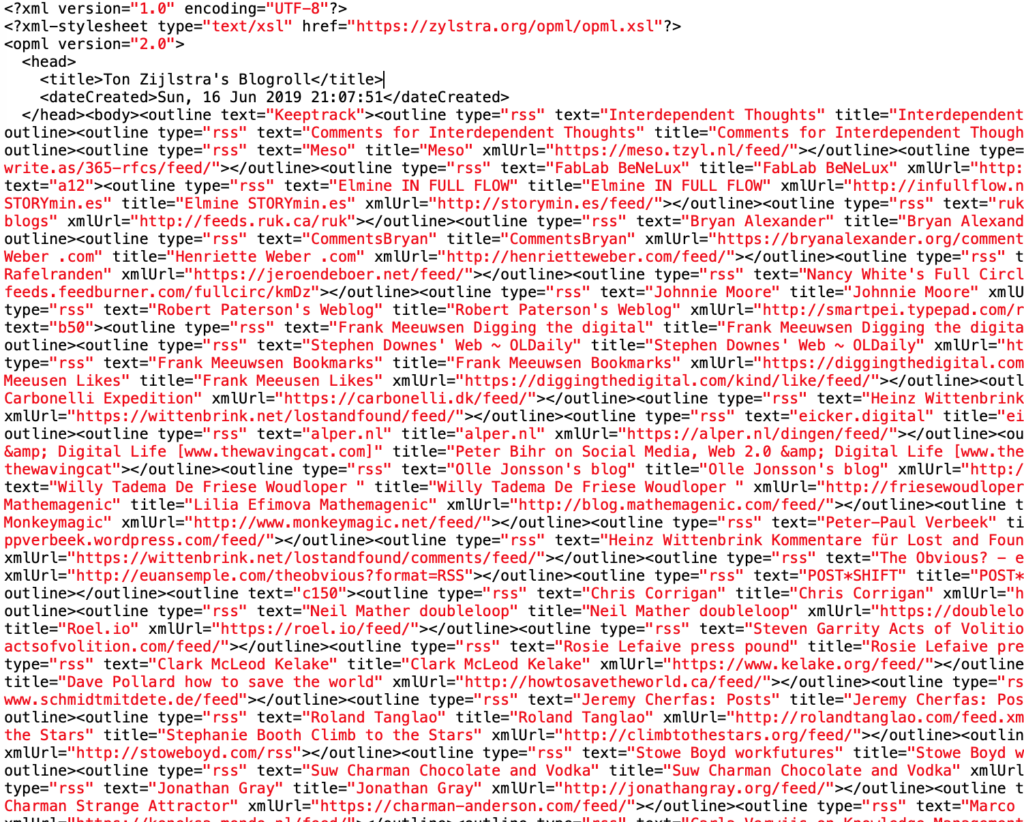 Machine readable presentation of my opml file
 Human readable presentation of the same opml file


 English