At IndieWeb Camp Nürnberg today I worked on changing the way my site displays webmentions. Like I wrote earlier, I would like for all webmentions to have a snippet of the linking article, so you get some context to decide if you want to go to that article or not.

It used to be that way in the past with pingbacks, but my webmentions get shown as “Peter mentioned this on ruk.ca”.

After hunting down where in my site this gets determined, I ended up in a file my Semantic Weblinks plugin, called class-linkbacks-handler.php. In this file I altered “get_comment_type_excerpts” function (which sets the template for a webmention), and the function “comment_text_excerpt”, where that template gets filled. I also altered the max length of webmentions that are shown in their entirety. My solution takes a snippet from the start of the webmention. I will later change it to taking a snippet from around the specific place where it links to my site. But at least I succeeded in changing this, and now know where to do that.

When the next update of this plugin takes place I will need to take care, as then my changes will get overwritten. But that too is less important for now.


The webmentions for this posting are now shown as a snippet from the source, below the sentence that was previously the only thing shown.

A great effect of spending a day in the same room with 20 or so more geeking inclined others, is you get a lot of examples, tools and services mentioned. And geek is as geek does, I try them out on the spot. Today this helped me become aware that something is wrong on my server with the OAuth authentication I run. I thought that it was working fine, as it is no problem to actually use it, for instance to log in with my own domain name at the IndieWeb wiki. But when interacting with my micropublishing endpoint not all goes well.

Today I noticed that:

  • When I try to post from Micropublish.net, I can log in at micropublish.net, but when I try to post I get an ‘unauthorized’ error
  • When I try to use the Omnibear Firefox add-on it authorises ok, but then endlessly tries to load the list of syndication targets
  • When I use Quill to post, it posts fine, but does not load the list of syndication targets

Those missing syndication targets (now that I understand what they are from todays sessions) was what first caught my eye. Testing the micropublish endpoint on my server myself I got the correct response, but Quill turned out to get ‘unauthorized’ as response for that request, just like micropublish.net got for posting.

The endpoint gives a correct response

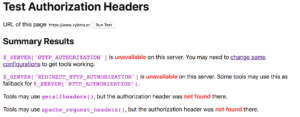
In WordPress my IndieAuth plugin has a diagnostic tool, and running that, it turns out an authorisation header is not send out.

Which seems to be causing the problems. Reading in the links provided it seems like with XML-RPC, my hoster is actively blocking that header. [UPDATE: It is not, it’s just not available in the way the server currently runs PHP] Resulting in exactly the same experience as I had with XML-RPC, that it seems to be only half working (namely the ‘safe’ uses work, while the rest fails). There’s a work around, renaming the headers that get send out, and implementing that work-around is a thing for me to do tomorrow. To see if I can get around being unauthorised. [UPDATE: That workaround did not work until now]

We’re in a time where whatever is presented to us as discourse on Facebook, Twitter or any of the other platforms out there, may or may not come from humans, bots, or someone/a group with a specific agenda irrespective of what you say or respond. We’ve seen it at the political level, with outside influences on elections, we see it in things like gamer gate, and in critiques of the last Star Wars movie. It creates damage on a societal level, and it damages people individually. To quote Angela Watercutter, the author of the mentioned Star Wars article,

…it gets harder and harder to have an honest discussion […] when some of the speakers are just there to throw kerosene on a flame war. And when that happens, when it’s impossible to know which sentiments are real and what motivates the people sharing them, discourse crumbles. Every discussion […] could turn into a […] fight — if we let it.

Discourse disintegrates I think specifically when there’s no meaningful social context in which it takes place, nor social connections between speakers in that discourse. The effect not just stems from that you can’t/don’t really know who you’re conversing with, but I think more importantly from anyone on a general platform being able to bring themselves into the conversation, worse even force themselves into the conversation. Which is why you never should wade into newspaper comments, even though we all read them at times because watching discourse crumbling from the sidelines has a certain addictive quality. That this can happen is because participants themselves don’t control the setting of any conversation they are part of, and none of those conversations are limited to a specific (social) context.

Unlike in your living room, over drinks in a pub, or at a party with friends of friends of friends. There you know someone. Or if you don’t, you know them in that setting, you know their behaviour at that event thus far. All have skin in the game as well misbehaviour has immediate social consequences. Social connectedness is a necessary context for discourse, either stemming from personal connections, or from the setting of the place/event it takes place in. Online discourse often lacks both, discourse crumbles, entropy ensues. Without consequence for those causing the crumbling. Which makes it fascinating when missing social context is retroactively restored, outing the misbehaving parties, such as the book I once bought by Tinkebell where she matches death threats she received against the sender’s very normal Facebook profiles.

Two elements therefore are needed I find, one in terms of determining who can be part of which discourse, and two in terms of control over the context of that discourse. They are point 2 and point 6 in my manifesto on networked agency.

  • Our platforms need to mimick human networks much more closely : our networks are never ‘all in one mix’ but a tapestry of overlapping and distinct groups and contexts. Yet centralised platforms put us all in the same space.
  • Our platforms also need to be ‘smaller’ than the group using it, meaning a group can deploy, alter, maintain, administrate a platform for their specific context. Of course you can still be a troll in such a setting, but you can no longer be one without a cost, as your peers can all act themselves and collectively.
  • This is unlike on e.g. FB where the cost of defending against trollish behaviour by design takes more effort than being a troll, and never carries a cost for the troll. There must, in short, be a finite social distance between speakers for discourse to be possible. Platforms that dilute that, or allow for infinite social distance, is where discourse can crumble.

    This points to federation (a platform within control of a specific group, interconnected with other groups doing the same), and decentralisation (individuals running a platform for one, and interconnecting them). Doug Belshaw recently wrote in a post titled ‘Time to ignore and withdraw?‘ about how he first saw individuals running their own Mastodon instance as quirky and weird. Until he read a blogpost of Laura Kalbag where she writes about why you should run Mastodon yourself if possible:

    Everything I post is under my control on my server. I can guarantee that my Mastodon instance won’t start profiling me, or posting ads, or inviting Nazis to tea, because I am the boss of my instance. I have access to all my content for all time, and only my web host or Internet Service Provider can block my access (as with any self-hosted site.) And all blocking and filtering rules are under my control—you can block and filter what you want as an individual on another person’s instance, but you have no say in who/what they block and filter for the whole instance.

    Similarly I recently wrote,

    The logical end point of the distributed web and federated services is running your own individual instance. Much as in the way I run my own blog, I want my own Mastodon instance.

    I also do see a place for federation, where a group of people from a single context run an instance of a platform. A group of neighbours, a sports team, a project team, some other association, but always settings where damaging behaviour carries a cost because social distance is finite and context defined, even if temporary or emergent.

    During his keynote at the Partos Innovation Festival Kenyan designer Mark Kamau mentioned that “45% of Kenya’s GDP was mobile.” That is an impressive statistic, so I wondered if I could verify it. With some public and open data, it was easy to follow up.

    World Bank data pegs Kenya’s GDP in 2016 at some 72 billion USD.
    Kenya’s central bank publishes monthly figures on the volume of transactions through mobile, and for September 2018 it reports 327 billion KSh, while the lowest monthly figure is February at 300 billion. With 100 Ksh being equivalent to 1 USD, this means the monthly transaction volume exceeds 3 billion USD every month. For a year this means 3*12=36 billion USD, or about half of the 2016 GDP figure. An amazing volume.


    It was a beautiful day in Amsterdam, while I walked to the venue through the eastern harbour area

    Today I was in Amsterdam, participating in the Partos Innovation Festival, a yearly meet-up of those working on change and innovation in development and humanitarian aid. It was a much larger gathering than I had expected, and through the day I encountered a wide variety of projects and ideas. It was clear I normally operate in different environments, as some of the projects were making (technology) choices that wouldn’t have been made elsewhere. Clearly all of us work within the constraints of the capabilities, experience and knowledge available to us in our networks and sectors. The day started with two worthwile keynotes, one by Kenyan designer Mark Kamau, one by human rights lawyer Tulika Srivastava from India.

    The reason I attended was that I was a jury member for one of 5 innovation awards presented today, the Dutch Humanitarian Coalition for Innovation’s “Best Humanitarian Innovation Award”. Together with Klaas Hernamdt, we go back a long time in the FabLabs network, and Suzanne Laszlo, general director of UNICEF Netherlands, we had the pleasure to judge a short list of 8 projects, from which we already selected 3 nominees two weeks ago. Today the winner was announced: Optimus, that through data analysis and optimisation models, helps the WFP to save millions of dollars while distributing food of the same nutritional value to those most in need. This allowed the WFP in trial runs to feed 100.000 people more against the same costs. This is crucial as food aid is continuously struggling with getting enough funding.

    While Optimus were deserved winners I must say the other two finalists came close. Of the overall 40 points they could get in our judging method, all three ended up within 2.5 points of each other, while the other 5 nominees fell further behind. Personally I liked Translators Without Borders very much as well, who ended up in second place. I also had the pleasure of meeting Animesh Prakash of Oxfam India, who with a cheap and distributed early flood warning system came third, twice in the past week. It seems to me his effort might benefit from building closer ties to the maker community in India, and I will try and assist him doing that.


    Klaas handing the award to the winners of the Optimus project, with the day’s moderator Marina Diboma

    In just over a week I will be joining the Nuremberg IndieWebCamp, together with Frank Meeuwsen. As I said earlier, like Frank, I’m wondering what I could be working on, talking about, or sharing at the event. Especially as the event is set up to not just talk but also build things.

    So I went through my blogpostings of the past months that concerned the indie web, and made a list of potential things. They are of varying feasibility and scope, so I can probably strike off quite a few, and should likely go for the most simple one, which could also be re-used as building block for some of the less easy options. The list contains 13 things (does that have a name, a collection of 13 things, like ‘odd dozen’ or something? Yes it does: a baker’s dozen, see comment by Ric below.). They fall into a few categories: webmention related, rss reader related, more conceptual issues, and hardware/software combinations.

    1. Getting WebMention to display the way I want, within the Sempress theme I’m using here. The creator of the theme, Matthias Pfefferle, may be present at the event. Specifically I want to get some proper quotes displayed underneath my postings, and also understand much better what webmention data is stored and where, and how to manipulate it.
    2. Building a growing list of IndieWeb sites by harvesting successful webmentions from my server logs, and publish that in a re-usable (micro-)format (so that you could slowly map the Indieweb over time)
    3. Make it much easier for myself to blog from mobile, or mail to my blog, using the MicroPub protocol, e.g. using the micropublish client.
    4. Dive into the TinyTinyRSS datastructure to better understand. First to be able to add tags to feeds (not articles), as per my wishlist for RSS reader functionality.
    5. Make basic visualisation possible on top of TinyTinyRSS database, as a step to a reading mode based on pattern detection
    6. Allow better search across TinyTinyRSS, full text, to support the reading mode of searching material around specific questions I hold
    7. Adding machine translation to TinyTinyRSS, so I can diversify my reading, and compare original to its translation on a post by post basis
    8. Visualising conversations across blogs, both for understanding the network dynamics involved and for discovery
    9. Digging up my old postings 2003-2005 about my information strategies and re-formulate them for networked agency and 2018
    10. Find a way of displaying content (not just postings, but parts of postings) limited to a specific audience, using IndieAuth.
    11. Formulate my Networked Agency principles, along the lines of the IndieWeb principles, for ‘indietech’ and ‘indiemethods’
    12. Attempt to run FreedomBone on a Raspberry Pi, as it contains a range of tools, including GnuSocial for social networking. (Don’t forget to bring a R Pi for it)
    13. Automatically harvest my Kindle highlights and notes and store them locally in a way I can re-use.

    These are the options. Now I need to pick something that is actually doable with my limited coding skills, yet also challenges me to learn/do something new.