Previously I had tried to get GNU Social running on my own hosted domain as a way to interact with Mastodon. I did not get it to work, for reasons unclear to me, I could follow people on Mastodon but would not receive messages, nor would they see mine.

This morning I saw the message below in my Mastodon timeline.

It originates from Peter Rukavina’s own GNU Social install. So at least he got the ‘sending mentions’ part working. He is also able to receive my replies, as my responses show up underneath his original message. Including ones I limited the visibility of it seems.

Now I am curious to compare notes. Which version of GNU Social? Any tweaks? Does Peter receive my timeline? How do permissions propagate (I only let people follow me after I approve them)? And more. I notice that his URL structures are different from those in my GNU Social install for instance.

I was a bit surprised to see a Dutch title above one of Peter’s blog posts. It referred to the blog of Marco Derksen, that I follow. I think Peter may have found it in the list of blogs I follow (in OPML) that I publish.

Peter read it through machine translation. Reading the posting made me realise I only follow blogs in the languages I can read, but that that is limiting my awareness of what others across Europe and beyond blog about.

So I think I need to extend my existing list of demands for an RSS reader with built-in machine translation. As both Tiny Tiny RSS which I self host and Google translate have API’s that should be possible to turn into a script.

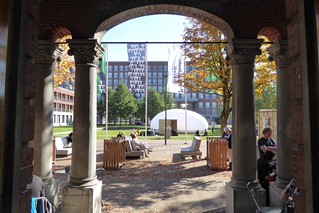
We spent a lovely day in sunny Breda today at the BredaPhoto Festival, titled To Infinity and Beyond. The weather was perfect and we had lunch outside even.

Some images.

BredaPhoto BredaPhoto
Walking through Breda

BredaPhoto BredaPhoto
Work by Kenta Cobayashi (festival page)

BredaPhoto
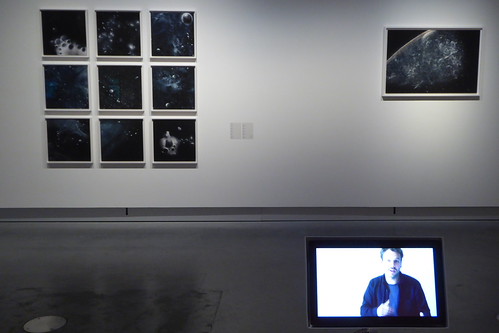
The artist and someone else’s work. (video interview with Jeroen Bocken, work on the wall by Maija Tammi

BredaPhoto
BredaPhoto
BredaPhoto
Three data visualisations photographed by Jos Jansen: Criminal relationship network (University of Amsterdam), Lidar images of trees (University of Amsterdam), Probability function of the Higgs Boson (NIKHEF).

BredaPhoto
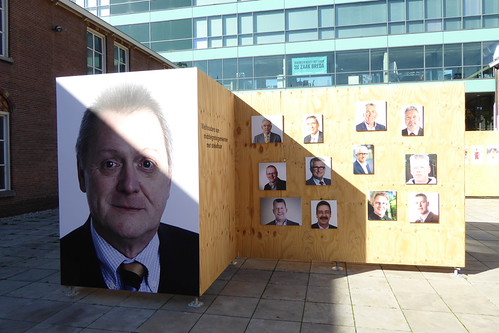
Pictures of Aldermen of medium sized cities, with grey buzz cuts…Jan Dirk van der Burg serialises photos found online into weird patterns and categories.

BredaPhoto
Image deemed controversial by Iran’s ministry for culture. From the Qajar series by Shadi Ghadirian

BredaPhoto BredaPhotoAntony Cairns, IBM CTY1, city photos on IBM punch cards.

BredaPhoto
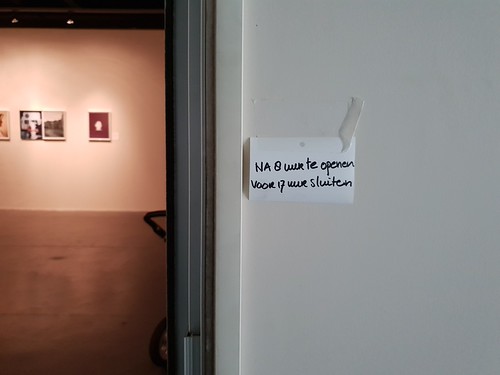
Open after 8:00, close before 17:00. Note on a door at Breda city archive.

BredaPhoto
Empty lunch cafe in Breda city center, as everyone was outside enjoying the sun.

We had a good day, but I found the photo festival lacking cohesion and a narrative, binding it all into the theme To Infinity and Beyond.

As I didn’t succeed yet in getting Mastodon to run on a Raspberry Pi, nor in running a Gnu Social instance that actually federates on my hosting package, I’ve opted for an intermediate solution to running my own Mastodon instance.

Key in all this is satisfying three dimensions: control, flexibility and ease of use. My earlier attempts satisfy the control and flexibility dimensions, but as I have a hard time getting them to work, do not satisfy the ease of use dimension yet.

At the same time I did not want to keep using Mastodon on a generic server much longer, as it builds up a history there which with every conversation ups the cost of leaving.

The logical end point of the distributed web and federated services is running your own individual instance. Much as in the way I run my own blog, I want my own Mastodon instance.

Such an individual instance needs to be within my own scope of control. This means having it at a domain I own. and being able to move everything to a different server at will.

There is a hoster, Masto.host run by Hugo Gameiro, who provides Mastodon hosting as a monthly subscription. As it allows me to use my own domain name, and provides me with admin privileges of the mastodon instance, this is a workable solution. When I succeed in getting my own instance of Mastodon running on the Rapsberry Pi, I can simply move the entire instance at Masto.host to it.

Working with Hugo at Masto.host was straightforward. After registering for the service, Hugo got in touch with me to ensure the DNS settings on my own domain were correct, and briefly afterwards everything was up and running.
Frank Meeuwsen, who started using Masto.host last month, kindly wrote up a ‘moving your mastodon account’ guide in his blog (in Dutch). I followed (most) of that, to ensure a smooth transition.

Using Mastodon? Do follow me at https://m.tzyl.nl/@ton.

Screenshots of my old Mastodon.cloud account, and my new one on my own domain. And the goodbye and hello world messages from both.

Today I had a bit of time to try running Mastodon on Raspberry Pi again. Last week I got stuck as some of the mentioned dependencies in the Mastodon installation guide could not be installed. As the step where I got stuck deals with a different Linux version, I tried simply skipping to the next step.

From the linked guide the steps ubuntu dependencies, node.js repository, yarn repository did not work.
The step after that, for various other dependencies, works again (which includes yarn actually).
Then a few steps follow that need to be executed as the specific user for mastodon. Installing ruby and node.js works fine, and almost all steps to install ruby and node.js dependencies. The final 2 steps of the dependencies throw errors (bundle install and yarn install). As at least some parts of the bundle install command do get executed, but not all. These are the last two steps before actually getting into configuring the installation, so it feels like being nearly there.

I’d have to dive deeply into the logfiles to see what wasn’t installed and what is missing. Not sure if I will easily find time to do so, and if I would actually understand what the log files tell me. It is also unclear if there is a relationship with the three steps I have skipped earlier in the process as they didn’t work.

This Tuesday 2 October sees the annual event of the Dutch Coalition for Humanitarian Innovation. The coalition consists of government entities, knowledge institutions, academia, businesses, and humanitarian organisations in the Netherlands. Together they aim to develop and scale new solutions to increase impact and reduce costs of humanitarian action.

I was asked to join this year’s jury for DCHI’s innovation award. There is a jury award and a public award. For the jury award 8 projects were shortlisted, from which the jury has now selected 3 finalists that were announced last Friday. The public award winner will be selected from the same short list.
At the annual event of DCHI this Tuesday the public award winner will be announced, followed by closing remarks by the Minister of development cooperation mrs Sigrid Kaag, who is very well experienced when it comes to international development. The jury award will be presented to the winner on October 11th at the Partos innovation festival.

The three finalists my colleagues and I in the jury selected are all very interesting, so I briefly want to list them here.

Optimus by the UN’s World Food Program and Tilburg University
Data analysis and mathematical modeling optimises supply and distribution also by taking into account locally available food and conditions. Optimisation means delivering the same nutritional value against lower efforts. It has been successfully used in Syria, Iraq, Yemen and Ethiopia. In Iraq it helped save a million USD per month, allowing the program to provide an additional 100.000 people in need with food packages. (link in Dutch)

Quotidian early warning solutions by Oxfam India
Flood prediction models in India are accurate, but still flooding causes many fatalities. The cause is often not being able to timely reach and warn everyone. Oxfam India came up with ways to integrate early warning systems with existing local infrastructure, and so create a low cost option for real time distribution of flood warnings.

Words of Relief / Translators without borders
Being able to provide key information to people in need depends on having that information in the right language. Information only saves lives if those who need it understand it. Translators without Borders creates glossaries which can be used for humanitarian response. Their Gamayun initiative wants to bring 20 underserved languages online by creating such glossaries and providing that as open data to all who can use it. They see it as a key tool for equality as well. In a slightly different setting I saw this work in practice, during the Syrian refugee wave in Germany, at a hackathon I attended such glossaries were used to build apps to help refugees navigate German bureaucracy and find the help they needed.

These three projects are very different, in terms of technology used, in the issues they address, and the way they involve the communities concerned, and all three highly fascinating.