Saturday I visited the Maker Faire in Eindhoven. Jeroen of the Frysklab team invited me to come along, when their mobile FabLab was parked in our courtyard for Smart Stuff That Matters. They had arranged a touring car to take a group of librarians and educators to the Maker Faire, and invited me to join the bus ride. So I took a train to Apeldoorn and then a taxi out to a truck stop where the bus was scheduled to stop for a coffee break, and then joined them for the rest of the drive down south.

The Maker Faire was filled with all kinds of makers showing their projects, and there was a track with 30 minute slots for various talks.
It was fun to walk around, meet up with lots of people I know. Lots of projects shown seemed to lack a purpose beyond the initial fascination of technological possibilities however. There were many education oriented projects as well, and many kids happily trying their hand on them. From a networked agency point of view there were not that many projects that aimed for collective capabilities.

Some images, and a line or two of comment.

Makerfair Eindhoven
En-able, a network of volunteers printing 3d-printed prosthetics, was present. Talked to the volunteer in the image, with his steam-punk prosthetic device. They printed 18 hands and arm prosthetics for kids in the Netherlands last year, and 10 this year until now. Children need new prosthetics every 3 to 6 months, and 3d printing them saves a lot of costs and time. You even get to customise them with colors, and your favourite cartoon figure or super hero.

Makerfair Eindhoven Makerfair Eindhoven
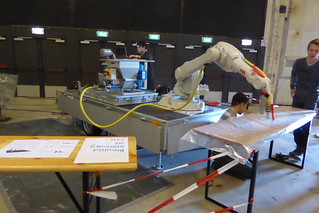
3d printing with concrete, a project in which our local FabLab Amersfoort is involved. Didn’t get to see the printer working alas.

Makerfair Eindhoven Makerfair Eindhoven Makerfair Eindhoven
Novelty 3d printing of portraits.

Makerfair Eindhoven Makerfair Eindhoven
Building your own electronic music devices.

Makerfair Eindhoven Makerfair Eindhoven
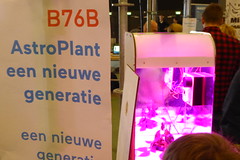
Bringing LED-farming to your home, open source. Astroplant is an educational citizen science project, supported by ESA.

Maker Faire Eindhoven Maker Faire Eindhoven
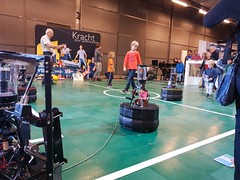
Robot football team versus kids team. Quite a few educational projects around robotics were shown. Mostly from a university of applied sciences, but with efforts now branching out to preceding education levels. Chatted to Ronald Scheer who’s deeply involved in this (and who participated in our Smart Stuff That Matters unconference).

Maker Faire Eindhoven Maker Faire Eindhoven
A good way to showcase a wide range of Microbit projects by school children. I can see this mounted on a class room wall.

Maker Faire Eindhoven Maker Faire Eindhoven
20180929_123913
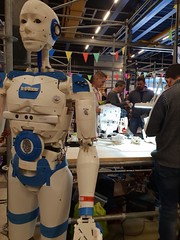
An open source 3d-printed, arduino controlled android. But what is it for? Open source robotics in general is of interest of course. There were also remote controlled robots, which were quite a lot of fun, as the video shows.

Maker Faire Eindhoven Maker Faire Eindhoven

20180929_134053

At the fringe of the event there was some steam punk going on.

Maker Faire Eindhoven Maker Faire Eindhoven
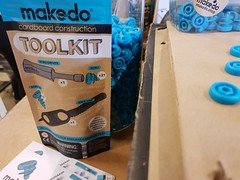
Building with card board boxes for children. Makedo is an Australian brand, and next to their kits, you can find additional tools and elements as 3d printable designs online.

Maker Faire Eindhoven
The Frysklab team presented the new Dutch language Data Detox kit, which they translated from the English version the Berlin based Tactical Tech Collective created.

For the UNDP in Serbia, I made an overview of existing studies into the impact of open data. I’ve done something similar for the Flemish government a few years ago, so I had a good list of studies to start from. I updated that first list with more recent publications, resulting in a list of 45 studies from the past 10 years. The UNDP also asked me to suggest a measurement framework. Here’s a summary overview of some of the things I formulated in the report. I’ll start with 10 things that make measuring impact hard, and in a later post zoom in on what makes measuring impact doable.

While it is tempting to ask for a ‘killer app’ or ‘the next tech giant’ as proof of impact of open data, establishing the socio-economic impact of open data cannot depend on that. Both because answering such a question is only possible with long term hindsight which doesn’t help make decisions in the here and now, as well as because it would ignore the diversity of types of impacts of varying sizes known to be possible with open data. Judging by the available studies and cases there are several issues that make any easy answers to the question of open data impact impossible.

1 Dealing with variety and aggregating small increments

There are different varieties of impact, in all shapes and sizes. If an individual stakeholder, such as a citizen, does a very small thing based on open data, like making a different decision on some day, how do we express that value? Can it be expressed at all? E.g. in the Netherlands the open data based rain radar is used daily by most cyclists, to see if they can get to the rail way station dry, better wait ten minutes, or rather take the car. The impact of a decision to cycle can mean lower individual costs (no car usage), personal health benefits, economic benefits (lower traffic congestion) environmental benefits (lower emissions) etc., but is nearly impossible to quantify meaningfully in itself as a single act. Only where such decisions are stimulated, e.g. by providing open data that allows much smarter, multi-modal, route planning, aggregate effects may become visible, such as reduction of traffic congestion hours in a year, general health benefits of the population, reduction of traffic fatalities, which can be much better expressed in a monetary value to the economy.

2 Spotting new entrants, and tracking SME’s

The existing research shows that previously inactive stakeholders, and small to medium sized enterprises are better positioned to create benefits with open data. Smaller absolute improvements are of bigger value to them relatively, compared to e.g. larger corporations. Such large corporations usually overcome data access barriers with their size and capital. To them open data may even mean creating new competitive vulnerabilities at the lower end of their markets. (As a result larger corporations are more likely to say they have no problem with paying for data, as that protects market incumbents with the price of data as a barrier to entry.) This also means that establishing impacts requires simultaneously mapping new emerging stakeholders and aggregating that range of smaller impacts, which both can be hard to do (see point 1).

3 Network effects are costly to track

The research shows the presence of network effects, meaning that the impact of open data is not contained or even mostly specific to the first order of re-use of that data. Causal effects as well as second and higher order forms of re-use regularly occur and quickly become, certainly in aggregate, much higher than the value of the original form of re-use. For instance the European Space Agency (ESA) commissioned my company for a study into the impact of open satellite data for ice breakers in the Gulf of Bothnia. The direct impact for ice breakers is saving costs on helicopters and fuel, as the satellite data makes determining where the ice is thinnest much easier. But the aggregate value of the consequences of that is much higher: it creates a much higher predictability of ships and the (food)products they carry arriving in Finnish harbours, which means lower stocks are needed to ensure supply of these goods. This reverberates across the entire supply chain, saving costs in logistics and allowing lower retail prices across Finland. When 
mapping such higher order and network effects, every step further down the chain of causality shows that while the bandwidth of value created increases, at the same time the certainty that open data is the primary contributing factor decreases. Such studies also are time consuming and costly. It is often unlikely and unrealistic to expect data holders to go through such lengths to establish impact. The mentioned ESA example, is part of a series of over 20 such case studies ESA commissioned over the course of 5 years, at considerable cost for instance.

4 Comparison needs context

Without context, of a specific domain or a specific issue, it is hard to asses benefits, and compare their associated costs, which is often the underlying question concerning the impact of open data: does it weigh up against the costs of open data efforts? Even though in general open data efforts shouldn’t be costly, how does some type of open data benefit compare to the costs and benefits of other actions? Such comparisons can be made in a specific context (e.g. comparing the cost and benefit of open data for route planning with other measures to fight traffic congestion, such as increasing the number of lanes on a motor way, or increasing the availability of public transport).

5 Open data maturity determines impact and type of measurement possible

Because open data provisioning is a prerequisite for it having any impact, the availability of data and the maturity of open data efforts determine not only how much impact can be expected, but also determine what can be measured (mature impact might be measured as impact on e.g. traffic congestion hours in a year, but early impact might be measured in how the number of re-users of a data set is still steadily growing year over year)

6 Demand side maturity determines impact and type of measurement possible

Whether open data creates much impact is not only dependent on the availability of open data and the maturity of the supply-side, even if it is as mentioned a prerequisite. Impact, judging by the existing research, is certain to emerge, but the size and timing of such impact depends on a wide range of other factors on the demand-side as well, including things as the skills and capabilities of stakeholders, time to market, location and timing. An idea for open data re-use that may find no traction in France because the initiators can’t bring it to fruition, or because the potential French demand is too low, may well find its way to success in Bulgaria or Spain, because local circumstances and markets differ. In the Serbian national open data readiness assessment performed by me for the World Bank and the UNDP in 2015 this is reflected in the various dimensions assessed, that cover both supply and demand, as well as general aspects of Serbian infrastructure and society.

7 We don’t understand how infrastructure creates impact

The notion of broad open data provision as public infrastructure (such as the UK, Netherlands, Denmark and Belgium are already doing, and Switzerland is starting to do) further underlines the difficulty of establishing the general impact of open data on e.g. growth. The point that infrastructure (such as roads, telecoms, electricity) is important to growth is broadly acknowledged, with the corresponding acceptance of that within policy making. This acceptance of quantity and quality of infrastructure increasing human and physical capital however does not mean that it is clear how much what type of infrastructure contributes at what time to economic production and growth. Public capital is often used as a proxy to ascertain the impact of infrastructure on growth. Consensus is that there is a positive elasticity, meaning that an increase in public capital results in an increase in GDP, averaging at around 0.08, but varying across studies and types of infrastructure. Assuming such positive elasticity extends to open data provision as infrastructure (and we have very good reasons to do so), it will result in GDP growth, but without a clear view overall as to how much.

8 E pur si muove

Most measurements concerning open data impact need to be understood as proxies. They are not measuring how open data is creating impact directly, but from measuring a certain movement it can be surmised that something is doing the moving. Where opening data can be assumed to be doing the moving, and where opening data was a deliberate effort to create such movement, impact can then be assessed. We may not be able to easily see it, but still it moves.

9 Motives often shape measurements

Apart from the difficulty of measuring impact and the effort involved in doing so, there is also the question of why such impact assessments are needed. Is an impact assessment needed to create support for ongoing open data efforts, or to make existing efforts sustainable? Is an impact measurement needed for comparison with specific costs for a specific data holder? Is it to be used for evaluation of open data policies in general? In other words, in whose perception should an impact measurement be meaningful?
The purpose of impact assessments for open data further determines and/or limits the way such assessments can be shaped.

10 Measurements get gamed, become targets

Finally, with any type of measurement, there needs to be awareness that those with a stake of interest into a measurement are likely to try and game the system. Especially so where measurements determine funding for further projects, or the continuation of an effort. This must lead to caution when determining indicators. Measurements easily become a target in themselves. For instance in the early days of national open data portals being launched worldwide, a simple metric often reported was the number of datasets a portal contained. This is an example of a ‘point’ measurement that can be easily gamed for instance by subdividing a dataset into several subsets. The first version of the national portal of a major EU member did precisely that and boasted several hundred thousand data sets at launch, which were mostly small subsets of a bigger whole. It briefly made for good headlines, but did not make for impact.

In a second part I will take a closer look at what these 10 points mean for designing a measurement framework to track open data impact.

This week I am in Novi Sad for the plenary of the Assembly of European Regions. Novi Sad is the capitol of the Vojvodina, a member region, and the host for the plenary meetings of the AER.

I took part in a panel to discuss the opportunities of open data at regional level. The other panelists were my Serbian UNDP colleague Slobodan Markovic, Brigitte Lutz of the Vienna open data portal (whom I hadn’t met in years), Margreet Nieuwenhuis of the European open data portal, and Geert-Jan Waasdorp who uses open data about the European labour market commercially.

Below are the notes I used for my panel contributions:

Open data is a key building block for any policy plan. The Serbian government certainly treats it as such, judging by the PM’s message we just heard, and the same should be true for regional governments.

Open data from an organisational stand point is only sustainable if it is directly connected to primary policy processes, and not just an additional step or effort after the ‘real’ work has been done. It’s only sustainable if it means something for your own work as regional administration.

We know that open data allows people and organisations to take new actions. These by themselves or in aggregate have impact on policy domains. E.g. parents choosing schools for their children or finding housing, multimodal route planning, etc.

So if you know this effect exists, you can use it on purpose. Publish data to enable external stakeholders. You need to ask yourself: around which policy issues do you want to enable more activity? Which stakeholders do you want to enable or nudge? Which data will be helpful for that, if put into the hands of those stakeholders?

This makes open data a policy instrument. Next to funding and regulation, publishing open data for others to use is a way to influence stakeholder behaviour. By enabling them and partnering with them.
It is actually your cheapest policy instrument, as the cost of data collection is always a sunk cost as part of your public task

Positioning open data this way, as a policy instrument, requires building connections between your policy issues, external stakeholders and their issues, and the data relevant in that context.

This requires going outside and listen to stakeholders and understand the issues they want to solve, the things they care about. You need to avoid making any assumptions.

We worked with various regional governments in the Netherlands, including the two Dutch AER members Flevoland and Gelderland. With them we learned that having those outside conversations is maybe the hardest part. To create conversations between a policy domain expert, an internal data expert, and the external stakeholders. There’s often a certain apprehension to reach out like that and have an open ended conversation on equal footing. From those conversations you learn different things. That your counterparts are also professionals interested in achieving results and using the available data responsibly. That the ways in which others have shaped their routines and processes are usually invisible to you, and may be surprising to you.
In Flevoland there’s a program for large scale maintenance on bridges and water locks in the coming 4 years. One of the provincial aims was to reduce hindrance. But an open question was what constitutes hindrance to different stakeholders. Only by talking to e.g. farmers it became clear that the maintenance plans themselves were less relevant than changes in those plans: a farmer rents equipment a week before some work needs to be done on the fields. If within that week a bridge unexpectedly becomes blocked, it means he can’t reach his fields with the rented equipment and damage is done. Also relevant is exploring which channels are useful to stakeholders for data dissemination. Finding channels that are used already by stakeholders or channels that connect to those is key. You can’t assume people will use whatever special channel you may think of building.

Whether it is about bridge maintenance, archeology, nitrate deposition, better usage of Interreg subsidies, or flash flooding after rain fall, talking about open data in terms of innovation and job creation is hollow and meaningless if it is not connected to one of those real issues. Only real issues motivate action.

Complex issues rarely have simple solutions. That is true for mobility, energy transition, demographic pressure on public services, emission reduction, and everything else regional governments are dealing with. None of this can be fixed by an administration on its own. So you benefit from enabling others to do their part. This includes local governments as stakeholder group. Your own public sector data is one of the easiest available enables in your arsenal.

In the past few days I tried a second experiment to run my own Mastodon instance. Both to actually get a result, but also to learn how easy or hard it is to do. The first round I tried running something on a hosted domain. This second round I tried to get something running on a Raspberry Pi.

The Rapsberry Pi is a 35 Euro computer, making it very useful for stand-alone solutions or as a cheap hardware environment to learn things like programming.

Installing Debian Linux on the Rapsberry Pi

I found this guide by Wim Vanderbauwhede, which describes installing both Mastodon and Pleroma on a Raspberry Pi 3. I ordered a Raspberry Pi 3 and received it earlier this week. Wim’s guide points to another guide by on how to install Ruby on Rails and PostgresSQL on a Rapsberry Pi. The link however was dead, and that website offline. However archive.org had stored several snapshots, which I save to Evernote.

Installing Ruby on Rails went fine using the guide, as did installing PostgresSQL. Then I returned to Wim’s guide, now pointing to the Mastodon installation guide. This is where the process currently fails for me: I can’t extend the Ubuntu repositories mentioned, nor node.js.

So for now I’m stalled. I’ll try to get back to it later next week.

Last week the 2nd annual Techfestival took place in Copenhagen. As part of this there was a 48 hour think tank of 150 people (the ‘Copenhagen 150‘), looking to build the Copenhagen Catalogue, as a follow-up of last year’s Copenhagen Letter of which I am a signee. Thomas, initiator of the Techfestival had invited me to join the CPH150 but I had to decline the invitation, because of previous commitments I could not reschedule. I’d have loved to contribute however, as the event’s and even more the think tank’s concerns are right at the heart of my own. My concept of networked agency and the way I think about how we should shape technology to empower people in different ways runs in parallel to how Thomas described the purpose of the CPH150 48 hour think tank at its start last week.

For me the unit of agency is the individual and a group of meaningful relationships in a specific context, a networked agency. The power to act towards meaningful results and change lies in that group, not in the individual. The technology and methods that such a group deploys need to be chosen deliberately. And those tools need to be fully within scope of the group itself. To control, alter, extend, tinker, maintain, share etc. Such tools therefore need very low adoption thresholds. Tools also need to be useful on their own, but great when federated with other instances of those tools. So that knowledge and information, learning and experimentation can flow freely, yet still can take place locally in the (temporary) absence of such wider (global) connections. Our current internet silos such as Facebook and Twitter clearly do not match this description. But most other technologies aren’t shaped along those lines either.

As Heinz remarked earlier musing about our unconference, effective practices cannot be separated from the relationships in which you live. I added that the tools (both technology and methods) likewise cannot be meaningfully separated from the practices. Just like in the relationships you cannot fully separate between the hyperlocal, the local, regional and global, due to the many interdependencies and complexity involved: what you do has wider impact, what others do and global issues express themselves in your local context too.

So the CPH150 think tank effort to create a list of principles that takes a human and her relationships as the starting point to think about how to design tools, how to create structures, institutions, networks fits right with that.

Our friend Lee Bryant has a good description of how he perceived the CPH150 think tank, and what he shared there. Read the whole thing.

Meanwhile the results are up: 150 principles called the Copenhagen Catalogue, beautifully presented. You can become signatory to those principles you deem most valuable to stick to.

Heinz Wittenbrink, who teaches content strategy at the FH Joanneum in Graz, reflected extensively on his participation in our recent Smart Stuff That Matters unconference.
We go back since 2006 (although I think we read each others blog before), when we first met at a BarCamp in Vienna. Later Heinz kindly invited me to Graz at several occasions such as the 2008 Politcamp (a barcamp on web 2.0 and political communication), and the 2012 annual conference of the Austrian association for trainers in basic education for adults.

He writes in German, and his blogpost contains a lot to unpack (also as it weaves the history of our interaction into his observations), so I thought I’d highlight and translate some quotes here. This as I find it rather compelling to read how someone, who’s been involved in and thinking about online interaction for a long time, views the event we did in the context of his and my work. And that some of what I’m trying to convey as fundamental to thinking about tools and interaction is actually coming across to others. Even if I feel that I’ve not yet hit on the most compelling way to formulate my ideas.

Heinz starts with saying he sees my approach as a very practice oriented one.
“Ton engages on a very practical level with the possibilities of combining the personal and personal relationships with the wider contexts in which one lives, from the local community to global developments. He has a technical, pragmatic and practice oriented approach. Also he can explain to others who are not part of a digital avantgarde what he does.”

And then places the birthday unconferences we did in that context, as an extension of that practice oriented approach. Something I realise I didn’t fully do myself.

“The unconference of last week is an example of how one can do things from a highly personal motivation – like meeting friends, talking about topics you’re interested in, conversing about how you shape your new daily routines after a move – and make it easy for others to connect to that. What you find or develop you don’t keep for yourself, but is made useful for others, and in turn builds on what those others do. So it’s not about developing an overarching moral claim in a small context , but about shaping and networking one’s personal life in such a way that you collectively expand your capabilities to act. Ton speaks of networked agency. Digital networking is a component of these capabilities to act, but only embedded in networks that combine people, as well as locations and technical objects.”

Speaking about the unconference he says something that really jumps out at me.

To list the themes [….of the sessions I attended…] fails to express what was special about the unconference: that you meet people or meet them again, for whom these themes are personal themes, so that they are actually talking about their lives when they talk about them. At an unconference like this one does not try to create results that can be broadcast in abstracted formulations, but through learning about different practices and discussing them, extend your own living practice and view it from new perspectives. These practices or ways of living cannot be separated from the relationships in which and with which you live, and the relationships you create or change at such an event like this.

Seeing it worded like that, that the topics we discussed, theorised about, experimented around, are very much personal topics, and in the context of personal relationships, hits me as very true. I hadn’t worded it in quite that way myself yet. This is however exactly why to me digital networks and human networks are so similar and overlapping, and why I see your immediate context of an issue, you and your meaningful relationships as the key unit of agency. That’s why you can’t separate how you act from your relationships. And why the layeredness of household, neighbourhood, city, earth is interwoven by default, just often not taken into account, especially not in the design phase of technology and projects.

Heinz then talks about blogging, and our earlier silent assumptions that novel technology would as per default create the right results. Frank’s phrasing and Heinz’s mention of the ‘original inspiration’ to blog resonate with me.

It’s probably not a coincidence that the people I had the most intensive conversations with have been blogging for a long time. They all stuck with the original inspiration to blog. Frank in his presentation called it “to publish your own unedited voice”. The openness but also the individuality expressed in this formulation was clearly visible in the entire unconference.

For me blogging was a way of thinking out loud, making a life long habit of note taking more public. The result was a huge growth in my professional peer network, and I found that learning in this networked manner accelerated enormously. Even if my imagined audience when I write is just 4 or 5 of people, and I started blogging as a personal archive/reflection tool, I kept doing it because of the relationships it helped create.

Continuing on about the early techno-optimism Heinz says about the unconference

The atmosphere at the unconference was very different. Of the certainties of the years shortly after 2000 nothing much remains. The impulses behind the fascination of yesteryear do remain however. It’s not about, or even less about technology as it was then, it’s about smart actions in themselves, and life under current conditions. It’s about challenging what is presented as unavoidable more than producing unavoidability yourself.

Only slowly I understand that technologies are much deeper embedded in social practices and can’t be separated from them. Back then I took over Ton’s concept of ‘people centered navigation’. Through the event last week it became clearer to me what this concept means: not just a ‘right’ efficient way to use tools, but a practice that for specific needs deliberately selects tools and in doing so adapts them.

People centered navigation is not a component of better more efficient mass media, but navigating information in reference to needs and capabilities of people in localised networks. Where above all the production of media and content in dialogue with a limited number of others is relevant, not its reception by the masses. Network literacies are capabilities to productively contribute to these localised networks.

Just like practice is inseparable from our relationships, our tools are inseparable from our practices. In networked agency, the selection of tools (both technology and methods) is fully determined by the context of the issue at hand and the group of relationships doing it. As I tried to convey in 2010 in my Maker Households keynote at SHiFT and indeed at the earlier mentioned keynote I gave at Heinz’s university on basic literacy in adult learning, networked literacies are tied to your personal networks. And he’s right, the original fascination is as strong as before.

Heinz finishes with adding the work of Latour to my reading list, by his last remark.

“The attempt to shape your local surroundings intelligently and to consider how you can connect them in various dimensions of networks, reminds me of the localised politics in fragile networks that Bruno Latour describes in his terrestrial manifest as an alternative to the utopies and dystopies of globalisation and closed national societies. Latour describes earth as a thin layer where one can live, because one creates the right connections and maintains them. The unconference was an experiment to discover and develop such connections.”

Thank you Heinz for your reflection, I’m glad you participated in this edition.