In reply to a post by Frank Meeuwsen

Well, yes, some of that social ‘cost of leaving’ plays a role. Yet:

It’s part of my company’s journey to better information security and data protection. Leaving silo’s, and Slack is just as much one as is Facebook, although with a different business model, is part of that. Similarly we’re starting to use our own cloud, in order to not use Google docs, Onedrive and the like. Our clients have different (and contradictory) rules against some of those silos, and we want to offer our own environment in which we can collaborate with clients as well. So our cloud and our Slack replacement run on our own server in a Dutch data center. This makes it easier to show GDPR compliance as well.

Within the company I’m the only heavy Slack user, taking part in about half a dozen Slack spaces. Still 90% of my Slack interaction is within my company.

Importing our Slack history into Rocket.chat, as well as that the URL of our Rocket.chat space is called Slack, help make a soft landing. Similarly Rocket.chat’s interface is similar to Slack’s.

Our cloud integrates well with Rocket, better than with Slack.

For mobile having another app on it is hardly an issue, given we all have half a dozen chat apps on it already.
For desktop it will be less automatic to make the switch, but adding Rocketchat to the dock will help.

So, there will be an adaption cost, but I’m optimistic it will be low, given our starting point. Over time I’ll reflect on how it went.


Screenshot of Rocketchat with previous Slack historty loaded

Hey Ton, ik heb al meer goeds gehoord over Rocketchat als vervanger van Slack. Wat me bij deze diensten toch erg interesseert is de kosten van overstap voor de overige gebruikers. Met name de mentale overstap. Ik kan me voorstellen dat je huidige conversatiepartners in Slack zelf ook meer Slack-koppelingen hebben.

Frank Meeuwsen

The Netherlands has the lushest and tastiest grass in the world according to discerning geese, and millions flock to Dutch fields because of it. Farmers rather use the grass for their dairy cows, and don’t like the damage the geese cause to their fields. To reduce damage geese are scared away, their nests spiked, and hunted. Each year some 80.000 geese are shot in the Province South-Holland alone. The issue is that the Dutch don’t eat much wild goose, and hunters don’t like to hunt if they know the game won’t be eaten. The role of the provincial government in the case of these geese is that they compensate farmers for damage to their fields.


“All your base belong to us…”, Canada geese in a Dutch field (photo Jac Janssen, CC-BY)

In our open data work with the Province South-Holland we’re looking for opportunities where data can be used to increase the agency of both the province itself and external stakeholders. Part of that is talking to those stakeholders to better understand their work, the things they struggle with, and how that relates to the policy aims of the province.

So a few days ago, my colleague Rik and I met up on a farm outside Leiden, in the midst of those grass fields that the geese love, with several hunters, a civil servant, and the CEO of Hollands Wild that sells game meat to both restaurants and retail. We discussed the particular issues of hunting geese (and inspected some recently shot ones), the effort of dressing game, and the difficulties of cultivating demand for geese. Although a goose fetches a hunter just 25 cents, butchering geese is very intensive and not automated, which means that consumable meat is very expensive. Too expensive for low end use (e.g. in pet food), and even for high end use where it needs to compete with much more popular types of game, such as hare, venison and wild duck. We tasted some marinated raw goose meat and goose carpaccio. Data isn’t needed to improve communication between stakeholders on the production side (unless there emerges a market for fresh game, in contrast to the current distribution of only frozen products), but might play a role in the distribution part of the supply chain.

Today with the little one I sought out a local shop that carries Hollands Wild’s products. I bought some goose meat, and tonight we enjoyed some cold smoked goose. One goose down, 79.999 to go.

Yesterday afternoon and evening we held an open house at our new The Green Land offices in a late 19th century former technical school building in the heart of Utrecht. It was a pleasant event with some 30 people attending, some good conversations with people I hadn’t met before, and an informal dinner party afterwards.


My colleague Frank saying a few words, with Utrecht’s 13th century cathedral tower in the background. Word is, you’re only truly in Utrecht, if you can see the tower from your windows

With the CPH Techfestival announced I just booked my early bird ticket for this year’s event in early September.
Having signed the Copenhagen Letter in 2017, and having had to miss participating in the Copenhagen 150 to draft the Copenhagen Catalogue last year, I will attend this year.

Subscribe to humans is this year’s tagline. In my information strategies and rss-reading tactics, I always have done just that: subscribe to people, not sources or blogs. I aim to contribute my networked agency work to the mix in September.

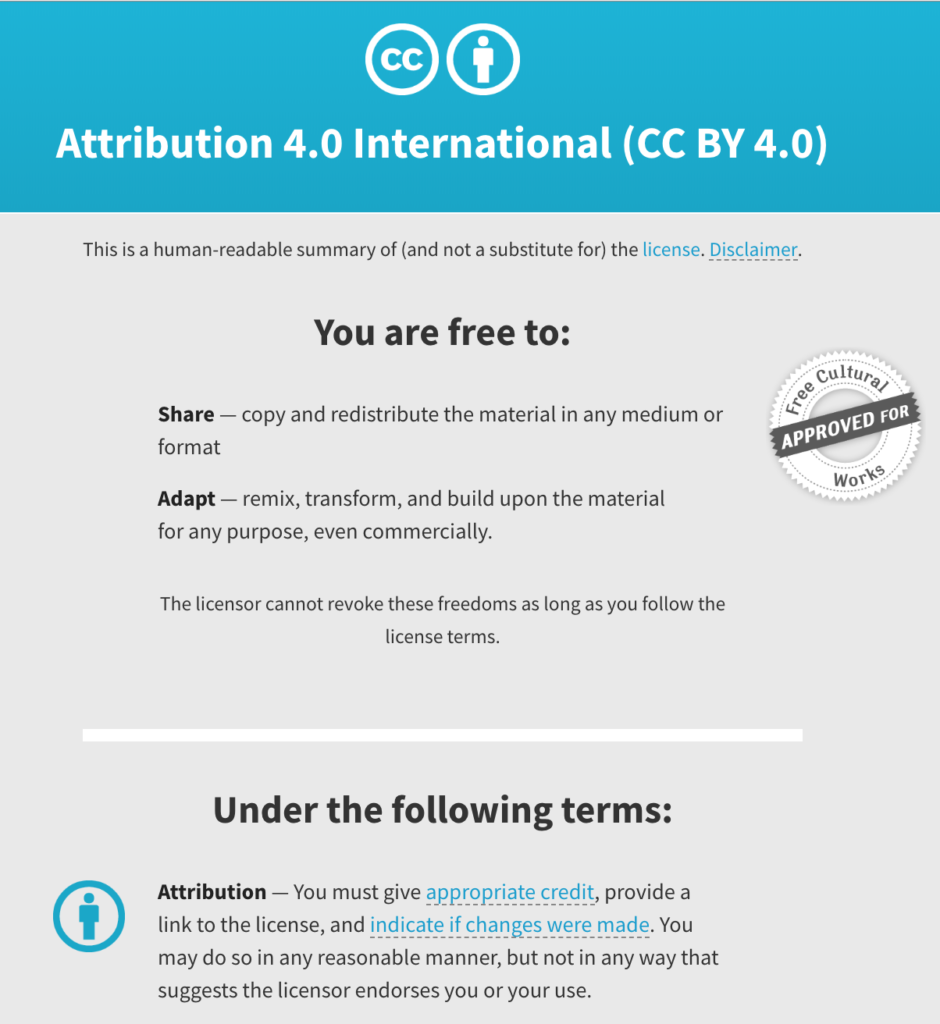
At the end of March the European Commission (EC) has announced it is adopting the Creative Commons By Attribution license as its standard license.

The CC-BY license will be used for videos and photos, studies published in peer-reviewed journals, data and visualisations on the EU open data portal and documents published on EU websites.

Re-use of EC material has been possible since 2006 (and rephrased in 2011), but in practice it wasn’t always clear to potential re-users what was allowed and what wasn’t.
While re-use and attribution is part of the EC’s copyright notice, it is likely re-users are discouraged by the copyright claim above it, and missing the permissions underneath it:


Current default copyright notice on EC websites, to be exchanged for a CC-BY license

In contrast adding the Creative Commons By Attribution license sends a clear message about permissions that are granted up-front without the need for a re-user to seek consent: any re-use is permitted, including commercial re-use, provided the EC is attributed as its source, and provided re-use forms or alterations don’t suggest they are endorsed by or coming from the EC.


The clarity that a Creative Commons license provides

(full disclosure: I am a board member of Open Nederland, the Dutch Creative Commons chapter)

Open Nederland heeft een eerste podcast geproduceerd. Sebastiaan ter Burg is de gastheer en Maarten Brinkerink deed de productie en muziek.

In de Open Nederland podcast komen mensen aan het woord komen die kennis en creativiteit delen om een eerlijke, toegankelijke en innovatieve wereld te bouwen. In deze eerste aflevering gaat het over open in verschillende domeinen, zoals open overheid en open onderwijs, en hoe deze op elkaar aansluiten.

De gasten in deze aflevering zijn:

  • Wilma Haan, algemeen directeur van de Open State Foundation,
  • Jan-Bart de Vreede, domeinmanager leermiddelen en metadata van Kennisnet en
  • Maarten Zeinstra van Vereniging Open Nederland en Chapter Lead van Creative Commons Nederland.

(full disclosure: ik ben zowel bestuurslid van Open Nederland als bestuursvoorzitter van Open State Foundation, waarvan CEO Wilma Haan in deze podcast deelneemt.)