Op 28 en 29 september vindt IndieWebCamp Amsterdam plaats. We hebben een locatie, maar die is nog niet helemaal rond. Maar rond genoeg om zeker te weten dat IndieWebCamp plaats gaat vinden!

Na IndieWebCamp Utrecht in mei, is dit de 2e IndieWebCamp in Nederland.
Zet het weekend van 28 en 29 september vast in je agenda, en zorg dat je er bij bent!

Neem het web in eigen hand! Het is de hoogste tijd te zorgen dat het web ons tot dienst is. Door meer van het web in eigen handen te nemen. Het onafhankelijk web (indieweb) is het oorspronkelijke web, waar jij bepaalt wat je deelt, wat zichtbaar is voor anderen, en waar jouw data van jou is omdat het op je eigen site staat.

IndieWebCamp Amsterdam heeft geen publiek, alleen deelnemers. Op de eerste dag kun je sessies voorstellen of aan sessies deelnemen over elk aspect van het onafhankelijk web dat je wilt. Op de tweede dag bouw je aan je eigen deelname of bijdrage aan het open web.

Jij bent iemand die een open web wil, al wel een eigen site heeft of nog niet, misschien ben je ook ontwerper of programmeur, ben je een denker of een doener. Jij bent degene die we zoeken om twee dagen met anderen om het onafhankelijke web te bespreken, te verkennen, en te bouwen.

Meer info over aanmelding volgt eind juli.

Do y’all understand how easy it is to make a fake tweet from a screenshot? Like by inspecting the browser and changing the text? …. I don’t trust posts I can’t search up on archives. And if you do have a link, archive it (not in an image but using an reputable archiving service).

Jacky Alciné’s words are true, so I thought I’d illustrate.

The general principle here is: if you make a statement about someone or something other than yourself or your personal opinions, you need to back it up with a link to supporting material. “X said on Twitter” needs to be linked to that tweet. Leaving googling for your source as an exercise to your readers isn’t just merely convenient to you, it is actively destructive of the web. The web is links, and they’re a key piece of information for your readers to judge if what you tweeted/said/blogged might be signal or noise. No links means it’s likely noise and it will degrade your standing as a source of signals. No links is aiding and abetting the bots, trolls and fakesters, as it allows them to hide in more noise.

Adding a screen-shot as Jacky Alciné says is not enough ‘proof’, as they can easily be altered directly in your browser. An example:

Yesterday I posted my first Tweet from my recent brain implant. It was awesome! So awesome in fact, I made a screenshot of it to preserve the moment for posterity.

In reality I posted from Indigenous (see there’s a link there!), a mobile app that provides my phone with IndieWeb reading and publishing capabilities, which I syndicated to my Twitter account (see there’s another link!). Also awesome, but much less awesome than blogging from a brain implant.

The difference between those two screenshots, getting from true to fake, is that I altered the text of the Twitter website in my browser. Every browser allows you to see a website you visit in ‘developer’ mode. It is helpful to e.g. play around with colors, to see what might work better for your site. But you can also use it to alter content. It’s all the same to your browser. See this screenshot, where I am in the process of changing ‘Indigenous’ into ‘brain implant’

But, you say, tweets might have been deleted and grabbing a screenshot is a good way of making sure I still have some proof if a tweet does get deleted. That’s true, tweets and other content do get deleted. Like self-congratulatory tweets/VK/FB messages about the downing of MH17 by separatist supporting accounts, before it became clear a regular line flight was shot out of the air, and those accounts were quickly scrubbed (See Bellingcat‘s overview). Having a screenshot is useful, but isn’t enough. If only for the reason that the originator may simply say you faked it, as it can so easily be done in a browser (see above). You still need to provide a link.

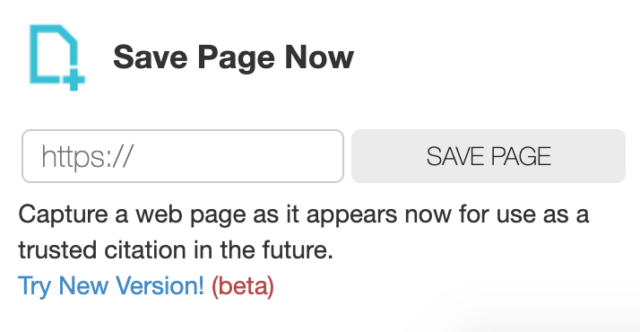
Using the Web Archive, or another archiving site, is your solution. The Web Archive has preserving as much of the web and other online content as possible as its mission. It is a trustable source. They save web pages on their own initiative, but you can submit any URL for preservation yourself and it will immediately be saved to the archive. Each archived page has its own URL as well, so you can always reference it. (Many links in Wikipedia point to the archived version of a page from the point in time it was referenced in Wikipedia for this reason).

I submitted my tweet from yesterday to the Web Archive, where it now has a web address that neither I, nor Twitter can change. This makes it acceptable proof of what I did in fact send out as a tweet yesterday.

Bookmarked Bridgy stats update (by Ryan Barrett)

Just shared at the opening of IndieWeb Summit in Portland, some very interesting statistics about the use of Brid.gy.

Brid.gy is a service that lets you connect both ways to various silos and social media platforms. I for instance use it to post to Twitter from here, and provide back Twitter’s interaction to my own site.

What stands out is that there is linear steady growth. Also the closing down of Facebook’s API and the closing of Google Plus are nicely visible as ‘saw tooths’ in the graphs.


A poem by Willem Brakman on the university’s steps: philosophy makes sense, science explains. But art shows, shows what it can’t say.

I facilitated two unconferences this week, on Monday and Thursday. The Industrial Design professorate at the Saxion University for Applied Sciences in Enschede celebrates its 15th anniversary this year. Karin van Beurden who has been leading the professorate from the start wanted to have a celebratory event. Not to look back, but to look forward to the next 15 years. She also wanted to do it in a slightly unconventional way. Karin participated in one of our birthday unconferences, and asked me to help her shape the event. In the past 2 months, Karin, her colleague Nienke and I collaborated on this. It was unconventional in the eyes of the university’s board, as well as for the network Karin invited. So we had some explaining and managing of expectations to do in the run-up to the event.

When the professorate started, the theme of Karin’s inaugural speech was how “oysters turn their irritants into pearls”. Now after 15 years it was time to not just look at the pearls created during that period, but mostly at what the pearls of the future would be and thus the issues of today. Under this broad theme some 50 people participated in the unconference, and it was a pleasure to facilitate the process.

After opening up the space, making everyone feel at ease and explaining the process, we created a program for the afternoon in BarCamp style, listing 15 sessions across four spaces, in a 2 hour program.

What followed (the way I experienced it) was a carroussel of amazing stories, ranging from financing challenges for research projects, enabling alternative energy provision discussion, the psychological impact of turning breast prostheses from a medically framed issue into a fashion issue, and the use of 3d printing to reduce time needed in operation rooms. Afterwards we had a pleasant bbq and further conversations nearby, and during the train ride back I had further good conversation with one of the participants. It was a pleasant day to be back in Enschede.


One of the sessions, in the FabLab space
A session in the FabLab Enschede space


Using pluggable hexagons to discuss energy grid issues


3d printed elements for bone reconstruction

What stood out for me was how various participants encountering the format for the first time, immediately realised its potential for their own work. The university’s chair mentioned how she would like to do this with her board to more freely explore issues and options for the university. A professor remarked how it might be a good way to have better, more varied project evaluation sessions with students in his courses. Also, judging by the conversations I had, we succeeded apparently in creating a space and set-up that felt safe for a range of very personal stories and details to be shared.


As I had a few minutes before my train left, I got to visit our favourite ice cream parlor in Enschede, our home town until 2 years ago. We haven’t found a comparably good ice cream vendor in Amersfoort.

(At CaL earlier this month in Canada, someone asked me if I did unconference facilitation as work. I said no, but then realised I had two events lined up this week putting the lie to that ‘no’. This week E suggested we might start offering training on how to host and facilitate an unconference.)

I facilitated two unconferences this week. On Monday with our company The Green Land we hosted a 90 minute unconference on (the future of) open government. It was a sweltering day, without much wind. Held on the rooftop of our office building, we had precisely the amount of shade needed to keep all participants out of the sun. With some 20 people from around our network we compared notes on open government, civic tech, and potential collective action. Having built the program with the group I participated in conversations on public versus market roles, what ‘sticks‘ we have in our toolbox when working towards more open government, and the Dutch Common Ground program.

A group in discussion
Groups in conversation

The program
The program

We ended with a fun ‘open government pubquiz’ led by my colleagues Frank and Niene.

(At CaL earlier this month in Canada, someone asked me if I did unconference facilitation as work. I said no, but then realised I had two events lined up this week putting the lie to that ‘no’. This week E suggested we might start offering training on how to host and facilitate an unconference.)

Bookmarked Untangling the IndieWeb by David Yates

Frank Meeuwsen pointed me to this article by David Yates, which contains explanations of IndieWeb components and their purposes, for less tech-oriented people. It concludes that, yes IndieWeb has a wide range of cool features, that let you use the Web itself as social medium, but that implementing them requires tech skills. It works very well for online interaction, “but the only people you interact with are other programmers who’ve also managed to implement all this stuff.”

Which is a good reminder to self. I’m not one of those ‘other programmers’, though I can keep up with tech oriented conversation. Which makes me a bit of a boundary spanner, between the techies and the less tech oriented. Given Peter’s notion of having an obligation to explain, I already had half baked plans to start writing a few explainers. While reading this blogpost by David Yates I had some additional ideas of what that should/shouldn’t look like. And that it should be in both Dutch and English. So thank you David for the nudge.

Meanwhile, I have E as an in-house ‘tester’ to see if my explanations work, and if I understand things correctly myself, while we are indiewebyfying her websites.