The Austrian Open Knowledge Chapter is dissolving itself (link in German), a decision already made at a general assembly in December 2018. Judging by the website activities had petered out in recent years, the blog falling silent at the end of 2017.

Austria over the years has been an active country concerning open government data and open knowledge in general. Specifically I see the Austrian open data community as a globally relevant good practice example, one that I still regularly refer to. Already in 2010, when I spoke at an open data meet-up in Graz, and in subsequent years presenting at OGD Austria conferences and various other events, what stood out to me was the broad scope the Austrian open data community had. Academia, activists, the federal chancellery, state governments, city governments, start-ups, technologists and traditional re-users were all around the same table. Informal get-togethers and resulting relations formed a basis on which more formal structures and cooperative initiatives could grow. I think such a solid community fundament is the key reason Austria was able to achieve a lot on open data in the absence of any legal framework to actively stimulate it, moreover with a constitution that enshrines civil service secrecy.

For a few years I was quite well informed about the Austrian efforts, through regular visits, and regular calls between German speaking community leaders from Germany, Austria and Switzerland, and me as the odd one out. Over time my connection grew more distant however.

With Open Knowledge Austria ceasing to exist, a chapter ends. I suspect the community substrate on which it could exist will endure, even if events, individual members lives and contexts are always in flux around us. It is laudable that OK Austria is actively deciding to dissolve. Organisations all too easily stumble into the pitfall that continued existence becomes the organisation’s primary goal. By dissolving, as Stefan Kasberger, OK Austria’s chair, wrote, one releases its hold on specific topics and niches in an ecosystem, and it becomes possible for new things to emerge over time.
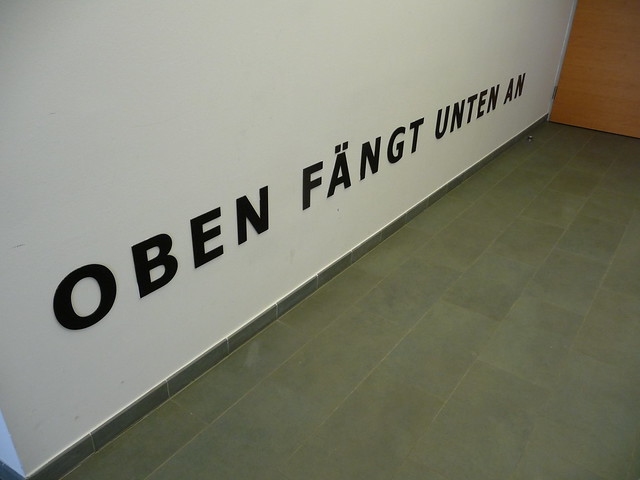

At the 2012 OGD Austria conference in Linz, a wall at the venue carried the text, near the floor obviously, “Above starts down below”. It seemed a good description of how the Austrian open data efforts were based on solid bottom-up community building to me at the time.

Since shortly after we moved in we have a temperature and humidity sensor in our garden.

This week’s heat wave is breaking records across Europe including here in the Netherlands. So I’ve kept an eye on the temperature in our garden. Our sensor is part of a city wide network of sensors, which includes two sensors nearby. Of the three sensors, ours indicates the lowest temperature at 36.8 (at 16:45), the other two hover just under 40 and at 41.8 respectively. Such differences are caused by the surroundings of the sensor. That ours is the lowest is because it’s placed in a very green garden, while the others are out on the street. In our completely paved and bricked up courtyard the temperature is 42.1 in the shade, due to the radiation heat of sun and stones. Goes to show that greenery in a city is key in lowering temperatures.

Three sensors in our neighbourhood, ours is in the middle, showing the lowest temperature. Note that the color scale is relative, for these 3 sensors running from 36.6 to 41.8.

In the past days since our return from France the temperature has been steadily rising, as per the graph below (which currently ends at the peak of 36.8 at 16:45). Staying inside is the best option, although the also increasingly higher lowest temperatures (from 15 to above 20) mean that the nights are slowly becoming more uncomfortable as the outside temperature will stay above the in house temperature during most or all of the night.

UPDATE as of 26/7 June noon, here you can see how the night minimum jumped 5 degrees in 24 hours, bringing it above the in house temperature for the entire night, except a brief moment around 6 am. At noon the maximum for the day before is already nearly reached.

The way to make this graph yourself is

  • Go to meetjestad.net/data, where you can select various data types and time frames. Our sensor is number 51, and I selected a time frame starting at July 19th at midnight. This allows me to download the data as CSV.
  • The data in that download is Tab separated, not comma,when you select a comma to be used as decimal point.
  • The file contains columns for the sensor number and its latitude and longitude, that are not needed as this is data for just one sensor. Likewise, empty columns for measurement values for which my sensor kit doesn’t contain sensors, such as particulate matter, can be removed. Finally the columns for battery level and humidity are also not needed on this occasion.
  • With the remaining columns, time and temperature it is easy to build the graph. In this case I replaced the timestamps with sequential numbers, as I intend to make a sparkline graph with it later.

Heinz rührt eine wichtige Frage an: Findet die parlamentarische Demokratie eine Antwort auf den Klimanotstand?
Und er beantwortet sie mit “So, wie wir sie kennen, nicht.”

Wichtige Beobachtung:
Ich glaube, dass das damit zusammenhängt, dass die wichtigsten Betroffenen der Klimakrise parlamentarisch nicht vertreten sind. Das gilt für die zukünftigen Generationen und es gilt für Menschen auf anderen Kontinenten, denen wir mit jedem Liter Benzin, den wir verbrauchen, ihr ohnehin geringes verbleibendes CO2-Budget weiter beschneiden. Es gilt vor allem für die nichtmenschlichen Akteure, die wir als Partner begreifen müssen statt als neutrales Material—für die Natur im weitesten Sinn. Eine parlamentarische Demokratie ist auf Interessenausgleich unter den in einem Gebiet lebenden Menschen ausgerichtet, aber nicht darauf, noch nicht Geborene, Menschen auf anderen Kontinenten oder nichtmenschlichen Wesen zu vertreten.

Er sucht die Lösung, zurecht denke ich, in eine Selbstbeschränkung des parlamentarischen Entscheidungsraums, so wie wir sie auch in anderen Fällen kennen:

Ich glaube eher, dass parlamentarische Demokratien eine strukturelle Selbstbeschränkung brauchen, um mit der Klimakrise umzugehen. Sie müssen begrenzen, was die Menschen entscheiden können, die gegenwärtig in einem Gebiet leben. Es gibt Beispiele dafür, das solche Begrenzungen funktionieren. Die wichtigsten sind der Markt und das Rechtswesen und für sie bestimmende Institutionen wie das Bankwesen bis hin zu Nationalbanken und Gerichte bis hin zu Verfassungsgerichten. Aber auch internationale Abkommen begrenzen die Souveränität von Parlamenten und werden trotzdem von ihnen akzeptiert.

Das hat eine Parallele auch in praktische Situationen, wie zB alltägliche Entscheidungen einzelner Bürger, oder Firmen: da sollte man immer die externalisierten Kosten geltend machen. Es ist aber üblich das Konsequenzen für zukünftige Menschen, Natur, oder Menschen ausserhalb des als eigenes verstandenen Gebietes unbeachtet bleiben, und nicht in eine ethische Abwägung bezogen werden, was den tatsächlichen, höheren, Preis einer Entscheidung verhüllt.

Es gilt deshalb über eine klimakonforme Demokratie nachzudenken und darüber, wer die parlamentarischen Entscheidungsprozesse entsprechend steuern und begrenzten könnte.

Ich mag den Begriff “klimakonforme Demokratie”, und es kommt bei mir die Frage auf welche Art von neuen (internationalen) Institutionen dazu passen, weil die Herkömmlichen für andere Zwecke konstruiert wurden, und zunehmend spröde erscheinen.


Thingvellir, the site of Althing, Iceland’s parliament from 930-1798 CE, covered in ice and snow. Photo Sheep”R”Us, license CC BY-NC-ND

(written by hand on July 16th, in the French country side, typed out and edited on the laptop after returning home)

Some notes on my experience with mobile blogging in the past few weeks that we spent in France. Normally I don’t post at all during our holidays. However it usually is a time I write a lot (because I usually read a lot), and my blog is the logical place for that writing to end up. As an experiment I wanted to see if current devices, tools and IndieWeb components might add up to a frictionless workflow. Results were mixed as you can see from the very first sentence above.

The set-up

  • I didn’t have my regular laptop with me this summer, but did have my phone and had a small 2013 Samsung Tablet (which means it has an old Android version that no longer supports a wide range of Android apps. It didn’t run Indigenous for instance, see below. Oddly my Opera browser also couldn’t do the current Captcha / I’m not a robot thingies, so had to use Chrome to log into my site, and then go back to my preferred browser).
  • The tablet was intended to write on the go more, as it had a bigger interface, and I dislike tapping out texts on my phone. Such writing took place in the webbrowser, being logged into my WordPress website’s console.
  • The phone runs Indigenous for Android, which is a Microsub client, which means it serves as a (RSS-) reader. I had it connected to my Aperture account as the Microsub server, and before leaving loaded it by hand with 41 feeds from sites I follow (which is about a fifth of what I normally follow).
  • The same Indigenous app also serves as a Micropub client, meaning I can use it to directly respond to something in the reader section of the app, e.g. to like, bookmark, or reply to a posting, as well as initiate a posting from the app.
  • I also have the ability to send a new posting by e-mail from a specific sender address, which I have enabled on my phone, to a specific receiver address that my blog can read, using the Postie plugin

Experiences

  • Posting images is something I had envisioned doing easily. Snapping a picture, add a remark and have it online before you know it. Reality was different.
    • Using Indigenous to upload a photo to the Media section of WordPress wasn’t useful. Indigenous uploads it, and comes back with a URL for it. What it can’t do is come back with the correctly sized and WordPress optimised version of the upload. This is logical because the Indigenous doesn’t know it’s talking to a WordPress site. Writing a HTML image statement by hand using that returned URL can be done, but means an uploaded photo will be shown using the largest file size available (and that you’ll be coding html by hand on a tiny screen).
    • What does work well in Indigenous is posting a photo as the posting type ‘photo’, and add a few remarks to it. This is different from using a photo inside a posting as illustration, because in such a case the photo is the posting.
    • So in two instances (e.g. 1, 2) I uploaded the photo from my phone to my WordPress back-end, and then created the posting directly in WordPress using the slightly larger keyboard interface of the tablet.
    • In one instance I created an image on my phone and posted it as the posting type of an image using Indigenous and adding some remarks.
    • I automatically upload images to Flickr from my phone, and I often embed photos from Flickr into my postings. Oddly that didn’t work on the phone nor tablet, as Flickr apparently doesn’t show the embed code button on mobile versions of their site, nor in their app. So no embedding was possible during our trip.
    • I haven’t posted as many images I would have, had it been a smoother experience. Also because proper 4G coverage in the French country side turned out to be spotty, making ‘quickly upload something without it disturbing the flow of things’ impossible. Which is likely just as well, being in the moment etc, but unexpected.
  • Writing postings was a mixed experience.
    • The keyboard on the tablet I brought was still way too small for my liking. I also have an Android tablet that has an attachable keyboard which would work much better. I didn’t bring that one, as it has a very weak battery, meaning you really should keep it connected to a power plug continuously during use.
    • It wasn’t possible to select a piece of text while in the editing screen of WordPress. This was unhelpful while adding links. Normally I write a posting, and then add the links in later. Now I needed to use the link button in the interface and write the linked text in the link form, where normally I’d select the text to link after which hitting the link button would pre-fill the form. On my laptop I have keyboard shortcuts as well for this type of flow, and they of course weren’t available to me on the tablet.
    • Initiating a posting in Indigenous worked fine, except for the disruptive interplay between my network provider and my hosting provider. My hosting provider shields the login screens of WordPress sites with a captcha to battle automated login attempts. It does this once a month for an IP address, so for me normally it’s not something I come across often. However when roaming in an area with very spotty coverage you end up having different IP addresses multiple times per day. This would break me being logged into both my site and my MicroPub end-point, as my hoster would force the captcha on me again. It meant almost any time I opened up Indigenous it would have lost my connection to my site for publishing (not for reading, as that part resides on a different server). Normally getting it to work again would be one flow, with Indigenous showing me the WordPress login, and then automatically returning to Indigenous. Now it was two flows as the captcha broke the return to Indigenous. So I logged into WordPress by doing the Captcha and then login to WP, and then being already logged into WP had no issue connecting from Indigenous to WP.
    • Initiating a posting from Indigenous does mean it gets posted in ‘visual’ mode rather than in ‘text’ mode. This way HTML I added to a posting, to link or show a photo, would end-up as is on my blog and not be interpreted as HTML. So I opted to write on my tablet in WP’s back-end more.
    • Writing in the back-end of WP itself, which I often do on my regular laptop, was an unpleasant experience on the tablet. Mostly because the interface was still tiny, and kept jumping around to accommodate for the on-screen keyboard. I installed a text editor on my tablet to write locally, and not connected to the internet. A finished text I would then copy over to the posting form WP.
    • After trying the text editor however, I started writing material on paper (like this posting), and only then started typing it into the tablet. Normally, with a full keyboard I prefer typing, as it is faster than my handwriting. With the still too small interface on my tablet, typing was a two-fingers affair and hand writing was a much better experience in comparison. When you already know what you want to type the two finger typing style is less of a burden. Writing as thinking out loud I therefore did on paper first.
    • The fact that I could only use Indigenous on my mobile and not on my tablet meant that I had to cross the divide between two devices if I wanted to write something based on what I had come across in my feed reader. This as URLs and sources weren’t easily shared between devices. This divide was rather cumbersome, and the only way I could really cross it was by sending an e-mail from my mobile containing the links, to the mail address attached to Android tablet.Or type over URLs by hand.
      In practice it meant I didn’t really do that other than a few times. Upon my return my mobile browser had about 70 open tabs, of things I’d like to have shared or used in some form but didn’t.
    • I did not try to post via e-mail, which would likely have worked well. To use it well you have to add short codes to the title and content of the e-mail, adding categories and tags etc. It can’t be used for different post kinds other than regular articles either. I didn’t remember to bring notes on how to do that with me however. My wife did use e-mail to post, and did so exclusively. When posting photos it would often not correctly adjust the orientation, posting photos on its side or upside-down, depending on the position the phone camera was used in.

Take-Aways

In 2004 I organised a BlogWalk session in Umeå, in the north of Sweden, which focused on mobile blogging. My recap from 15 years ago still seems relevant now, given my experiences the past weeks. One quote definitely still stands out as true “I’m not a moblogger, I’m a travelling blogger having trouble getting connected.“. Mobile blogging needs to reduce friction, not introduce it. My experiment these weeks surfaced several sources of friction that combined into not finding a comfortable flow.

  • Spotty internet connection was the key frustrating element. I am very much a ‘offline first’ type of person, but mobile blogging depends on connectivity in more ways than regular blogging on my laptop. Spotty internet connection easily turned a normally five minute task of pasting some text into WordPress, adding a link and ticking the boxes for categories into a 45 minute source of irritation. I adapted by doing the connectivity part on moments when I knew it would be more reliable, further fragmenting the flow.
  • Using two devices is inconvenient, if there’s a divide between them.
  • The tablet didn’t provide the bigger keyboard / screen I intended, or at least not big enough. On a future occasion I’d need a more recent tablet with attachable keyboard, so it can run both Indigenous and provide access to my WP back-end. This prevents the divide between two devices, and let’s both devices server their own use case.
  • The phone can be used as a stand alone device to blog photos and short notes that do not need additional linking to sources or associated postings. (Ignoring for now the frequent logging in, because of my hoster’s preventative measures)
  • I like an offline writing process. Writing by hand is a good way, especially when typing isn’t faster anyway. It does introduce the step to digitise it later. Transcribing could be seen as editing though. OCR’ing my handwriting is unlikely to be successful. Maybe writing by hand on a tablet works. I’ve seen others do it, but haven’t tried my hand on it. Or pens that digitise while you write, but that usually creates image files, not text files I think.
  • It’s useful to in more detail sketch out a mobile blogging flow for various types of use, and then test that over a longer period of time during regular working weeks. To land on a ‘settled’ mode for mobile blogging.


Camping in the French country side, relaxing but spotty connectivity. Better to sit back and sip a drink in front of our tent.

Bookmarked 20 Years of Blogging: What I’ve Learned by Anil Dash

This week marks the 20th anniversary of this blog. I thought the best way to observe the milestone, and to try to pass along some of the benefits I’ve gained from keeping a presence online all these years, would be to share some of the most important things I’ve learned since I started this site.

Anil Dash

Anil Dash reflects on two decades of blogging.

Some quotes that resonate:

I also do still strongly believe that someone who really has a strong point of view, and substantive insights into their area of interest, can have huge impact just by consistently blogging about that topic. It’s not currently the fashionable way to participate in social media, but the opportunity is still wide open.

Yes, maintaining a sustained online identity and presence is an opportunity, as it provides agency. The open web is an open invitation to do so, but it takes time to blog. Time that will not immediately result in dopamine triggering likes and retweets, so you will need to find the motivation for keeping up blogging elsewhere, likely within yourself. Even if you don’t have ‘substantive insights’ in your areas of interest but still consistently blog, there will be impact. I once had a client who hired me after reading my blog archives and realising from its tone and content I would bring the right attitude and outlook to the project. Over time any blog is a body of work.

If your website’s full of assholes, it’s your fault.

Platforms have always maintained they are just platforms, and not responsible for its content. That argument has been severely eroded by the platforms itself, because their adtech business models depend on engagement, and so they introduced addictive design patterns and algorithms that decide what you see, based on likelihood of sparking engagement (usually outrage, as it works so well). A platform that decides what you see in order to sell more ads, makes conscious editorial decisions, and is no longer a platform. Roads and their maintainers generally aren’t responsible for the conduct of drivers, but in this case the roads over time have been deliberately increasingly designed to make you speed, reward repeat offenders by reserving the fast lane for them, and road maintainers get paid by car repair shops based on a metric of a steady rise in car crashes so road rage gets encouraged to raise revenue. It’s why federation of very distributed nodes is important to me, it strongly reduces amplification of the things that we’ve come to loathe on the platforms. That e.g. Gab, having been deplatformed, moved to federated servers is a good thing. Now anyone can round around it as damage, and its content doesn’t get the amplification and recognition by being on general platforms, it otherwise would. I am the only one on my website. I am the only one on my Mastodon server. At that level moderation is extremely easy, while it doesn’t reduce my interactions in any way.

I’m not someone who thinks there was a “good old days”; social media has always been too exclusionary, and too dependent on systems and infrastructures that replicate the injustices of society as a whole. It is possible, though, to make new systems that are a little more equitable, and I still haven’t given up on that hope at all.

Me neither, there’s huge potential for increasing agency, especially for groups in specific contexts and around specific issues. A networked agency emerging from lowering technology and process thresholds. It means taking ourselves as the starting point, not the platform or its business model.

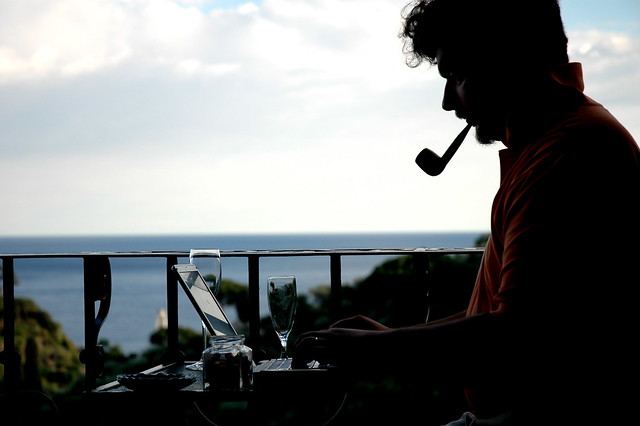
Bonus pic: my friend Paolo blogging, 13 years ago in June 2006.


image by Paolo Valdemarin, license CC BY-NC-ND

Blogging usually doesn’t involve a pipe, sitting outside, prosecco, or a sea view from the Ligurian coast. Blogging is totally mundane, this the exception. It might be a good addictive design pattern for blogging though 😉

This article in the Atlantic talks about families using tools like Trello and Slack to keep track of each others activities and tasks.
It calls it treating the home like the office or running the household like a business and presents it like an oddity if not a 21st century abberation of family life. E.g. tracking how often you call your mom.

I find the tongue in cheek tone rather tone deaf. It misses the point on several levels.
The examples are not showing how families are run like an office or business. Families are seeing parallels between work and private processes.
After all task allocation and keeping track of each other is important in the household too. Besides households are the original economic unit.

Tracking tasks, also for children, has been around for ages. Dalton schools, with their focus on independent learning tasks, have had to do / doing / done boards since the 1920s.
Hallways and refrigerator doors have displayed lists and overviews forever too. My grandma kept track of everything in notebooks, how many beans harvested and stored for the winter, how much fuel used etc.
All it shows is that what families have been doing all along is also done using tools imagined for a work environment. Just like owning carpentry tools was once limited to masters who were members in a guild, and are now found in every household.

That is useful for several reasons. It helps make sure that the household and family get at least equal attention as areas of responsibility.
Keeping track of work but not the home easily means the home gets attention when all else is finished, which it never is.
For that reason I have areas in my GTD todo lists for me personally, family, daughter, partner and the house. Similarly I have long term goal descriptions for them too.

We would never have moved so quickly and readily early 2017 if we had not set it as a goal in the summer of 2013 to be ready by the end of 2016 for it.
It meant building up the financial buffer for it, and thinking about where we would want to live. As part of that we regularly temporarily moved to other cities for a month to figure out what we wanted.
Since July 2013 when we set the goal on the balcony of a friends home in Switzerland, I kept track of what we needed to do for it in my GTD tools.

It does sometimes feel odd to track things like how often I spoke to my parents. But it was necessary as my parents would often forget when we talked last. Sometimes telling me it had been weeks when it was yesterday.
So I made sure I called them at least once a week by having it in my todo lists. I also kept notes especially when their health deteriorated as they would tell my sisters different things, so we could compare.

For the household and for our family we have shared Evernote notebooks. To share receipts, info about daycare, holiday plans, or my itinerary when I travel for work.
Weekly we look ahead at what is happening the next week or two.

I mentioned the household being the original economic unit, and in one aspect it means I do treat it as a business.
Optimising household income also means I regularly spend time assisting Elmines business, as she does mine. It helps maintain and increase our freedom of action.
Every Euro I help her make and she me being better at what I do means improvement for us and providing our daughter with a good start in life.

If Slack or Trello, Evernote or Things help us do that then great.