Frank Meeuwsen en ik hebben een datum geprikt en een locatie gevonden. IndieWebCamp gaat door, op 18 en 19 mei in Utrecht in de ruimte van Shoppagina.nl, Kanaalweg 14-L in Utrecht. Een rudimentaire site met aankondiging vind je op IndieWebCamp, en dezelfde info vind je in de IndieWeb wiki.

Er is plek voor maximaal 35 mensen. Dus als je heel graag aanwezig wilt zijn, mail mij of Frank dan alvast even. De inschrijving gaat binnenkort open. We zoeken nog wat ondersteuning, zoals een sponsor voor de lunch op zaterdag en zondag. Als je iets bij kunt of wilt dragen laat het weten!

The Mozilla foundation has launched a new service that looks promising, which is why I am bookmarking it here. Firefox Send allows you to send up to 1GB (or 2.5GB if logged in) files to someone else. This is the same as services like Dutch WeTransfer does, except it does so with end-to-end encryption.

Files are encrypted in your browser, before being send to Mozilla’s server until downloaded. The decryption key is contained in the download URL. That download URL is not send to the receiver by Mozilla, but you do that yourself. Files can be locked with an additional password that needs to be conveyed to the receiver by the sender through other means as well. Files are kept 5 minutes, 1 or 24 hours, or 7 days, depending on your choice, and for 1 or up to 100 downloads. This makes it suitable for quick shares during conference calls for instance. Apart from the encrypted file, Mozilla only knows the IP address of the uploader and the downloader(s). Unlike services like WeTransfer where the service also has e-mail addresses for both uploader and intended downloader, and you are dependent on them sending the receivers a confirmation with the download link first.


Firefox Send doesn’t send the download link to the recipient, you do

This is an improvement in terms of data protection, even if not fully water tight (nothing ever really is, especially not if you are a singled out target by a state actor). It does satisfy the need of some of my government clients who are not allowed to use services like WeTransfer currently.

Granularity (photo by Emily, license: CC-BY-NC)

A client, after their previous goal of increasing the volume of open data provided, is now looking to improve data quality. One element in this is increasing the level of detail of the already published data. They asked for input on how one can approach and define granularity. I formulated some thoughts for them as input, which I am now posting here as well.

Data granularity in general is the level of detail a data set provides. This granularity can be thought of in two dimensions:
a) whether a combination of data elements in the set is presented in one field or split out into multiple fields: atomisation
b) the relative level of detail the data in a set represents: resolution

On Atomisation
Improving this type of granularity can be done by looking at the structure of a data set itself. Are there fields within a data set that can be reliably separated into two or more fields? Common examples are separating first and last names, zipcodes and cities, streets and house numbers, organisations and departments, or keyword collections (tags, themes) into single keywords. This allows for more sophisticated queries on the data, as well as more ways it can potentially be related to or combined with other data sets.

For currently published data sets improving this type of granularity can be done by looking at the existing data structure directly, or by asking the provider of the data set if they have combined any fields into a single field when they created the dataset for publication.

This type of granularity increase changes the structure of the data but not the data itself. It improves the usability of the data, without improving the use value of the data. The data in terms of information content stays the same, but does become easier to work with.

On Resolution
Resolution can have multiple components such as: frequency of renewal, time frames represented, geographic resolution, or splitting categories into sub-categories or multilevel taxonomies. An example is how one can publish average daily temperature in a region. Let’s assume it is currently published monthly with one single value per day. Resolution of such a single value can be increased in multiple ways: publishing the average daily temperature daily, not monthly. Split up the average daily temperature for the region, into average daily temperature per sensor in that region (geographic resolution). Split up the average single sensor reading into hourly actual readings, or even more frequent. The highest resolution would be publishing real-time individual sensor readings continuously.

Improving resolution can only be done in collaboration with the holder of the actual source of the data. What level of improvement can be attained is determined by:

  1. The level of granularity and frequency at which the data is currently collected by the data holder
  2. The level of granularity or aggregation at which the data is used by the data holder for their public tasks
  3. The level of granularity or aggregation at which the data meets professional standards.

Item 1 provides an absolute limit to what can be done: what isn’t collected cannot be published. Usually however data is not used internally in the exact form it was collected either. In terms of access to information the practical limit to what can be published is usually the way that data is available internally for the data holder’s public tasks. Internal systems and IT choices are shaped accordingly usually. Generally data holders can reliably provide data at the level of Item 2, because that is what they work with themselves.

However, there are reasons why data sometimes cannot be publicly provided the same way it is available to the data holder internally. These can be reasons of privacy or common professional standards. For instance energy companies have data on energy usage per household, but in the Netherlands such data is aggregated to groups of at least 10 households before publication because of privacy concerns. National statistics agencies comply with international standards concerning how data is published for external use. Census data for instance will never be published in the way it was collected, but only at various levels of aggregation.

Discussions on the desired level of resolution need to be in collaboration with potential re-users of the data, not just the data holders. At what point does data become useful for different or novel types of usage? When is it meeting needs adequately?

Together with data holders and potential data re-users the balance needs to be struck between re-use value and considerations of e.g. privacy and professional standards.

This type of granularity increase changes the content of the data. It improves the usage value of the data as it allows new types of queries on the data, and enables more nuanced contextualisation in combination with other datasets.

This week NBC published an article exploring the source of training data sets for facial recognition. It makes the claim that we ourselves are providing, without consent, the data that may well be used to put us under surveillance.
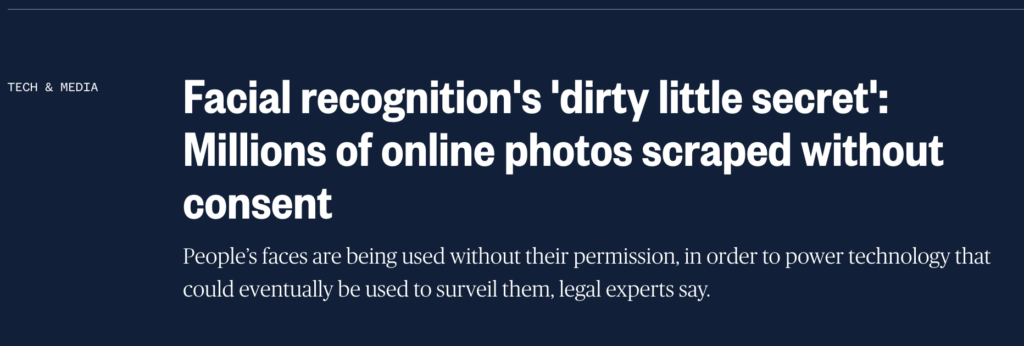
In January IBM made a database available for research into facial recognition algorithms. The database contains some 1 million face descriptions that can be used as a training set. Called “Diversity in Faces” the stated aim is to reduce bias in current facial recognition abilities. Such bias is rampant often due to too small and too heterogenous (compared to the global population) data sets used in training. That stated goal is ethically sound it seems, but the means used to get there raises a few questions with me. Specifically if the means live up to the same ethical standards that IBM says it seeks to attain with the result of their work. This and the next post explore the origins of the DiF data, my presence in it, and the questions it raises to me.

What did IBM collect in “Diversity in Faces”?
Let’s look at what the data is first. Flickr is a photo sharing site, launched in 2004, that started supporting publishing photos with a Creative Commons license from early on. In 2014 a team led by Bart Thomee at Yahoo, which then owned Flickr, created a database of 100 million photos and videos with any type of Creative Commons license published in previous years on Flickr. This database is available for research purposes and known as the ‘YFCC-100M’ dataset. It does not contain the actual photos or videos per se, but the static metadata for those photos and videos (urls to the image, user id’s, geo locations, descriptions, tags etc.) and the Creative Commons license it was released under. See the video below published at the time:

YFCC100M: The New Data in Multimedia Research from CACM on Vimeo.

IBM used this YFCC-100M data set as a basis, and selected 1 million of the photos in it to build a large collection of human faces. It does not contain the actual photos, but the metadata of that photo, and a large range of some 200 additional attributes describing the faces in those photos, including measurements and skin tones. Where YFC-100M was meant to train more or less any image recognition algorithm, IBM’s derivative subset focuses on faces. IBM describes the dataset in their Terms of Service as:

a list of links (URLs) of Flickr images that are publicly available under certain Creative Commons Licenses (CCLs) and that are listed on the YFCC100M dataset (List of URLs together with coding schemes aimed to provide objective measures of human faces, such as cranio-facial features, as well as subjective annotations, such as human-labeled annotation predictions of age and gender(“Coding Schemes Annotations”). The Coding Schemes Annotations are attached to each URL entry.

My photos are in IBM’s DiF
NBC, in their above mentioned reporting on IBM’s DiF database, provide a little tool to determine if photos you published on Flickr are in the database. I am an intensive user of Flickr since early 2005, and published over 25.000 photos there. A large number of those carry a Creative Commons license, BY-NC-SA, meaning that as long as you attribute me, don’t use an image commercially and share your result under the same license you’re allowed to use my photos. As the YFCC-100M covers the years 2004-2014 and I published images for most of those years, it was likely my photos are in it, and by extension likely my photos are in IBM’s DiF. Using NBC’s tool, based on my user name, it turns out 68 of my photos are in IBM’s DiF data set.

One set of photos that apparently is in IBM’s DiF cover the BlogTalk Reloaded conference in Vienna in 2006. There I made various photos of participants and speakers. The NBC tool I mentioned provides one photo from that set as an example:

My face is likely in IBM’s DiF
Although IBM doesn’t allow a public check who is in their database, it is very likely that my face is in it. There is a half-way functional way to explore the YFCC-100M database, and DiF is derived from the YFCC-100M. It is reasonable to assume that faces that can be found in YFCC-100M are to be found in IBM’s DiF. The German university of Kaiserslautern at the time created a browser for the YFCC-100M database. Judging by some tests it is far from complete in the results it shows (for instance if I search for my Flickr user name it shows results that don’t contain the example image above and the total number of results is lower than the number of my photos in IBM’s DiF) Using that same browser to search for my name, and for Flickr user names that are likely to have taken pictures of me during the mentioned BlogTalk conference and other conferences, show that there is indeed a number of pictures of my face in YFCC-100M. Although the limited search in IBM’s DiF possible with NBC’s tool doesn’t return any telling results for those Flickr user names. it is very likely my face is in IBM’s DiF therefore. I do find a number of pictures of friends and peers in IBM’s DiF that way, taken at the same time as pictures of myself.


Photos of me in YFCC-100M

But IBM won’t tell you
IBM is disingenuous when it comes to being transparent about what is in their DiF data. Their TOS allows anyone whose Flickr images have been incorporated to request to be excluded from now on, but only if you can provide the exact URLs of the images you want excluded. That is only possible if you can verify what is in their data, but there is no public way to do so, and only university affiliated researchers can request access to the data by stating their research interest. Requests can be denied. Their TOS says:

3.2.4. Upon request from IBM or from any person who has rights to or is the subject of certain images, Licensee shall delete and cease use of images specified in such request.

Time to explore the questions this raises
Now that the context of this data set is clear, in a next posting we can take a closer look at the practical, legal and ethical questions this raises.

In januari schreef ik aangenaam verrast over de Provincie Overijssel die hun iconenset uit de huisstijl onder een Creative Commons licentie hadden gepubliceerd. Ik schreef de Provincie er een complimenterende e-mail over, en stelde de vraag welke Creative Commons licentie er precies bedoeld werd. Want dat was niet duidelijk op de website. Zo was niet helder of naamsvermelding gewenst was, of commercieel hergebruik was toegestaan, en of afgeleid werk onder dezelfde condities moest worden gelicentieerd. Ik kreeg een mail terug met de aankondiging dat ze een aanpassing zouden doen.

Tot mijn verbazing was de aanpassing niet een verduidelijking maar een terugdraaiing van het geheel. De Creative Commons licentie is verdwenen en de site laat nu alleen het gebruik van de iconen toe voor en door de Provincie en hun leveranciers.

Ik stuurde een teleurgestelde e-mail, waarin ik vragen stelde over hoe de nieuwe keuze tot stand gekomen is. Dat wordt natuurlijk al snel een lange mail, omdat het bij dit soort zaken snel over details gaat. Elke vlottere formulering roept dan weer al gauw nieuwe vragen op. Het was dan ook prettig dat een van de communicatie-teamleden me vanmiddag belde om wat context te verschaffen.

Het toevoegen van CC aan de iconen was een door een medewerker gedaan experiment , op basis van ervaringen met eerdere iconen die onder CC beschikbaar waren. De intentie was om CC wat meer gebruik te geven. Dat maakt het bijvoorbeeld ook voor andere overheden makkelijker om dingen van elkaar her te gebruiken. Daar heeft iedereen profijt van. Maar juist bij creatieve uitingen (anders dan bijvoorbeeld bij data waar landelijk beleid geldt t.a.v. CC gebruik) zijn er meer auteursrechtelijke aspecten om rekening mee te houden. Commercieel hergebruik van de creatieve uitingen van een ander zijn dan praktisch en gevoelsmatig een andere stap. We hebben het over de huisstijl van de Provincie, dus wil je wel dat diezelfde iconen ‘overal’ kunnen opduiken? Het is niet de bedoeling dat andermans uitingen met die van jou worden geassocieerd.

Voortschrijdend inzicht op grond van die afwegingen, zijn de oorzaak dat men is teruggekeerd van de oorspronkelijke goede intentie. Dat is goed, al is het resultaat dat er jammer genoeg toch geen CC licentie aan de iconenset hangt. Een experiment is precies dat: een experiment, en dat betekent dat je ook kunt concluderen dat het niet voldeed.

Er zijn natuurlijk opener, minder open, en meer gesloten vormen van CC licenties. Dat is het hele punt van CC: dat je selectief op voorhand voor bepaalde hergebruiksvormen al toestemming verleent, zonder dat iedereen dat bij de auteursrechthebbende moet vragen. Van alle rechten voorbehouden naar sommige rechten voorbehouden.

Het blijft lovenswaardig dat het communicatieteam de intentie had en heeft om met CC te werken. En het is heel prettig dat er contact is opgenomen, dat praat makkelijker. Hopelijk leidt het er toe dat bij een volgende kans er wel een CC licentie gehanteerd kan worden.

In algemene zin, zou het helpen als het Ministerie van BZK, als houder van het dossier rond open overheid en open data, en de directie van decentrale overheden zoals een provincie hier sterker sturend in zouden zijn. Dan zijn experimenten niet nodig, en ontstaat er ook geen angst of zorg op de werkvloer voor mogelijk onbedoelde gevolgen, waardoor je voorzichtige terugtrekkingen als dit krijgt. Die voorzichtigheid is een normale voorspelbare menselijke reactie, maar die kun je in je organisatie onnodig maken. BZK stelt al als beleidslijn dat CC0 en CCBY voor data publicaties gehanteerd moeten worden. Open standaarden zijn al 11 jaren verplicht (maar weinig overheden houden zich daaraan in de praktijk). Het hanteren van een eenduidige praktische interpretatie van de auteurswet ook voor creatieve uitingen van overheden en de daarmee verbonden logische licentiekeuzes door BZK, en het bekrachtigen daarvan door het bestuur van decentrale overheden zou hier helpen. Er is voldoende ervaring inmiddels om het BZK mogelijk te maken hierin normerend op te treden.

After California, now the Washington State senate has adopted a data protection and privacy act that takes the EU General Data Protection Regulation (GDPR) as an example to emulate.

This is definitely a hoped for effect of the GDPR when it was launched. European environmental and food safety standards have had similar global norm setting impact. This as for businesses it generally is more expensive to comply with multiple standards, than it is to only comply with the strictest one. We saw it earlier in companies taking GDPR demands and applying them to themselves generally. That the GDPR might have this impact, is an intentional part of how the EC is developing a third proposition in data geopolitics, between the surveillance capitalism of the US data lakes, and the data driven authoritarianism of China.

To me the GDPR is a quality assurance instrument, with its demands increasing over time. So it is encouraging to see other government entities outside the EU taking a cue from the GDPR. California and Washington State now have adopted similar laws. Five other States in the USA have introduced similar laws for debate in the past 2 months: Hawaii, Massachusetts, New Mexico, Rhode Island, and Maryland.