It seems the efforts against Covid19 are entering a new phase in the Netherlands. From isolation and suppression efforts to slowing down the spread of contagion. This as for an increasing number of patients it is unclear how they caught it, and the needed effort to do contact research for positive cases is becoming too much work to keep up. As a result measures have been announced that cover the entire country.

  • Gatherings of more than 100 people are now banned, and this includes not just events, but also clubs, sports facilities and e.g. musea. (Schools will remain open for now, but if this follows the Italian path that will change in a week at most)
  • Those that can should work from home.

For my company this means that all events we were to attend in the coming weeks are no longer taking place.
We’ve instructed our colleagues to take working from home as a default. Our work is well suited to remote working, and we’ll treat it as an opportunity to test our remote working tools also in working with clients (having switched to our own cloud environment early this year comes in handy here), as well as a good time to focus on finishing deliverables.

The announced measures are in place until the end of March, so for the next two and a half weeks.

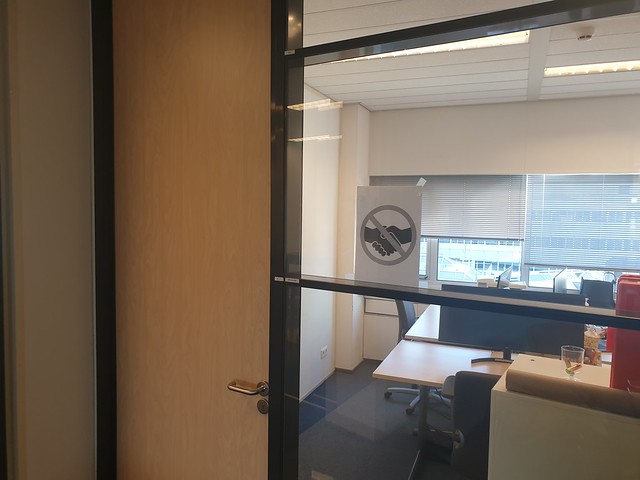
Today during morning rush hour, as opposed to Monday and Tuesday, it was already noticeably less busy in public transport and on the streets of Utrecht. The government offices I visited today had ‘no hand shakes’ signs in every room.

The Covid19 situation in the Netherlands is about where Italy was 2 weeks ago. Going from the first case on February 27th, to over 300 now 12 days later, with four deaths. Below is a graph of the total number of people testing positive for the virus in the Netherlands, created from taking the announced numbers from the daily news bulletins of the RIVM, the national institute for health and environment.

As of tonight the entire country is requested to stop shaking hands, and employers in the province Noord-Brabant are requested to enable and allow people to work from home. This is the province where a number of cases cannot be traced back to their source.

Harold Jarche rightly points to being able to judge and shape your information filters as a critical element in keeping yourself informed about emergent crises like Covid19. What Harold calls trusted filters is the primary reason I follow people not sources in my feeds, and all of those people are selected by myself, not by someone else’s algorithm. It is how I came across Harold’s post in the first place, because he’s been in my list of feeds for many years. Feedback across filters, so that what Harold shares might get commented here, which then gets shared back to my network which includes Harold, is how patterns emerge. This of course does mean you need to ensure your filter has enough variety and churn to avoid echo chambers. Which is why hand curating my list of people to follow is important, I know these people and what I know about them is an active part of the filtering I do. In my mind, the combination of my filtering and sharing, and Harold’s filtering and sharing as well as those of others I follow, constitute a LOFAR, which is able to spot small movements and emerging interests across my networks, and recognising which noises are actually signals to my interests and concerns. Keeping my LOFAR in good working order requires regular attention, and likely more than I already pay to it.

This doesn’t mean that institutional information isn’t valuable. It is actually invaluable. Institutions are the stock of info, the residue of years of knowledge, where my networks and filters are the flow, the reflection on, application, changing and emergence of knowledge. Such knowledge is critical for crap detection, also when it comes to the stuff my network shares with me. In times of emergent crises like Covid19, such institutional knowledge about how to deal with the specifics of e.g. a pandemic is crucial. So I keep an eye on the general statistics collected at John Hopkins, the advise and info of the RIVM (the Dutch national institute for health and environment, in charge of epidemic response) concerning the Netherlands specifically, and what e.g. the WHO says about pandemic response on a personal level and organisational level (e.g. business continuity). My LOFAR in turn allows me to sense what is going on across my networks in this context.

The LOFAR ‘superterp’ in Drenthe, which has hundreds of small antennas, combining with 47 other locations into a total of some 20.000 antennas for signal detection
De Weblogmeeting komt terug, roept Frank Meeuwsen. Weblogmeetings waren ‘een ding’ in de ’00s. Met mijn blog in het Engels, en het wonen op 2 uur van de randstad, zat ik niet zo in de algemene NL blogscene (ik kom volgens mij ook niet in Frank’s boek Bloghelden voor), maar ik ben wel een paar keer op zo’n soort meeting geweest. Zowel meet-ups van Edubloggers (met bloggers uit de onderwijswereld, waar ik als kennismanagement blogger mee verwant was), Blognomics, als ook de Weblogmeetings waar Frank aan refereert (in Amsterdam of Utrecht was het als ik me goed herinner). Ik ben ooit ook nog eens voor het online bloggerzine About:blank geïnterviewd.

Met mijn en andermans verstevigde terugkeer (in mijn geval eind 2017) naar het eigen blog, en weg van de silo’s, is de blik niet alleen naar voren gericht (hoe geeft het internet ons weer meer handelingsvermogen in plaats van dat het onze autonomie ondermijnt?), maar ook onderheving aan enige nostalgie. Dat zal ook wel de leeftijd zijn inmiddels. Kortom, de Datumprikker voor de Weblogmeeting 2020 ingevuld, in de hoop dat er een datum uitrolt die inderdaad schikt. Zin in.

Op 12 maart vindt in Utrecht een bijeenkomst plaats om allerlei organisaties rondom Public Tech en Civic Tech bij elkaar te brengen. Om onze gezamenlijke inspanningen te vergelijken en te kijken waar we elkaar kunnen steunen. Dit stond al een langere tijd op mijn taken- en verlanglijstje. Code for NL heeft nu het voortouw genomen om te zorgen dat het ook plaatsvindt. Rondom civic tech, technologie die het algemeen nut ondersteunt, en public tech, de technologie zoals die door onze overheden en instituten wordt gebruikt, is er wat mij betreft een nieuw maatschappelijk middenveld nodig. Omdat het kennisniveau in de Nederlandse maatschappij en het bestuur bijzonder laag ligt over wat er kan, wat verstandig is en wat niet. Organisaties die in dit gebied actief zijn kunnen door onderlinge uitwisseling en meer gezamenlijk optreden denk ik veel meer maatschappelijk impact bewerkstellingen. Als je een organisatie vertegenwoordigd die ook op dit vlak actief is, kijk dan even op Meet-Up voor meer informatie.