David Orban highlights the inverse proportional relationship between efficiency and resilience. When you have a fully efficient process it won’t be able to cope with even small changes in surrounding conditions. Whereas a system with some redundancy built in to cope with changes in conditions is less efficient (because that redundancy means increased costs for the same output).

Resilience I think can be decoupled from efficiency sometimes, but then it is usually coupled with effectivity. When the input/output ratio isn’t impacted, but the quality and utility of the output temporarily diminishes. Resilience is a component in how I think about networked agency.

Processes and systems that have been slimmed down to high efficiency as a result are often very brittle. In current affairs Brexit and the Corona virus are colliding with that brittleness, the first is a slow speed collission hard to look away from and the second one a more high speed collision. Whether it is disruption of (JIT) production or transport processes, or whether it is overwhelming healthcare systems, or both. The biggest impact on you of e.g. Covid-19 is likely not that you individually might fall ill and die, but the brittleness of systems that are impacted by it (production, delivery, mobility, healthcare availability also for other things than Covid-19) and how it impacts your personal life (running out of your meds, opportunity loss, slowing down of business, goods not arriving). Cascading system failures because of all the interdependencies.

I for instance have 3 products to be delivered from China, and the factories involved have been closed for well over a month now. One factory is now allowed to re-open and will take 6 weeks to get back on track. For me that is a trivial issue, but if you run a company that sells these products, or produce things that depend on a specific part that comes from a now closed factory, it isn’t trivial but a real and present issue.
More directly a healthcare system overwhelmed or even just starting to get impacted by Covid can lead to higher fatality rates amongst Covid patients (visible in Wuhan at the moment) as well as others. Currently there are 20 Covid patients in the Netherlands, and already three different ICU’s are closed for new patients. Not because they can’t handle the numbers, but because they had a Covid patient without realising and are now closed until they are certain there is no more risk of infection. This directly impacts e.g. where other types critical patients can go and be treated.

In that light the following articles are worth reading, about numbers, the likelihood of a pandemic, and brittleness of systems.

On the spread and transmission of Covid-19: Coronavirus’s Genetics Reveal Its Global Travels
On the impact of numbers: Forget about mortality rate, this is why you should be worried about coronavirus
From a business continuity perspective: Coronavirus Predictions and Business Impact: How Fast It Will Spread, Creating a Business Continuity Plan, and What You Should Stock Up On

And then think about what you can do to increase your personal resilience. E.g. by ensuring you have a month worth of your regular meds, or by having larger stocks than usual. At worst you’ve done your shopping a few weeks early, at best you are all set should you be required to isolate yourself at home for two weeks or more. Tthere’s not much of a down-side to taking such measures, while it prevents a large potential down-side.

Bryan Alexander blogs a good overview of resources to track the spread of Covid-19. We’re not in pandemic territory yet, but given current statistics, it may end up where about 50% of a country’s population gets the virus (with ~2% fatalities). The coming weeks will tell how it plays out. Bryan links to a cool global dashboard by John Hopkins (screenshot below).

With two independent confirmed cases in the Netherlands in the last 24 hours (both having travelled to the Italian areas with an outbreak), it’s a good time to check preparedness, for the company (pdf) and personally. I am already encountering impacts like production cycles getting disrupted and deliveries of things I ordered getting postponed indefinitely because the Chinese factories aren’t running at their normal levels. I am also hearing the first companies in my network cancelling international travel of their employees to events.

In my company there’s not much to prepare really, as we can switch to fully remote work easily. There may be mid-term to longer term impact on landing new projects. Specifically some work in SE Asia, foreseen for June I think might be impacted. Other projects in the pipeline also may depend on how cautious clients will get in the coming weeks depending on developments.

At home we’ve checked our stocks to ensure we can take care of ourselves for about a month. This as if you happen to find yourself in an outbreak area, like Milan currently, you will likely encounter empty supermarket shelves within 3 days. Currently the most disruptive thing likely is if public spaces like Y’s daycare get shut down, meaning she’ll be at home 3 extra days. For now we’re not anywhere near that though.

This article, found via Alper, about the work on ethics by MIT highlights various worrisome perspectives. Whether it is in avoiding regulation, the lobbying, its leadership, or the focus on a specific take that supports a current bigtech development but ignores the wider context. The latter, when it is about (G’s) self driving cars is a glaring example. Because of it I’ve been sceptical of MIT’s work on ethics for at least five years.

Through a reference by Julian Elvé, I read Doc Searls’ talk that he gave last October and has now published, Saving the Internet – and all the commons it makes possible.
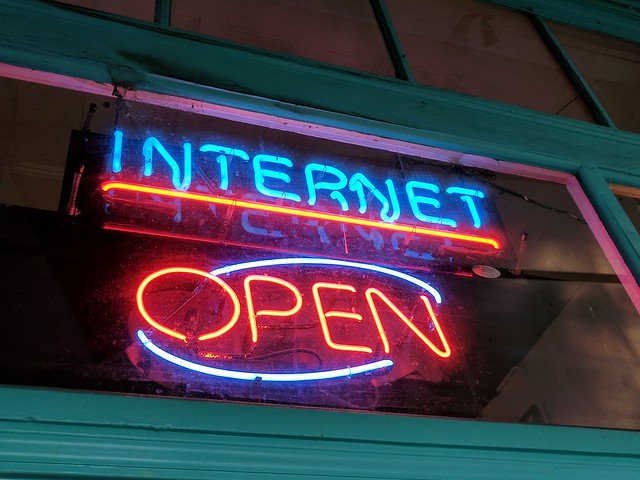
Internet Open, image by Liz Henry, license CC BY ND

First he says of the internet as commons
In economic terms, the Internet is a common pool resource; but non-rivalrous and non-excludable to such an extreme that to call it a pool or a resource is to insult what makes it common: that it is the simplest possible way for anyone and anything in the world to be present with anyone and anything else in the world, at costs that can round to zero.

As a commons, the Internet encircles every person, every institution, every business, every university, every government, every thing you can name. It is no less exhaustible than presence itself. By nature and design, it can’t be tragic, any more than the Universe can be tragic.

He then lists 9 enclosures of that commons currently visible, because enclosure is one of the affordances the internet provides.

See, the Internet is designed to support every possible use, every possible institution, and—alas—every possible restriction, which is why enclosure is possible. People, institutions and possibilities of all kinds can be trapped inside enclosures on the Internet.

  1. service provisioning, for example with asymmetric connection speeds. Asymmetry favours consumption over production. Searls singles out cable companies specifically for wanting this imbalance. I’ve been lucky from early on. Yes until fiber to the home, we had asymmetrical speeds, but I had a fixed IP address from the start and ran a web server under my desk from the mid ’90s until 2007 when I started using a hoster for this blog. I still run little experiments from my own server(s) at home. The web was intentioned to be both read and write even at the level of a page you visited (in short the web as online collaboration tool, in a way like Google documents). For most people the general web is preceived as read-only I assume, even if they participate in silos where they do post stuff themselves.
  2. 5G wireless service, as a way for telco’s to do the same as cable companies did before, in the form of content-defined packages. I am not sure if this could play out this way in the Netherlands or the EU, where net neutrality is better rooted in law, and where, especially after the end of roaming charges in the EU, metered data plans either have become meaningless as unmetered plans are cheap enough, or at least the metered plans themselves are large enough to make e.g. zero-rating a meaningless concept. 5G could however mean households might choose to no longer use a fixed internet subscription for at home, and do away with their own wifi networks, I suspect, and introducing a new dependency where your mobile and at home access are all the same thing and a singular choke point.
  3. government censorship, with China being the most visible one in this space, but many countries do aim to block specific services at least temporarily, and many countries and collections of countries are on the path to realising their own ‘data spaces’. While understandable, as data and networks are strategic resources now, it also carries the risk of fragmentation of the internet (Russia e.g.), motivated ostensibly by safety concerns but with a big dollop of wanting control over citizens.
  4. the advertising-supported commercial Internet. This is the one most felt currently. Adtech that tracks you across your websurfing habits, and not just in the silos you inhabit
  5. protectionism, which Searls ties to EU privacy laws, which I find a very odd remark. While GDPR could be better, it is a quality instrument with a rising floor, that is not designed to protect the EU market, but to encourage global compliance to its standards. A way of shaping instruments the EU uses more often, and has proven to be a succesfull export product. The cookie notices he mentions are a nuisance, but not the result of the GDPR, and in my mind more caused by interpreting the (currently under revision) cookie law in a deliberate cumbersome way. Even then, I don’t see how privacy regulation is protectionism, as it finds its root in human rights, not competition law.
  6. Facebook.org, or digital colonialism. This is the efforts by silos like FB to bring the ‘next billion’ online in a fully walled garden that is free of charge and presented as being the web, or worse the internet itself. I’ve seen this in action in developing countries and it’s unavoidable for most if not all, because it is the only way to access the power of agency that the internet promises, when there’s is no way you can afford connectivity.
  7. forgotten past, caused by the focus on the latest, the newest, while at the same time the old is not only forgotten but also actively lost as it gets taken offline etc. I think this is where strong opportunities are arising for niche search engines and also search engines as a personal tool. You don’t need to build the next Google or be a market player even, to meaningfully erode the position of Google search. For instance it is quite feasible to have my own search engine that only searches all the blogs I subscribe and have subscribed to (I actually should build that). At the same time, there is a slow steady and increasing effort of bringing more of the old, just not the old web, online by the ongoing digitisation of physical archives and collections of artefacts. More of our past, our global cultural heritage, is coming onto the web every day and it is really still only at the start.
  8. algorithmic opacity. This one is very much on the agenda across Europe currently, mainly as part of ethical discussions and right now mostly centered around government transparency. The GDPR contains a clause that automated algorithmic decision making about people is not allowed. At the very least having explainable alogrithms, and transparent usage of them is a likely emerging practice. Asymmetry of decision making also plays a useful role. This one too is closely tied to human rights which will help bring in parties to the discussion that are not of the tech world. At issue with what we currently see of algorithms is that they are used over our heads, and not yet much as personal tool, where it could increase our networked agency.
  9. the one inside our heads, where we accept the internet as it is presented to us by those invested in one or more of the above 8 enclosures. With understanding what the internet is and how it is a commons as a public awareness need.

Go read the entire thing, where Doc Searls describes what the internet is, how it connects to human experience and making the hyper local key again when there is a global commons encompassing everyone, and how it erodes and replaces institutions of the 20th century and earlier. He talks about how the internet “means we are all authors of each other“.

At the end he asks What might be the best way to look at the Internet and its uses most sensibly?, and concludes “I think the answer is governance predicated on the realization that the Internet is perhaps the ultimate commons“, and “There is so much to work on: expansion of agency, sensibility around license and copyright, freedom to benefit individuals and society alike, protections that don’t foreclose opportunity, saving journalism, modernizing the academy, creating and sharing wealth without victims, de-financializing our economies… the list is very long”

I’m happy to be working on the first three of those.

Walled garden, image by Ron Frazier, license CC BY

Favorited An app can be a home-cooked meal by Robin Sloan

(via Peter Rukavina and Roland Tanglao)

For a long time, I have struggled to articulate what kind of programmer I am. I’ve been writing code for most of my life, never with any real discipline, but/and I can, at this point, make the things happen on computers that I want to make happen. At the same time, I would not last a day as a professional software engineer……
I am the programming equivalent of a home cook.

Robin Sloan

I really like this metaphor by Robin Sloan. I would never call myself a ‘real’ programmer, or a programmer at all really. Yet, I’ve been programming stuff since I was 12. In BASIC during my school years, in assembly, Pascal, C++ at university, and in Perl, VisualBasic in my early days at work (which included programming the first intranet applications for my then employer), and currently in PHP and Applescript (to get my websites/tools and my laptop to do the things I want). Except for some university assignments all of that programming was and is because I want to, and done in spare time.

I too am the programming equivalent of a home cook (which coincidentally I also am).

Robin Sloan also hits on what irks me about the ‘everyone needs to learn to code’ call to action. “The exhortation “learn to code!” has its foundations in market value. “Learn to code” is suggested as a way up, a way out… offers economic leverage … [it] goes on your resume.”

“People don’t only learn to cook so they can become chefs. Some do! But far more people learn to cook so they can eat better, or more affordably, or in a specific way…..”

The above is I think an essential observation. Eating better, more affordably or in a specific way, translates to programming with the purpose to hone the laptop as your tool of trade and adapt it to your own personal workflows, making it support and work with your very own quirks. This is precisely what I don’t get from some that I quizz about their tool use, the way they accept the software on their laptop as is, and don’t see it as something you can mould to your own wishes at all.

“And, when you free programming from the requirement to be general and professional and scalable, it becomes a different activity altogether, just as cooking at home is really nothing like cooking in a commercial kitchen.”

Removing the aura of ‘real programming’ from all and any programming except paid for programming, might just break this ‘I’m not a programmer so I better accept the way software works as the vendor delivered it’ effect.

Me and Boris Mann cooking in his kitchen in Vancouver in 2008. Coincidentally we connected through our desire to shape tools to our personal wishes. Programming as a home cook, brought us together to well, home cook. His blog still is a mix of cooking and programming well over a decade on.

In reply to Things that have caught my eye: An Algorithm That Grants Freedom, or Takes It Away. by Euan Semple

One element to look for in algorithms I think is if they are symmetric or asymmetric in how its choices are treated. I just helped realise an automated subsidy allocation decision process for a Dutch regional government. Key element is that subsidy requests can be automatically awarded (cutting back the processing time from 13 weeks and payment in 17 weeks, to immediate and payment to under 5 days), but that requests cannot be automatically denied. If the automatic process can’t allocate automatically it goes to a civil servant that reviews the request and allocates or denies the subsidy. (Not coincidentally the GDPR forbids automated decision making about people, especially if that decision is detrimental to the person being decided about)

Algorithms already deciding all sorts of things to do with people’s lives. Who gets to decide their priorities and how will we feel when we realise that they are already being applied to us?

Euan Semple