Favorited Reflections on My “Summer of Proust.” by Gretchen Rubin

I like this notion by Gretchen Rubin of defining an ‘adventure’ for the summer. I try to do one ‘extracurricular’ activity per quarter (e.g. 12 hacks in Q1, or how we used to do a month in another European city each year), but framing it as a seasonal adventure has a more human ring to it. Makes it an epic tale of which you are both the narrator and protagonist.

A season is 13 weeks, and that is a useful time span to plan something for. It is small enough to keep an overview and keep track, and long enough to do something meaningful even with little bits of time. I’ve been doing my own planning in 13 week periods for 6 years now, and name those 13 weeks periods by season (although they actually coincide with quarters).

With Summer almost behind us, what will be my adventure of the Fall?

Every spring, on the Happier with Gretchen Rubin podcast, my sister Elizabeth and I talk about our yearly resolution to “Design your summer.” This resolution was originally inspired by this passage from Robertson Davies:

“Every man makes his own summer. The season has no character of its own, unless one is a farmer with a professional concern for the weather. Circumstances have not allowed me to make a good summer for myself this year … My summer has been overcast by my own heaviness of spirit. I have not had any adventures, and adventures are what make a summer.”

This passage inspired me to make sure that every summer has some sort of adventure.

Gretchen Rubin, in turn citing Robertson Davies

Amexus is organising a conference on digitisation in the energy sector, and more specifically in the energy transition. Earlier this week I was interviewed at home about the role of open data in energy transition and my work with Dutch provinces on this topic.

The video, in German, has already been made available.

Since the summer I am holding three questions that are related. They all concern what role machine learning and AI could fulfil for an individual or an everyday setting. Everyman’s AI, so to speak.

The first question is a basic one, looking at your house, and immediate surroundings:

1: What autonomous things would be useful in the home, or your immediate neighbourhood?

The second question is more group and community oriented one:

2: What use can machine learning have for civic technology (tech that fosters citizen’s ability to do things together, to engage, participate, and foster community)?

The third question is perhaps more a literary one, an invitation to explore, to fantasise:

3 What would an “AI in the wall” of your home be like? What would it do, want to do? What would you have it do?

(I came across an ‘AI in the wall’ in a book once, but it resided in the walls of a pub. Or rather it ran the pub. It being a public place allowed it to interact in many ways in parallel, so as to not get bored)

Today my old friend Max interviewed me in our garden. We discussed the role of digitisation in general, and of open data in particular, for the energy transition. This in preparation for the energie.digital conference I will be speaking at in Germany next month. It was a good rehearsal as well, as I will be speaking in German, and I need to work on my German language jargon 🙂

Heute hat mein alter Freund Max in unserem Garten ein Video-Interview mit mir gemacht. Im September werde ich auf der von seiner Firma organisierten Konferenz energie.digital sprechen über Open Data, und wie offene Daten eine Rolle spielen in der Energiewende.


Max setting up his equipment, and borrowing some more equipment from Elmine, my in house video professional

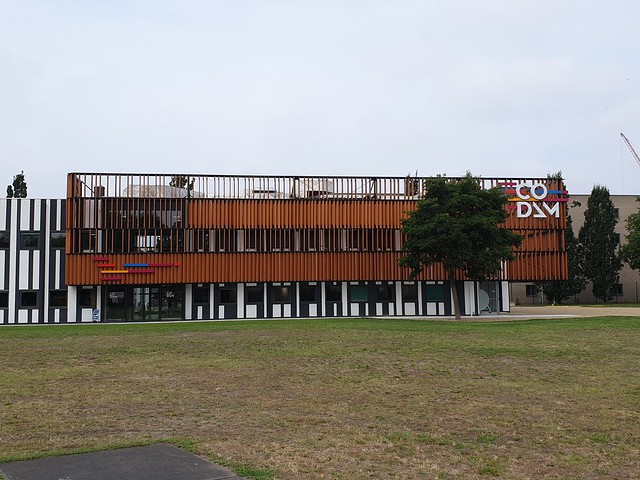
Yesterday I visited CODAM, a new Amsterdam coding college. It’s part of the 42 network, which originated in France, and offers a free 4 year curriculum to learn how to code (one or more of unix, graphics, machine learning). The education is free, and aimed at those who didn’t fit or couldn’t afford the regular educational options, dropped out or never had the opportunity to opt-in. The commitment is however large. The first month is a heavy filter, expecting students to keep a steady rhythm, and afterwards a high attendance is expected (some 50 hours per week).

CODAM’s mission of allowing students from all backgrounds to increase their capabilities, using coding skills as a path to agency, has a good overlap with the IndieWeb’s ambition of allowing people to own their own on-line identity, be in control of what they publish and share, and connect and interact outside the silos.

A month ago CODAM’s Lisa Stamm, the community and communications person, offered CODAM as a venue for IndieWebCamp Amsterdam. Yesterday I had the opportunity to visit their location on the old Amsterdam naval yard, near Central Station. CODAM and their location are a good fit with IndieWebCamp’s needs, so the conclusion was easy:

IndieWebCamp Amsterdam will take place at CODAM on September 28th and 29th.

Registration is already open, and free of charge. Both the View Source conference and the Fronteers conference take place in the days after, so if you’re in web dev you could turn it into a full week in Amsterdam.

Some pictures of the CODAM venue, and its surroundings below