Bookmarked WordPress AI: Generative Content & Blocks (by Joe Hoyle, found via Chuck Grimmett)

As many others I am fascinated by what generative algorithms like ChatGPT for texts and Stable Diffusion for images can do. Particularly I find it fascinating to explore what it might do if embedded in my own workflows, or how it might change my workflows. So the link above showing an integration of ChatGPT in WordPress’ Gutenberg block editor drew my attention.

The accompanying video shows a mix of two features. First having ChatGPT generate some text, or actually a table with specific data, and having ChatGPT in ‘co-pilot’ style generate code for Gutenberg blocks. I think the latter might be actually useful, as I’ve seen generative AI put to good use in that area. The former, having ChatGPT write part of your posting is clearly not advisable. And the video shows it too, although the authors don’t point it out or haven’t reflected on the fact that ChatGPT is not a search engine but geared to coming up with plausible stuff without being aware of its actual information (the contrast with generating code is that code is much more highly structured in itself so probabilities collapse easier to the same outcome).

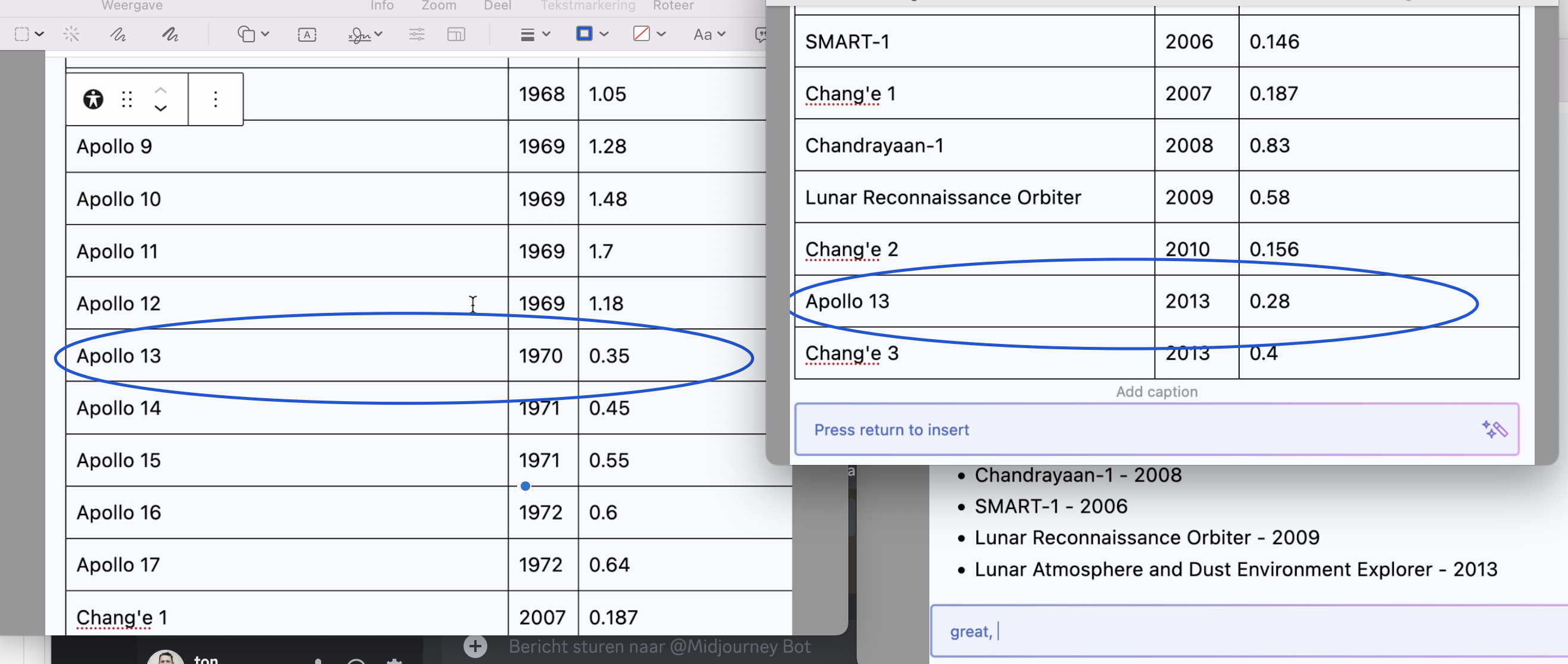
The blogpost in the video is made by generating a list of lunar missions, and then turning them into a table, adding their budgets and sorting them chronologically. This looks very cool in the vid, but some things jump out as not ok. Results jump around the table for instance: Apollo 13 moves from 1970 to 2013 and changes budget. See image below. None of the listed budgets for Apollo missions, nor their total, match up with the detailed costs overview of Apollo missions (GoogleDocs spreadsheet). The budget column being imaginary and the table rows jumping around makes the result entirely unfit for usage of course. It also isn’t a useful prompt: needing to fact check every table field is likely more effort and less motivating than researching the table yourself from actual online resources directly.
It looks incredibly cool ‘see me writing a blogpost by merely typing in my wishes, and the work being done instantly’, and there are definitely times I’d wish that to be possible. To translate a mere idea or thought into some output directly however means I’d skip confronting such an idea with reality, with counter arguments etc. Most of my ideas only look cool inside my head, and need serious change to be sensibly made manifest in the world outside my head. This video is a bit like that, an idea that looks cool in one’s head but is great rubbish in practice. ChatGPT is hallucinating factoids and can’t be trusted to create your output. Using it in the context of discovery (as opposed to the justification context of your output such as in this video) is possible and potentially useful. However this integration within the Gutenberg writing back-end of WordPress puts you in the output context directly so it leads you to believe the generated plausible rubbish is output and not just prompting fodder for your writing. ‘Human made’ is misleading you with this video, and I wouldn’t be surprised if they’re misleading themselves as well. A bit like staging the ‘saw someone in half and put them together again’ magician’s trick in an operating room and inviting surgeons to re-imagine their work.

Taking a native-first approach to integrating generative AI into WordPress, we’ve been experimenting with approaches to a “WordPress Copilot” that can “speak” Gutenberg / block-editor.

Copy-pasting paragraphs between ChatGPT and WordPress only goes so far, while having the tools directly embedded in the editor … open up a world of possibilities and productivity wins…

Joe Hoyle


An android robot is filling out a table listing Apollo missions on a whiteboard, generated image using Midjourney

Bookmarked Feedly launches strikebreaking as a service (by Molly White)

Molly White does a good write-up of the extremely odd and botched launch by Feedly of a service to keep tabs on protests that might impact your brand, assets or people. Apparently in that order too. When E first mentioned this to me I was confused. What’s the link with a feedreader after all? Feedly’s subsequent excuse ‘we didn’t consider abuse of this service’ sounds rather hollow, as their communications around it seem to precisely focus on the potential abuse being the service announced.

The question ‘how did Feedly end-up here?’ kept revolving in my mind. Turns out the starting point is logged in my own blog:

Machines can have a big role in helping understand the information, so algorithms can be very useful, but for that they have to be transparent and the user has to feel in control. What’s missing today with the black-box algorithms is where they look over your shoulder, and don’t trust you to be able to tell what’s right.

Edwin Khodabakchian cofounder and CEO of RSS reader Feedly, in Wired, March 2018

In a twisted way I can see the reflection of that quote in the service Feedly announced. Specifically w.r.t. the first part, using algorithms to better understand information. The second part seems to have gone missing in the past 5 years though, the bit about transparency, avoiding black boxes, and putting users in control. Especially the ‘not trusting people to tell what’s right’ grates. It seems to me Feedly users in the past days very much could tell what’s right and Feedly hoped they wouldn’t.

I do agree with the 2018 quote though, but ‘algorithmic interpretation as a service‘ isn’t what follows to me. That’s just a different way of commoditising your customers.
Algorithmic spotting of emergent patterns is relevant if I can define the context and network of people (and perhaps media sources) whose feeds I follow. For that I need to be in control of the algorithm, and need to be the one who defines what specific emergent patterns I am interested in. That is on my list for my ideal feed reader. But this botched Feedly approach isn’t that.

I have a little over 25 years worth of various notes and writings, and a little over 20 years of blogposts. A corpus that reflects my life, interests, attitude, thoughts, interactions and work over most of my adult life. Wouldn’t it be interesting to run that personal archive as my own chatbot, to specialise a LLM for my own use?

Generally I’ve been interested in using algorithms as personal or group tools for a number of years.

For algorithms to help, like any tool, they need to be ‘smaller’ than us, as I wrote in my networked agency manifesto. We need to be able to control its settings, tinker with it, deploy it and stop it as we see fit.
Me, April 2018, in Algorithms That Work For Me, Not Commoditise Me

Most if not all of our exposure to algorithms online however treats us as a means to manipulate our engagement. I see them as potentially very valuable tools in working with lots of information. But not in their current common incarnations.

Going back to a less algorithmic way of dealing with information isn’t an option, nor something to desire I think. But we do need algorithms that really serve us, perform to our information needs. We need less algorithms that purport to aid us in dealing with the daily river of newsy stuff, but really commodotise us at the back-end.
Me, April 2018, in Algorithms That Work For Me, Not Commoditise Me

Some of the things I’d like my ideal RSS reader to be able to do are along such lines, e.g. to signal new patterns among the people I interact with, or outliers in their writings. Basically to signal social eddies and shifts among my network’s online sharing.

LLMs are highly interesting in that regard too, as in contrast to the engagement optimising social media algorithms, they are focused on large corpora of text and generation thereof, and not on emergent social behaviour around texts. Once trained on a large enough generic corpus, one could potentially tune it with a specific corpus. Specific to a certain niche topic, or to the interests of a single person, small group of people or community of practice. Such as all of my own material. Decades worth of writings, presentations, notes, e-mails etc. The mirror image of me as expressed in all my archived files.

Doing so with a personal corpus, for me has a few prerequisites:

  • It would need to be a separate instance of whatever tech it uses. If possible self-hosted.
  • There should be no feedback to the underlying generic and publicly available model, there should be no bleed-over into other people’s interactions with that model.
  • The separate instance needs an off-switch under my control, where off means none of my inputs are available for use someplace else.

Running your own Stable Diffusion image generator set-up as E currently does complies with this for instance.

Doing so with a LLM text generator would create a way of chatting with my own PKM material, ChatPKM, a way to interact (differently than through search and links, as I do now) with my Avatar (not just my blog though, all my notes). It might adopt my personal style and phrasing in its outputs. When (not if) it hallucinates it would be my own trip so to speak. It would be clear what inputs are in play, w.r.t. the specialisation, so verification and references should be easier to follow up on. It would be a personal prompting tool, to communicate with your own pet stochastic parrot.

Current attempts at chatbots in this style seem to focus on things like customer interaction. Feed it your product manual, have it chat to customers with questions about the product. A fancy version of ‘have you tried switching it off and back on?‘ These services allow you to input one or a handful of docs or sources, and then chat about its contents.
One of those is Chatbase, another is ChatThing by Pixelhop. The last one has the option of continuously adding source material to presumably the same chatbot(s), but more or less on a per file and per URL basis and limited in number of words per month. That’s not like starting out with half a GB in markdown text of notes and writings covering several decades, let alone tens of GBs of e-mail interactions for instance.

Pixelhop is currently working with Dave Winer however to do some of what I mention above: use Dave’s entire blog archives as input. Dave has been blogging since the mid 1990s, so there’s quite a lot of material there.
Checking out ChatThing suggests that they built on OpenAI’s ChatGPT 3.5 through its API. So it wouldn’t qualify per the prerequisites I mentioned. Yet, purposely feeding it a specific online blog archive is less problematic than including my own notes as all the source material involved is public anyway.
The resulting Scripting News bot is a fascinating experiment, the work around which you can follow on GitHub. (As part of that Dave also shared a markdown version of his complete blog archives (33MB), which for fun I loaded into Obsidian to search through. Also for comparison with the generated outputs from the chatbot, such as the question Dave asked the bot when he first wrote about the iPhone on his blog.)

Looking forward to more experiments by Dave and Pixelhop. Meanwhile I’ve joined Pixelhop’s Discord to follow their developments.

In October 2017 Maltese investigative journalist Daphne Caruana Galizia was assassinated by planting an explosive in her car. She worked on exposing financial and political corruption, and worked on the Panama Papers. Last year October the murderers were convicted, while the court case against the political and business principal is still ongoing. Four months later Slovak journalist Ján Kuciak was gunned down alongside with his life partner Martina Kušnírová, possibly after his name leaked from freedom of information requests. Kuciak was also involved in reporting on the Panama Papers. In that case the gunmen have been convicted, whereas similarly to Caruana Galizia’s case, the court case against the principal, also a politically connected businessman, is still ongoing. That is to say both were murdered by the klept, to use William Gibson’s label, for their work on transparency. As someone who has worked on government transparency for some 15 years from a different angle, there are always some overlaps between my (net)work and European investigative journalists, the organisations they work with and the projects they work on.

A large part of this week I was in Valletta, Malta, for the EuroGeographics General Assembly. Tuesday afternoon I strolled around town, and made sure to visit the impromptu memorial for Daphne Caruana Galizia that is on Republic Street in front of the courts of justice. Because the case is still ongoing, the corruption still in place therefore. And because upon arrival the very first Maltese newspaper I saw Sunday evening carried a headline about the assassination, still in the spotlight of attention five and a half years after the fact.


The improvised memorial for Daphne Caruana Galizia, calling for justice to be done almost 6 years on. Located on the square in front of St. Johns Cathedral along Republic Street, facing the front doors of the Courts of Justice. (Photo by me)


The Sunday Malta Times of 19 March 2023, with a headline connected to the 2017 assassination of Daphne Caruana Galizia.

This conversation on 11 August 2022 with GPT-3 describes an alternate universe in which I was a prominent business blogger. An interpretation of my two decades of blogging as generated by GPT-3.
(text in bold are my prompts to the GPT-3 algorithm. Coded text is the AI response. italic texts between () and are my comments on the algorithm output.)

When did Ton Zijlstra start blogging?
Ton Zijlstra started blogging in 2003.

(I started blogging in 2002 on Blogspot, but switched to my own domain in the spring of 2003, so this could be an understandable internet search outcome)

Why did Ton Zijlstra start blogging and what were the topics he blogged about?

Ton Zijlstra started blogging to share his knowledge and thoughts on various topics with the world. He has blogged about topics such as business, technology, and personal development.

(this is particularly bland meaningless text)

What is the most impactful posting he ever wrote on his blog?

The most impactful posting Ton Zijlstra ever wrote on his blog is "The Power of Connections".
In this posting, he talks about the importance of networking and building relationships with others. "The Power of Connections" was his most impactful blog because it helped him to connect with others and build relationships that have helped him both personally and professionally.

What are some of the awards Ton Zijlstra has won for his blog? Ton Zijlstra has won the Best Business Blog Award in 2006 and 2007, and the Best European Business Blog Award in 2008.

(No such posting exists, I did cover the topic though, but would not have created such a sales-pitchy title.
GPT-3 comes up with a question of its own here! This blog(ger) has never won or competed for awards.)

Of course he didn’t blog just on his own, he was part of a network of bloggers and their blogs that together had meaningful conversations. A great example of such a cross-blog conversation that garnered much attention is….
...the one on Ton's weblog on 13 September 2005, where he asked What is a blog?. This was picked up by Doc Searls, Stowe Boyd, Dave Winer, Robert Scoble, and many others, and is still being referenced today.
(This is intriguing, mentioning a specific date. No such posting exists on my blog, I did not even post on that date. My blog never asked "what is a blog", at least a search comes up empty, but it is a typical question from when we were blogging a lot about figuring out blogging, and the bloggers mentioned, while US centric, all would have had such discussions, that I would have been aware of in my feedreader. Where I in the prompt hint towards conversations in a network of bloggers, GPT-3 turns that into a single blogpost by me being ‘picked up’, phrasing it as amplification rather than conversation.)

There were instances where Ton’s blogposts carried over into academic research. An early example of that was…
...his weblogpost on 'the daily me', where he pointed out the potential dangers of a world in which we would only be exposed to information that we already like, and which confirmed our beliefs. This was picked up and elaborated on by danah boyd in her doctoral dissertation.

(The Daily Me is a 1995 term used by MIT Media Lab’s Nicholas Negroponte in ‘Being Digital‘, a book from 1995. boyd’s 2008 dissertation "Taken out of context, American teen sociality in networked publics" doesn’t mention it, although it references Negroponte’s 1995 book in passing. Blog conversations, including one in which my blog played a central role, were a key part of Lilia Efimova’s 2009 dissertation titled “Passion at work: blogging practices of knowledge workers. See the final image of such wide spread conversations, called the ‘big one’ by Anjo Anjewierden who created the image, at the end of this post)

Ton's blog has been a source of inspiration for many people. One of his blogposts that has been particularly popular, is the one in which he proposed the 10-90 rule: for every hour you spend creating content, you should spend 9 hours connecting with others. This blogpost has been referenced by many people, and has been translated into several languages. Ton Zijlstra's blog has had a significant impact on the blogging community and has helped to shape the way we think about blogging and its role in our lives.

(Ha, this phrasing is all so brand-me blogging and bland in tone (which reflects a lot of blogging)! Online search surfaces a 10-90 rule of thumb from the pre-online advert era, where 10% of budget would be for ad content, and 90% of budget for buying space in media (air time, pages in print). Here that’s turned to time spent and content versus making connections with others. There might be something to it as a suggestion, although turning it into a rule of thumb, makes connection more of a means than an end in itself.)


Image generated with Stable Diffusion using the prompt “A human and an android robot have a conversation in a podcast interview setting, oil on canvas painting style”, public domain.

John Caswell writes about the role of conversation, saying "conversation is an art form we’re mostly pretty rubbish at". New tools that employ LLM’s, such as GPT-3 can only be used by those learning to prompt them effectively. Essentially we’re learning to have a conversation with LLMs so that its outputs are usable for the prompter. (As I’m writing this my feedreader updates to show a follow-up post about prompting by John.)

Last August I wrote about articles by Henrik Olaf Karlsson and Matt Webb that discuss prompting as a skill with newly increasing importance.

Prompting to get a certain type of output instrumentalises a conversation partner, which is fine for using LLM’s, but not for conversations with people. In human conversation the prompting is less to ensure output that is useful to the prompter but to assist the other to express themselves as best as they can (meaning usefulness will be a guaranteed side effect if you are interested in your conversational counterparts). In human conversation the other is another conscious actor in the same social system (the conversation) as you are.

John takes the need for us to learn to better prompt LLM’s and asks whether we’ll also learn how to better prompt conversations with other people. That would be great. Many conversations take the form of the listener listening less to the content of what others say and more listening for the right time to jump in with what they themselves want to say. Broadcast driven versus curiosity driven. Me and you, we all do this. Getting consciously better at avoiding that common pattern is a win for all.

In parallel Donald Clark wrote that the race to innovate services on top of LLM’s is on, spurred by OpenAI’s public release of Chat-GPT in November. The race is indeed on, although I wonder whether those getting in the race all have an actual sense of what they’re racing and are racing towards. The generic use of LLM’s currently in the eye of public discussion I think might be less promising than gearing it towards specific contexts. Back in August I mentioned Elicit that helps you kick-off literature search based on a research question for instance. And other niche applications are sure to be interesting too.

The generic models are definitely capable to hallucinate in ways that reinforce our tendency towards anthropomorphism (which needs little reinforcement already). Very very ELIZA. Even if on occasion it creeps you out when Bing’s implementation of GPT declares its love for you and starts suggesting you don’t really love your life partner.

I associated what Karlsson wrote with the way one can interact with one’s personal knowledge management system the way Luhmann described his note cards as a communication partner. Luhmann talks about the value of being surprised by whatever person or system you’re communicating with. (The anthropomorphism kicks in if we based on that surprisal then ascribe intention to the system we’re communicating with).

Being good at prompting is relevant in my work where change in complex environments is often the focus. Getting better at prompting machines may lift all boats.

I wonder if as part of the race that Donald Clark mentions, we will see LLM’s applied as personal tools. Where I feed a more open LLM like BLOOM my blog archive and my notes, running it as a personal instance (for which the full BLOOM model is too big, I know), and then use it to have conversations with myself. Prompting that system to have exchanges about the things I previously wrote down in my own words. With results that phrase things in my own idiom and style. Now that would be very interesting to experiment with. What valuable results and insight progression would it yield? Can I have a salon with myself and my system and/or with perhaps a few others and their systems? What pathways into the uncanny valley will it open up? For instance, is there a way to radicalise (like social media can) yourself by the feedback loops of association between your various notes, notions and follow-up questions/prompts?


An image generate with Stable Diffusion with the prompt “A group of fashionable people having a conversation over coffee in a salon, in the style of an oil on canvas painting”, public domain