A while ago Peter wrote about energy security and how having a less reliable grid may actually be useful to energy security.

This the difference between having tightly coupled systems and loosely coupled systems. Loosely coupled systems can show more robustness because having failing parts will not break the whole. It also allows for more resilience that way, you can locally fix things that fell apart.

It may clash however with our current expectations of having electricity 24/7. Because of that expectation we don’t spend much time about being clever in our timing and usage of energy. A long time ago I provided training to a group of some 20 Iraqi water provision managers, as part of the rebuilding efforts after the US invasion of Iraq. They had all kinds of issues obviously, and often issues arising in parallel. What I remember connected to Peter’s post is how they described Iraqi citizens had adapted to the intermittent availability of electricity and water. How they made things work, at some level, by incorporating the intermittent availability of things into their routines. When there was no electricity they used water for cooling, and vice versa for instance. A few years ago at a Border Sessions conference in The Hague, one speaker talked about resilience and intermittent energy sources too. He mentioned the example that historically Dutch millers had dispensation of visiting church on Sundays if it was windy enough to mill.

The past few days in Dutch newspapers a discussion is taking place that some local solar energy plans can’t be implemented because the grid maintainers can’t deal with the inputs. Now this isn’t necessarily true, but more the framing that comes with the current always on macro-grid. Tellingly any mention of micro grids, or local storage is absent from that framing.

In a different discussion with Peter Rukavina and with Peter Bihr, it was mentioned that resilience is, and needs to be, rising on the list of design principles. It’s also the reason why resilience is one of three elements of agency in my networked agency thinking.


Power lines in Canada, photo Ian Muttoo, license CC BY SA

Wilma Haan has been named the new general director of the Open State Foundation. As, the equally new, chairman of the board of the Open State Foundation, I think her joining OSF is a great new step for the organisation. Backed by strong experience in both journalism and digital, she has shown herself a great energy source that will strengthen the team. The fit with Tom, who stepped in as interim director when Arjan left last summer, and the rest of the team is also very good. Tom has done great work as interim director in the past months, and will be the new deputy director. Together they will bring the Open State Foundation further, I am convinced, and I look forward to working with them both. I hope to learn lots from them, as my role on the board is a recent one as well.

Today I made my first Open Street Map edit. Open Street Map is a global map, created by its users (which includes lots of open government geographic data). My first edit was triggered by Peter Rukavina’s call to action. He wrote how he wants to add or correct Open Street Map data for a location when he mentions that location or business in his blogposts. He also calls upon others to do the same thing.

I don’t think I mention locations such as restaurants often or even at all in my blog, so it’s an easy enough promise for me to make. However, I did read and copy the steps Peter describes. First installing Alfred on my laptop. Alfred is a workflow assistant basically. I know Peter uses it a lot, and I looked at it before, and until now concluded that the Mac’s standard Spotlight interface and Hazel work well enough for me. But the use case he describes for quickly searching in a map through Alfred made sense to me: it’s a good way to make Open Street Map my default search option, and foregoing Google Maps. So I installed Alfred, and made a custom search to use Open Street Map (OSM).

The next step was seeing if there was something small I could do in OSM. Taking a look on the map around our house, I checked the description of the nearest restaurant and realised most meta-data (such as opening hours, cuisine, etc) were missing. I registered my account on OSM, and proceeded to add the info. As Peter mentions, such edits immediately get passed on to applications making use of OSM. One of those applications is a map layer showing restaurants that are currently open, and my added opening hours show up immediately:

My first edit also resulted in being contacted by a OSM community member, as they usually review the early edits any new user makes. It seems I inadvertently did something wrong regarding the address (OSM in the Netherlands makes use of the government data on addresses, BAG, and I entered an address by hand. As it came from a pick-up list I assumed it was sourced from the BAG, but apparently not). So that’s something to correct, after I find out how to do that.

[UPDATE: The fix was simple to do. The issue was that in the Netherlands the convention is to add meta data about stores to its corresponding address node (not as a separate node, unless there are more businesses at the same address). So the restaurant node I amended should not have been there. I copied all the attributes (tags) over to the address node, and then deleted the original node I edited. The information about the restaurant is now available from the address node itself. If you follow the link to the earlier node, you will now see it says that I deleted it.

I think it’s also great that within minutes of my original edit I had a message from a long time community member, Eggie. He welcomed me, pointed me to some resources on good practice and conventions, before providing some constructive criticism and nudge me in the right direction. Not by fixing what I did wrong, but by explaining why something needed improvement, and linking to where I could find out how to fix it myself, and saying if I had any questions to message him. After my correction I messaged him to check if everything was up to standard now which he acknowledged, ending with ‘happy mapping’. This is the type of welcoming and guidance that healthy communities provide. My Wikipedia experiences have been different I must say.
/UPDATE]

Mozilla fellow, artist and distributed web promoting coder Darius Kazemi has launched the 365 RFCs project. For each day of 2019 he will post and discuss a RFC, request for comment, of the Network Working Group. Starting with the very first RFC that was published in April 1969, 50 years ago, and continuing to RFC 365 (published in July 1972).

Darius writes “In honor of [the 50th] anniversary [of RFC1], I figured I would read one RFC each day of 2019, starting with RFC 1 and ending with RFC 365. I’ll offer brief commentary on each RFC. I’m interested in computer history and how organizations communicate so I think this should prove pretty interesting even though RFCs themselves can be legendarily dry reading (the occasional engineering humor RFC notwithstanding).”

I think it’s good to bring the early internet (or arpanet) history to attention. This because I think having a basic understanding of how the internet works is a civic requirement for the 21st century. So add Kazemi’s project to your RSS reader (here’s the feed), and follow 3 years of internet history in 2019. (found via Frank Meeuwsen and Jeremy Keith)

It’s the end of December, and we’re about to enjoy the company of dear friends to bring in the new year. This means it is time for my annual year in review posting, the ‘Tadaa!’ list.

Eight years ago I started writing end-of-year blogposts listing the things that happened that year that gave me a feeling of accomplishment, that make me say ‘Tadaa!’. (See the 2017, 2016, 2015, 2014, 2013, 2012, 2011 and 2010 editions). I am always moving forwards to the next thing as soon as something is finished, and that often means I forget to celebrate or even acknowledge things during the year. Sometimes I forget things completely. Although I have worked on improving that sense of awareness over the past few years, it remains a good way to reflect on the past 12 months. So, here’s this year’s Tadaa!-list:

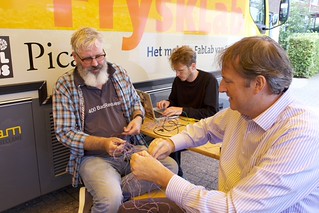
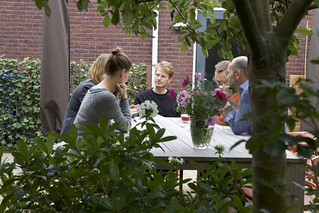
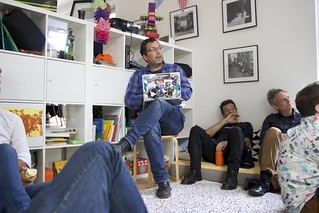
  • The Smart Stuff That Matters unconference and bbq party in honour of Elmine’s 40th birthday was an awesome event bringing together so many great people from our various contexts. Thank you to all who were there, from right next door to halfway across the globe, and so many different places in between. It is a great privilege you came together in our home.
    STM18 STM18
    STM18 STM18
    STM18 STM18
    STM18 STM18
    STM18 STM18
    STM18
    So much fun having you all at STM18! Of course we had the mythical German sausages again….
    Through the Eyes of the Artist
    Peter made a sketch of our house, sitting in the garden
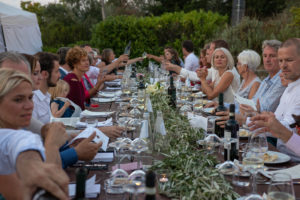
  • Being witness and officiating at our dear friends’ Klaas and Amarens wedding in Tuscany.


    Dinner al fresco / Thirty years of friendship (images by Elmine)
  • Presenting Networked Agency during a keynote at State of the Net in Trieste. A great opportunity to create a better narrative to explain Networked Agency, and present it to a much wider audience. Also great to see Paolo and Monica, as well as many others again.
    sotn2018 Sotn 18
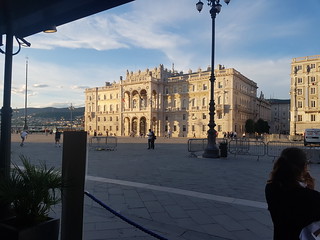
    Our friend Paolo opening State of the Net, enjoying the beautiful city of Trieste
  • Working in Serbia, Italy, UK, Germany, Netherlands, Belgium.
  • Creating a measurement framework for open data impact, that allows for different levels of maturity, embraces complexity, and aims to prevent gaming of measurements.
  • Getting tremendous feedback by the funder of a client project last year, that it was the most exciting thing they funded.
  • Getting asked back by multiple clients
  • Joining the board of Open Nederland, the Dutch Creative Commons chapter as treasurer
  • Joining the board of Open State Foundation, the leading Dutch advocate for open government, as its chairman, after having been one of the initiators of the very first event in 2008, that later turned into this great organisation
  • Taking the time to just hang out with other geeks at IndieWebCamp in Nürnberg
  • I spent every Friday at home to be with our daughter. A joy to watch her develop.
    20181014_092552
  • Giving the opening key-note at FOSS4GNL. I especially enjoyed writing the narrative for it, which ties local data governance to geopolitics and ethics.

    the Dutch open source geo community, and during the keynote (images Steven Ottens)
  • Got to be there for friends, and friends got to be there for me. Thank you.
  • Sponsoring the Open Knowledge Belgium conference with my company The Green Land, and participating in the conference with our entire team, and providing two sessions.
  • Finding my voice back in blogging. I’ve written more blogposts this year than the preceding eleven combined, and as much as the first 5 years of busiest blogging combined. As a result I’ve also written much more in-depth material than any other year since I started in 2002. This has created more space for reflection and exploration, useful to shape my ideas and direction in my work. It was inspiring to renew the distributed conversations with other bloggers. As a result I am revisiting much of my writing about information strategies and the workings of human digital networks.
  • Working with a client to further detail and document both Networked Agency and the ‘impact through connection’ project we based on it.
  • Making day trips with Elmine and (not always) Y, e.g. to BredaPhoto, Eddo Hartmann and Fries Museum. Making good use of our more central location.
  • Started to make better use of the various spaces our house offers, like the garden, the attic studio, and my own room. Room for improvement in the next year though.
  • Avoiding feeling hurried, while keeping up the level of results.

All in all it was a rather unhurried year, with more time for reflection about next and future steps. I worked 1728 hours, which averages out to about 36,5 per week worked. This is not yet getting closer to the 4 day work weeks I actually have, compared to last year, but at least stable.
I’ve read 69 books, at a steady pace. All fiction, except for a handful. I’m looking to create the space to start reading more non-fiction. That likely requires a separate approach.

Elmine gave me an amazing sculpture for my birthday, called “Strange Bird Totem”. The artist Jacqueline Schäfer’s work is described as “showing a positive vibe for life in a complex modern society“. That sort of feels like a great motto for the next year. Ever onwards!

US Congress just before leaving for Christmas has voted to approve a new law, that mandates two key elements: public information is open by default and needs to be made actively available in machine readable format, as well as that policy making should be evidence based. In order for agencies to comply they will need to appoint a Chief Data Officer.

I think while of those two the first one (open data) is the more immediately visible, the second one, about evidence based policy making, is much more significant long term. Government, especially politics, often is willingly disinterested in policy impact evaluation. It’s much more status enhancing to announce new plans than admitting previous plans didn’t come to anything. Evidence based policy will help save money. Additionally government agencies will soon realise that doing evidence based policy making is made a lot easier if you already do open data well. The evidence you need is in that open data, and it being open allows all of us to go look for that evidence or its absence.

There’s one caveat to evidence based policy making: it runs the risk of killing any will to experiment. After all, by definition there’s no evidence for something new. So a way is needed in which new policies can be tried out as probes. To see if there’s emerging evidence of impact. Again, that evidence should become visible in existing open data streams. If evidence is found the experimental policy can be rolled out more widely. Evidence based policies need experiments to help create an evidence base, not just of what works but also of what doesn’t.

A great result for the USA’s open government activists. This basically codifies the initiatives of the Obama Presidency, which were the trigger for much of the global open data effort these last 10 years, into US federal law.