Through a posting of Roel I came across Rick Klau again, someone who like me was blogging about knowledge management in the early ’00s. These days his writing is on Medium it seems.

Browsing through his latest posts, I came across this one about homebrew contact management.

Contact management is one area where until now I mostly stayed away from automating anything.
First and foremost because of the by definition poor initial data quality that you use to set it up (I still have 11 yr old contact info on my phone because it is hard to delete, and then gets put back due to some odd feedback loop in syncing).
Second, because of the risk of instrumentalising the relationships to others, instead of interacting for its own sake.
Third, because most systems I encountered depend on letting all your mail etc flow through it, which is a type of centralisation / single point of failure I want to avoid.

There’s much in Rick’s post to like (even though I doubt I’d want to shell out $1k/yr to do the same), and there are things in there I definitely think useful. He’s right when he says that being able to have a better overview of your network in terms of gender, location, diversity, background etc. is valuable. Not just in terms of contacts, but in terms of information filtering when you follow your contacts in several platforms etc.

Bookmarked to come up with an experiment. Timely also because I just decided to create a simple tool for my company as well, to start mapping stakeholders we encounter. In Copenhagen last September I noticed someone using a 4 question page on her phone to quickly capture she met me, the context and my organisation. When I asked she said it was to have an overview of the types of organisations and roles of people she encountered in her work, building a map as it were of the ecosystem. Definitely something I see the use of.

Handshakes and conversations is what I’m interested in, not marketing instruments. Image Handshake by Elisha Project, license CC BY SA

Earlier this week I wrote how European IPv4 addresses have now all been allocated. The IPv6 address space is extremely bigger than IPv4 is. IPv4 has 2^32 possible addresses, as they have a length of 32 bits. IPv6 is 128 bits long, allowing 2^128 addresses.

We have an IPv6 address with our fiber to the home connection (currently 500Mbit symmetrical, which is actually a step down from the 1Gbit symmetrical we had before). I asked our provider what type of address allocation they use for IPv6. They allocate a (currently recommended) /48 block to us. A /48 IPv6 block contains 2^(128−48) = 2^80 addresses. The total IPv4 address space is 2^32 addresses. So we actually have an available address space at home that is 2^16 (65.536) times larger than the square of the total number of IPv4 addresses (2^16*2^32*2^32=2^80). These are mind bogglingly large numbers.

Today, my ‘on this day in …’ widget tells me it is 16 years ago that I triggered what turned out to be the most pivotal discussion my blog generated, the Making Actionable Sense conversation. It became a key building block of Lilia‘s PhD, and the subject of network visualisation research. It shaped my own thinking about the funnel of information input, through processing, to getting to action, and how being deliberately and consciously networked feeds into agency.

Probably the top left gives the most realistic information. Image by Brooke Novak, license CC BY

An organisation that says it wants to work data driven as well as sees ethics as a key design ingredient, needs to take a very close look imho at how they set KPI’s and other indicators. I recently came across an organisation that says those first two things, but whose process of setting indicators looks to have been left as a naive exercise to internal teams.

To begin with, indicators easily become their own goals, and people will start gaming the measurement system to attain the set targets. (Think of call centers picking up the phone and then disconnecting, because they are scored on the number of calls answered within 3 rings, but the length of calls isn’t checked for those picked up)

Measurement also isn’t neutral. It’s an expression of values, regardless of whether you articulated your values. When you measure the number of traffic deaths for instance as an indicator for road safety, but not wounded or accidents as such, nor their location, you’ll end up minimising traffic deaths but not maximising road safety. Because the absence of deaths isn’t the presence of road safety. Deaths is just one, albeit the most irreparable one, expression of the consequences of unsafety. Different measurements lead to different real life actions and outcomes.

‘Gauges’ by Adam Kent, license CC BY

When you set indicators it is needed to evaluate what they cover, and more importantly what they don’t cover. To check if the overall set of indicators is balanced, where some indicators by definition deteriorate when others improve (so balance needs to be sought). To check if assumptions behind indicators have been expressed and when needed dealt with.

Otherwise you are bound to end up with blind spots, lack of balance, and potential injustices. Defined indicators also determine what data gets collected, and thus what your playing field is when you have a ‘data driven’ way of working. That way any blind spot, lack of balance and injustice will end up even more profoundly in your decisions. Because where indicators mostly look back in time at output, data driven use of the data underlying those indicators actively determines actions and thus (part of) future output, turning your indicators in a much more direct and sometimes even automated feedback loop.

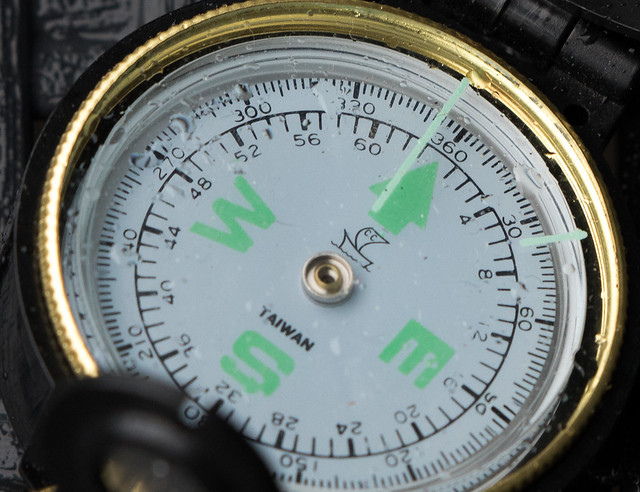
Only if you’ve deliberately defined your true north, can you use your measurements to determine direction of your next steps. ‘Compass’ by Anthony, license CC BY ND

RIPE announced yesterday that they’ve handed out the last IPv4 address ranges. RIPE is the organisation that allocates IP addresses for Europe, Middle East, Eurasia and Middle Asia.

Time to step up the transition to IPv6, an address space that even at the current available ranges (about 20% of the total), easily allows for the allocation of some 4000 ip addresses to every person on the planet as end-users. IPv6 is what makes it possible to have a much wider range of objects in our environment be connected. Such as ever more sensors in/around your home and in your city. It allows the level of data saturation that is needed to provide self driving cars with rails of data and not have them depend on just their own onboard sensors.

Our home internet connection has an IPv6 address and an IPv4 one, which allows us to reach both types of addresses (you can’t otherwise visit one from the other as they’re different protocols, unless you can use a translation service). I am unsure what type of range, if any, I’m allocated in the IPv6 range though. Will have to ask my provider.

With my company we now have fully moved out of Slack and into Rocket.Chat. We’re hosting our own Rocket.Chat instance on a server in an Amsterdam data center.

We had been using Slack since 2016, and used it both for ourselves, and with some network partners we work with. Inviting in (government) clients we never did, because we couldn’t guarantee the location of the data shared. At some point we passed the free tier’s limits, meaning we’d have to upgrade to a paid plan to have access to our full history of messages.

Rocket.chat is an open source alternative that is offered as a service, but also can be self-hosted. We opted for a Rocket.chat specific package with OwnCube. It’s an Austrian company, but our Rocket.chat instance is hosted in the Netherlands.

Slack offers a very well working export function for all your data. Rocket.chat can easily import Slack archives, including user accounts, channels and everything else.

With the move complete, we now have full control over our own data and access to our entire history. The cost of hosting (11.50 / month) is less than Slack would already charge for 2 users when paid annually (12.50 / month). The difference being we have 14 users. That works out as over 85% costs saving. Adding users, such as clients during a project, doesn’t mean higher costs now either, while it will always be a better deal than Slack as long as there’s more than 1 person in the company.

We did keep the name ‘slack’ as the subdomain on which our self-hosted instance resides, to ease the transition somewhat. All of us switched to the Rocket.chat desktop and mobile apps (Elmine from Storymines helping with navigating the installs and activating the accounts for those who wanted some assistance).

Visually, and in terms of user experience human experience, it’s much the same as Slack. The only exception being the creation of bots, which requires some server side wrangling I haven’t looked into yet.

The move to Rocket.chat is part of a path to more company-wide information hygiene (e.g. we now make sure all of us use decent password managers with the data hosted on EU servers, and the next step is running our own cloud e.g. for collaborative editing with clients and partners), and more information security.