For some other reason I happened to open Jane Jacobs 1961 work ‘The Death and Life of Great American Cities’.
Leaving through the Contents overview my eye fell on the heading ‘Illustrations’. Of which the book actually contains none at all.

Underneath the heading it reads

The scenes that illustrate this book are all about us. For illustrations, please look closely at real cities. While you are looking, you might as well listen, linger, and think about what you see.

What an awesome call to action. In my work we often try to encourage our clients to go outside, or it is our actual work to bring them outside.
Go out, look around, experience what happens around you. Hear it, see it, smell it, touch it. Sense it.
Watch the stories unfold around you, be part of the complexity they represent.

As a necessary element of thinking. As the much needed phenomenological stimulant for thinking, having the world or other subject matter in front of your eyes.
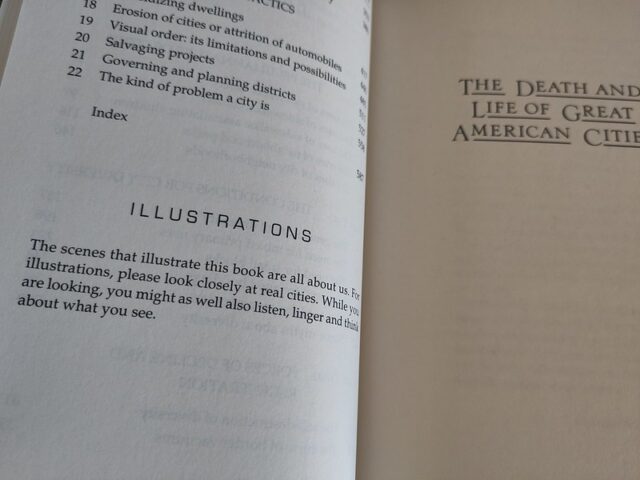

The quoted phrase seen in the Contents section of the book

Attempting to understand the ‘Noosphere’ and Subconscious tooling that Gordon Brander is developing results in several questions. Brander proposes a new ‘low level infrastructure’ (subconscious) for sharing stuff across the internet, which should result in us thinking together on a global scale (the noosphere).

I’ve followed the recent Render conference on ‘tools for thought’ where Gordon Brander presented Noosphere and Subconscious. In the wake of it I joined the Discord server around this topic, and read the ‘Noosphere Explainer‘. Brander’s Render talk roughly follows that same document.

Brander says: The internet is already a tool for thought, so we should make it better at it. The tools at our disposal to deal with this new voluminous information environment haven’t reached their potential yet. Learning to think together at planetary scale is a needed ingredient to address global issues. There are many interesting tools out there, but they’re all silos of SaaS. They’re silos because of same origin policy which prevents cross-site/host/domain/port sourcing of material. Subconscious is meant to solve that by providing a ‘protocol for thoughts’.

This leaves me with a range of questions.

  • Subconscious is meant to solve same origin policy. SOP however seems to be a client (i.e. browser) enforced thing, focused on (java)scripts, and otherwise e.g. ignores HTML. Apps are/can be viewers like browsers are viewers. So why isn’t the web suitable, with the app or a tweaked browser on top? Why a whole new ‘infrastructure’ over the internet? That sounds like it wants to solve a whole lot more than same origin to remove the bias towards silos. What are those additional things?
  • The intended target is to make the internet a better tool for thought. Such thoughts are text based it seems so what does Subsoncsious do in contrast to current text based thoughts shared that e.g. the web doesn’t?
  • Assuming Subconscious does what it intends, how do we get from a ‘low level infrastructure’ to the stated overarching aim of thinking together globally? I see texts, that may or not be expressed thoughts, being linked and shared like web resources, how do we get to ‘thinking together’ from there? The talk at Render paid tribute to that at the beginning but doesn’t show how it would be done (and the invocation of the Xanadu project at the start might well be meaningful in that sense), not even in any ‘and then the magic happens to get to the finish line’ fashion. Is the magic supposed to be emergent, like I and others assumed the web and social software would do 20-30 years ago? Is it enough to merely have a ‘protocol for thoughts’? What about non-infrastructure type decision and consensus building tools like Liquid Feedback or Audrey Tang’s quadratic voting in vTaiwan? Those are geared to action, and seem more immediately useful towards solving global issues, don’t they?

I’ll be hanging out in the Discord server, you can too (invite link), and going through Gordon Brander’s earlier postings, to see if I can better understand what this is about.