Imagine you have a recipe for a dish you like. You copied the ingredients and instructions from a magazine once, or your mother wrote it by hand decades ago. You decide to use the recipe, and from its list of ingredients you make a shopping list. Some things you already have at home, other items you need to get. You think of the one or two different shops you’d need to go to, and list the different items in a way that follows the order in which you will walk through the store. Would you describe the recipe as creative output? And the shopping list? Yes, no, neither, or both? Which one would you think qualifies for copyright?

The recipe (both the directions and the ingredient list) is seen as a mere statement of fact. Copyright is not applicable. That’s why cookbooks usually have a clear curated selection stated in their title (‘The 50 most cherished Indian recipes from around the UK diaspora’), photos (the dish with a sprig of herbs positioned just so), and anecdotal flourishes (‘Upon entering the village I saw an old grandmother make this in front of her house, and she shared the family secret of this incredible sauce with me’). Because those elements do carry copyright. Just not the recipe as such. Take 500 grams of chopped tomatoes and cook for 12 minutes on a low fire. Add half a tablespoon of powdered cayenne peppers and stir. Serve cold.

Your shopping list is a unique thing in comparison. It contains a curated list of ingredients (excluding the things you already have), and you ordered them to align with your actual physical path through one or more shops that you mentally selected to go to. Maybe you crossed something out, and added it in a different place after first making the list. Maybe you added one or two other things that you need, as you are going to the store anyway. This does clear the, deliberately very low, hurdle for creative effort recognised by copyright law. It’s just that you as author perhaps think of it as ephemeral, trivial, and something you may well leave at the bottom of the shopping cart as you exit the store.
Some lists are of course solely statements of fact, e.g. a list of all the heads of state and the years of their reign, the planets in our solar system in whichever order, a bibliography of an author. When you add a little bit of purpose to a list, moving it to an unique expression of an idea you had, then it quickly becomes something else.

A creative artefact.
A list that is the result of some internal process of yours with some internal logic, even if it eludes another person encountering the list, is more than the sum of its items. Curation, selection and exclusion, ordering, at one or more levels of hierarchy, are determined by and express the intention and purpose of the list maker.

List maker.
It’s something E calls me every now and then, list maker. Because quite often my first response to anything that requires planning, thinking, or writing is ‘I’ll make a little list’. Because sitting down and making a first list is beginning the work. Writing a list is not the result of thinking, but part of the process of thinking itself.
An Outliner tool is a key digital list making aid (even if they all have their limitations). A good Outliner allows you to put making lists ‘on rails’ as Dave Winer put it.
Moving an item up or down, to the top or the bottom. Nesting a thing under another, or deeper still. Moving a nested item up a level of hierarchy. Hide the subitems under a thing, or revealing them. Make a connection with an element elsewhere in an outline or with/in a different outline. Turn lines into bullets into numberings and back. Switch between different types of visualisation, one of which is the outline. All made seamless with keyboard shortcuts.

In the 1968 Mother of All Demoes Doug Engelbart, showing his vision of what computers should and can do, impresses the audience when he moves things in a list around in an outliner and switches between visualisations of the list, before using another outline for a presentation. The list he makes is of course a shopping list.

Many of the lists I use emerged over time from my notes and work, a type of emergent and earned structure. Some have both an outline structure and a more visualised networked one (a tool like Tinderbox allows you to switch between views, so does Obsidian with Excalidraw). Some have a bit more complicated inner structure or are partly dynamic or help with decision making, making them small knowledge machines.

There are many types of lists I regularly make and use.

  • Checklists for various processes and events (like travel), and periodic reviews
  • Dashboards, which are (check)lists in two dimensions, that ensure I take into account all aspects of something.
  • Daylogs with links to appointment notes, listing events, links to things I found and interstitial journaling.
  • Maps of Content (or elephant paths as I call them)
  • Memory palace overviews (listing loci) of places I might use as mnemonic device
  • Card decks for spaced repetition.
  • Outlines of texts I’m writing, outlines of presentations, both with links to underlying notes and references.
  • Interests I currently have (questions, examples) and how I might see them as elements of practice, knowledge fundament etc.
  • Tasks lists, selected on context (train, home office, company office etc), effort, energy level and time needed.
  • A spreadsheet that provides, yes, my shopping list for larger parties, based on the list of participants, their dietary requests etc., based on previous parties and amounts consumed.
  • Book lists

Book lists are like any list in that they involve selection and ordering too. They are also a bit more than a creative artefact.

Book lists are libraries.
Any list of books you create is a library, even if it’s a library of the mind that you make tangible in a list.
The list of books that are in my home office book case for instance is a simple example describing that part of the actual collection of physical books in our home. But there are more book lists I work with.
All the books, whether I (still) own them or not, that I have read in a given year.
All the physical and electronic non-fiction books I own and have not read yet, by topic. Or don’t have yet but thought interesting enough to note. They form a reservoir of preselected books I thought might be of interest at some point, that can serve as a research tool. That list I call my anti-library.
Or a similar list for unread fiction books I have, to use when selecting a new book to start in.
A list of books I may want to acquire at some point (generated from what I come across online and in shops that looks interesting or fun, without buying it), a library of wishes of sorts.
A list of books I definitely do not want to own or read, which contains books I have regularly come across thinking they looked interesting, and then realising I had rejected them a few times in the past already, and also contains authors I want to avoid.

These lists overlap, interlink and morph. Most of my daily note making is in the shape of lists, where items may get extended into paragraphs. Using outliner functionality I move them around, extend, link and change them. Parts get shunted into their own notes, some becoming a note in my core personal knowledge notes, others ending up in more mundane notes. Most will remain where I wrote them. Some will become lists I use more frequently or have a structure that is a piece of personal knowledge in itself, such as the ones listed above.

Making lists is not a chore or something predefined, but key to the work of eliciting meaning from all the disparate things I encounter in a day. It allows manipulation of all the small bits of information, from which meaning and structure may emerge. It’s a way to locally reduce entropy in my notes where useful.

Make lists. As your creative artefacts, as your libraries.

left part of screen shows an outlined list, right part shows Doug Engelbart during the 1968 Mother of All Demoes.
State of the art list making, 1968. (Screenshot of the 1968 demo by Doug Engelbart of an outlining tool)
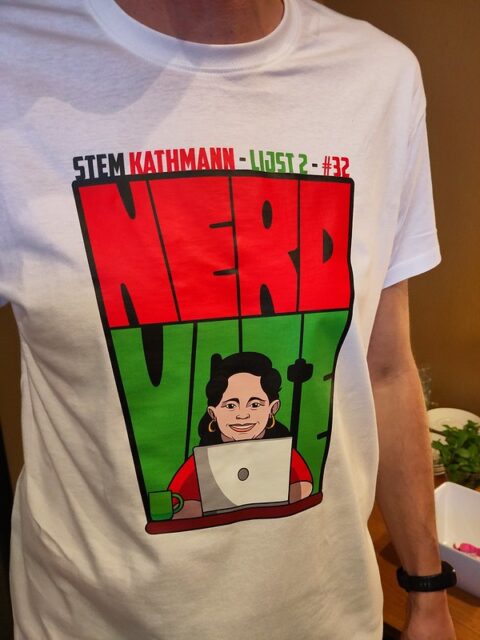
Gisteren kwam ik op een bijeenkomst van Open State Foundation (disclosure: daar ben ik voorzitter van) in het wild een Nerdvote t-shirt tegen:


Een wit t-shirt met daarop in groene en rode letters NerdVote, met eroverheen een cartoon-tekening van Barbara Kathmann achter een laptop. Erboven staat ‘Stem Kathmann – Lijst 2 – #32’.

NerdVote? Ja, NerdVote: met de verkiezingen het aantal mensen met kennis van digitale zaken in het parlement vergroten, doordat kiesgerechtigde nerds kennis van digitalisering in hun stemkeuze meenemen. En dan met name de verbinding tussen digitalisering en verstandig gebruik in lijn met burger- en mensenrechten. Privacy, informatieveiligheid, digitale autonomie. Digitalisering is een fundamentele zaak.

Op NerdVote.nl vind je een overzicht met alle kandidaten van verschillende partijen die je als certified nerd in overweging kunt nemen voor je stem om meer aandacht voor en kennis van digitalisering in de Tweede Kamer te krijgen.

Strategisch maakt de NerdVote het meeste kans om Barbara Kathmann met voorkeursstemmen opnieuw het parlement in te stemmen.

Vote Nerd! Nerdvote.

From ancient Greece 32 tragedies are available to us. These plays, from the 5th century BCE, mostly don’t have a good ending. Hence our use of the word tragedy.

The 32 remaining are from just three authors, Euripides (18), Aeschylus (7) and Sophocles (7).
Hundreds of tragedies have been written, we know of some 300 more through fragments and titles from just those three authors. There were other authors, and we know the number of festivals and stagings etc. that we know took place implies there have been hundreds more than that. Just at the Athens festivals alone an estimated 648 different tragedies have been performed over a 70 year period in the 5th century BCE. Just 1 or 2 percent of tragedies written and staged are left to us. A tragedy in its own right.

Why these 32 works? These three authors mostly because a century onwards, the Greeks themselves held them in high regard. But beyond that, why these out of the 300 or so the 3 authors wrote? Mostly because of the Romans. 24 of 32 remaining works were selected by Roman grammatic scholars 600 years later, becoming canon in the 2nd and 3rd centuries CE. All 7 from both Aeschylus and Sophocles, and 10 by Euripides. Likely because of their link to the Homeric tales, which was central in Roman educational efforts. The number 24 isn’t a coincidence either, aiding memory techniques and echoing the 24 chapters in the Iliad and the Odyssee. Of these 24 we have multiple manuscripts and comments and marginalia, because they were taught and used.

This filter, 600 years after the tragedies were written, and 1800 years ago to us means that neither the ancient Greeks nor we ourselves have had any influence on the logic of this selection. The 24 handed down to us through the Roman filter, weren’t selected because the Greeks thought them most representative, nor because we think they are the most outstanding work. And possibly not because of esthetic reasons at all, but because of Roman educational preferences in teaching Greek grammar.

The other 8, all by Euripides, have come to us via a different way. Their titles are in alphabetic order, ε to ι, a piece of what once would have been a full overview of Euripides work, being copied together by some scribes. No selection criteria, just coincidence that one part of these ‘collected works’ survived. No annotations or comments either, just the works.

We know tragedies end badly, right? The ancient Greek word, originally meaning something like ‘goat song’, has come to mean that very thing to us. But it’s not that the ancient Greek playwrights were all depressed or nihilists. It seems it’s just that the Romans selected 24 works that mostly ended badly. Contemporary sources from Ancient Greece tell us tragedies did also end happily, and that such plays were very popular. Yet, the Roman selection 600 years later definitely picked mostly ones ending in, well, tragedy.

Comparing the two groups of plays by Euripides gives an enormous contrast though: of the 10 Roman selected works by Euripides only 2 end happily (20%), of the 8 ‘alphabetical’ ones by the same author, 7 end happily (88%). A reverse image!

The Roman selection is what made tragedies tragedies for us. A group of people 600 years removed from the source of these plays and 1800 years removed from us. For their own, unknowable to us, reasons. It’s a survival bias, not an inherent trait of the plays concerned.

And we’re stuck with that choice.

Tragic.

Also highly fascinating, I find.

Sources: Libraries of the Mind by William Marx (2025), page 3 and 112-116, Greek Tragedy on Wikipedia.

Today I received a copyright infringement notice from ANP Photo, the Dutch photo press organisation, telling me I was using an image they hold the rights to on this site without a license. And suggesting I pay them 370,56 Euro for the privilege.

The image, that I used in a 2018 blogpost, is this one:


Image: European Space Agency, Creative Commons BY-SA

While ANP, despite its phase of being venture capital owned some time back, is generally seen as a respectable agency, this is a clear and unworthy attempt at license trolling.

ANP Photo contains over 100 million images, and the one above is indeed in their image bank as well, although it doesn’t surface if you use Mars and ESA as selection criteria.

Early on in this blog in the ’00s, I have occasionally used images wrongly and afaik that’s all corrected and no longer the case.

The problem here however is of course that ANP does not have the IP or licensing rights to the image that they claim.

In this site I mostly use images that I made myself, and otherwise use Creative Commons licensed images where the rights holder specifies the types of use you don’t need upfront permission or pay for.

This is one such image.

The image is of the Korolev crater on Mars, so there is no dispute about its source, because no one else had a camera, let alone a human being or photo journalist, in orbit around Mars at the time it was taken in November 2018: the European Space Agency.

That’s also where I got it from, directly from the ESA website, under a Creative Commons license and the clear conditions of having to attribute the image (‘BY’, by attribution, here done by linking and mentioning the source in the text) and sharing any derivative under the same conditions (‘SA’, share alike, here true by default because the image wasn’t altered), but otherwise to do with it as I see fit, even commercially.
If you follow that link to the image, and click on it you’ll see the download link ESA provides for different sizes, and a repeat of the Creative Commons licensing information underneath.
Just posting the image, without me adding links or attribution, would have been enough though, because that is also clearly stated in the image by ESA itself, in the bottom left corner where it says (c) ESA/DLR/FU Berlin, CC BY SA 3.0 IGO.

Even if that CC license would now no longer be there at the ESA web page and had been retracted, it would still mean nothing for this image, because CC licenses cannot be retroactively withdrawn or altered: the license that applied at the moment of use remains always applicable.

That same Creative Commons licensing statement is in the image that ANP holds in their image data base.
So a false claim by ANP, and a very disappointing one too.

There even is a potential argument to be made, a lawyer friend told me, that this image can’t be copyrighted as it was automatically taken without any real time human influence as to timing, angle, composition etc (the camera being on a time delay of 4 to 24 minutes between Earth and Mars after all). But I doubt that argument holds here: I assume the image is a selection and crop of a much bigger image, and that choice and selection probably clears the threshold for creativity in copyright law.

[UPDATE] After I responded to ANP that their infringement claim was license trolling they withdrew the claim, albeit without apology. I followed up with asking if they know how many other Creative Commons licensed or even public domain images they have in their 100 million+ database, given a number of public sources they include for their images, and if they know how many false claims and payments they made and received on those images. I bet the answer is they don’t know (nor care apparantly).

Gabrielus Landsbergis, until late last year the minister for foreign affairs of Lithuania, has joined the advisory board of Defend Democracy, a Dutch non-profit based in Brussels. Since a few months I’m serve on Defend Democracy’s board as treasurer.

Gabrielius Landsbergis served as Lithuania’s Minister of Foreign Affairs from 2020 to 2024. Born under Soviet occupation, he witnessed Lithuania’s fight for independence, led by his grandfather Vytautas Landsbergis. Throughout his career, he has fought for freedom. As Minister, he positioned Lithuania as a global advocate for freedom, strongly supporting Ukraine and backing democratic movements in Moldova, Georgia, and Taiwan. Since leaving politics he continues to challenge authoritarianism..

I’m pleased and a bit awed that Defend Democracy is able to gather the advisory board it has. Such as former Dutch MEP Sophie in ‘t Veld, whose work I much admire. And now Luthuania’s former MFA. A clear sign how well regarded our executive director Alice Stollmeyer is.
Late next week I will be in Brussels for in person meetings with the other board members. Much looking forward to it.

Back in 2022 the Belgian and other data protection boards found that IAB’s ‘Transparency and Consent Framework‘ is illegal, because it is neither transparent nor has any meaningful connection with the word consent. IAB is the industry club for adtech users. Yesterday this verdict was upheld on appeal.

You know the kind of consent form from about 80% of websites, it takes one click to give away everything for the next three generations, and a day of clicks to deny consent. They need to coerce your consent to feed the tracking based real-time-bidding mechanisms for displaying all those ads that you see if you don’t use an ad blocker like a sane adult.

It was always clear that type of behaviour does not result in freely given consent for tracking and is illegal under the GDPR. But it takes time to have such things contested in court and affirmed before adtech corporations will admit it.

The 2022 decision now upheld on appeal (PDF in Dutch) applies immediately across the EU, and will impact such IAB members as Google, Microsoft, Amazon, X, and Automattic (WordPress) (at least they were a member back in 2022). The appeal to the decision was filed in March 2022, and the Belgian court submitted several prejudicial questions to the European court of justice, that were answered in spring 2024, and now lead to a decision.

Excellent work by the Irish Council for Civil Liberties and others.

Ceterum censeo AdTech is fundamentally non-compatible with the GDPR, and needs to die.