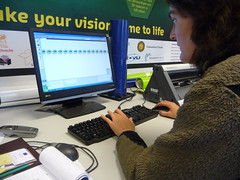
After the workshop last week Friday on experimenting with Lego Mindstorms and Arduino open source hardware, I returned to the ProtoSpace FabLab in Utrecht today. This time around it was all about learning to work with the machines the FabLab is equipped with: a laser cutter, a vinyl cutter, a milling machine and a full colour 3D printer. 

The impressive bit of FabLab is not the fact that the type of machines it offers exist. The impressive part is that you can get these machines to do your bidding by feeding it things as simple as PDF files. You create your model or drawing and then basically hit the print button, select ‘laser cutter’ instead of your regular ink jet printer, and watch the machine get to work.

We played with the 3D full colour printer, which is very impressive.
In the 5 minute video I documented the whole process. From the example object, to making 7 smaller copies of it. 3D printing is time consuming, but you can do amazing things with it.

Siert and I created a card board casing for Arduino boards to prevent it from short-circuiting because of the surface it is lying on. For the first version I simply drew a first sketch in Neooffice (the Mac version of Open Office), in a text document. I then imported that text document as PDF into Corel Draw on one of the PCs in the FabLab and hit the print button. The lasercutter cut a piece of card board according to my sketch, which assembled resulted in the first version of our Arduino holder.

Card board housing for Arduino v1.0
Version 1.0 of Arduino board holder

Then Sierts education as an engineer kicked in and he adapted the design into version 2.0. Again hitting Print resulted in a handful of pieces of cardboard coming out of the lasercutter that fitted snugly together. Who would have guessed I could be so pleased with a few bits of card board?

Card board housing for Arduino v2.0
Version 2.0 of the Arduino holder

The video shows another run with the laser cutter for a different item (part of a 3D game board)

Last week as well as today I made a point of showing the other participants how easy it is to share pictures and video of what you are doing while you are doing it. To help lower the threshold for them to start sharing their FabLab work as well.

Transient Technology
For about 18 months now I’ve been looking into transient technologies. Digital applications are breaking the boundaries of our laptop screens, and the internet of things, as well as internet connected peripheral devices, both sensors and actuators, are moving into our physical surroundings. This means that it is now no longer enough for me to have a sense of what is happening in software development circles to see what kind of new apps are coming, and that I also feel the need to look into hardware more.  Open source hardware like Arduino, sensor based space and time aware applications (Spimes), RFID tech, Chumby and Nabaztag etc. That is why I proposed an Arduino workshop to Reboot last June, even though I did not know much about it myself. Alexandra and Nick of Tinker.it in London stepped up and made it happen, but in the end I did not get to attend my ‘own’ workshop (except for opening it and closing it), because I was speaking at the same time in the hall next door. 

Protospace FabLab

Workshop at ProtoSpace
But today I finally attended an Arduino workshop. It’s been a long time since I tinkered with electronics. About 18 years I guess, but I assume I still have a soldering iron in the attic. The workshop was organized by ProtoSpace, one of the FabLabs in the Netherlands. My brother in law is the lab manager there, and he attended the Arduino workshop at Reboot I mentioned. He is now spreading that knowledge again.
In the morning of the day we covered a basic introduction about FabLab and ProtoSpace, and talked about Phidgets (physical widgets) and Lego Mindstorms, before getting to Arduino. The entire afternoon was then spend on playing with Arduino.

Play
I have been used to playing with software tools for so long I really rediscovered the fun of playing with tangible stuff again. A lot of old knowledge of electronics resurfaced. The physics of it hasn’t changed of course, but the threshold to make programmable stuff has been seriously lowered, as has the cost of acquiring sensors and actuators that enable you to do interesting stuff.

Playing with Lego Mindstorms:

The trajectory to drive
The trajectory the Mindstorms robot has to follow

Our Slalom Design

Designing the trajectory before programming

Programming Lego Mindstorms

Programming the robot via USB

Video on YouTube of the finished experiment

Experimenting with Arduino open source hardware video on YouTube

FabLab

Next week Friday I will return to ProtoSpace for a workshop on how to use the different machines that make up the FabLab there: a lasercutter, a milling machine, a vinyl cutter, and a full color 3D printer. All programmable of course. Already looking forward to it.

Lasercutting an apple during lunch video on YouTube

3D printing examples lying around video on YouTube