We look back on a great event, our ‘Make Stuff that Matters’ unconference and bbq. Bringing together some 45 people from around our various networks to our home for a day of making. Most never had done anything like it before, most had never met each other before. So how do you guide a group like that through the day, in a way that they actually have made something together by the end? How do you make makers out of all of us? Here’s a quick run-down of the process we designed.
Turning introductions into an overview of skills and experience
We started with a quick intro-game. Each participant was given a blank card with the instructions to:
- write their name on the card
- find a stranger in the room
- introduce yourself, your skills and experiences
- let the other person draw on your card what she thinks stands out
- then have the other take their turn for the same
- stick the resulting cards on the wall to serve as reference for the day


Introductions and making the cards / Inspecting the skill cards on the wall

Examples of cards
Printing new humans as a way to decide what to make
After these introductions it was time to start the real process. We created groups of 5 or 6. Then the group members created a series of drawings of humans. The first, invisible to their neighbour, drew a head, the second a body, the third legs. Doing that in a circle created 5 or 6 drawings per round. After a first round to warm up, the second round we asked to add more character, expression or indications of background or profession.
From the resulting drawings, the group then discussed and selected their favourite one and constructed a story around them. The story would explain character, backgrounds, origins, and things like age and their name. Stories were mailed to Elmine who printed them out.
The resulting figures and their stories were put on a big flipover sheet and then stuck to the walls.
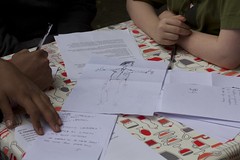

Drawing humans in groups, and a resulting drawing
Individually all participants then added post-its to the ‘new humans’ with items these people might use, want, need or care about. Then individually people picked one or more of these items to make during the rest of the day, and helped eachother to do that.


Drawn humans on the wall with their story, adding post-its with ideas for things to make for them
Rationale behind the process
We wanted to make sure that all had the same starting point. Otherwise someone who had more experience or an idea up front might dominate a group simply because others had less well formed ideas, even though the others might not really be interested in realizing that idea. We wanted to make sure that everyone could pick something that was of interest to themselves, which triggered enough intrinsic motivation to see it through. By putting all through creating a ‘new human’ and specify their material needs, we created both a specific and neutral context in which an object was to be used, as well as enough diversity in ideas for all to choose from.
Origins of the process
Given our rationale of wanting to pick people up where they were, and offer enough ideas neutrally, we needed to come up with a process. Originally the ‘drawing people’ idea was suggested by Peter Troxler as an introduction game, but discussing it we realized it could be the starting point of the making process. We then thought some more about how to introduce people and repurposed a similar intro-game from last time (there one person wrote on a card how the other person was connected to us, which we turned into a network map), refocusing it on skills and experiences. Drawing was added to get people’s creative juices flowing. Elmine then put it all together in a instruction manual for all to use, embedding the process in a story that made the steps follow each other logically.
 English